
Male Hormones Accelerate Skin Stem Cell Differentiation, Slowing Wound Healing Compared to Females
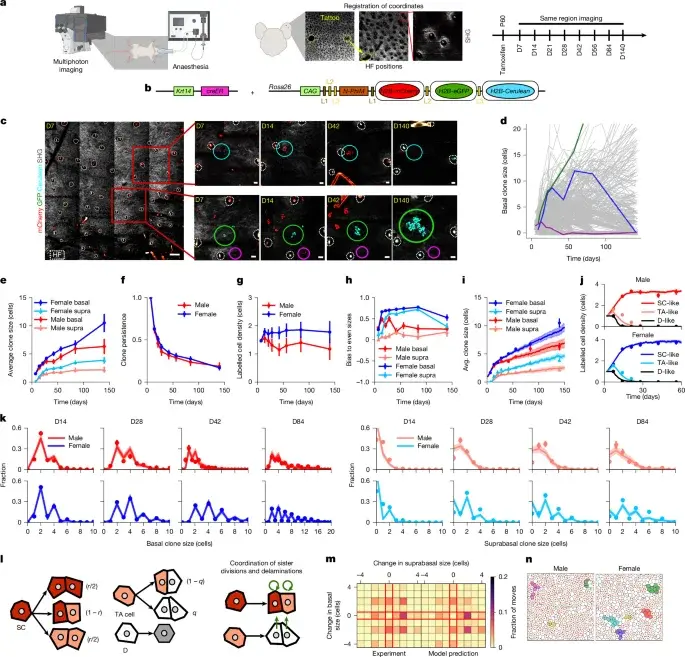
Researchers at Nature have identified a fundamental sexual dimorphism in the dynamics of epidermal stem cells, revealing that male and female skin operate under distinct regulatory mechanisms. Using long-term intravital time-lapse imaging of mouse ear skin, the study confirms a two-compartment model where stem cells and transit-amplifying cells function hierarchically. Crucially, female mice exhibit highly synchronized cell division and delamination, leading to faster wound closure. In contrast, male skin shows less coordination, driven by androgens that promote rapid differentiation and loss of basal cells. Castration in males restores female-like coordination, while ovariectomy in females eliminates it, proving that sex hormones, not just chromosomal factors, dictate these differences. This discovery resolves previous conflicts in epidermal biology models and highlights why female skin heals wounds more rapidly than male skin.
Key points
- The study utilizes 140-day intravital time-lapse imaging to track 1,171 clones in mouse ear skin, confirming a two-compartment hierarchy of stem and transit-amplifying cells.
- Female mice display significantly higher synchronization in cell division and delamination, with a correlation coefficient of 0.9 for sister cell lifetimes, compared to 0.6 in males.
- Wound healing is faster in females; at day 2 post-injury, female proliferative rings are thicker (800 µm vs. 590 µm) and denser (4,330 vs. 2,860 cells/mm²) than in males.
- Male sex hormones, specifically androgens, drive faster delamination and asymmetric division; castration reduces delamination rates from 47% to 14%, matching female levels.
- Single-cell RNA sequencing identifies distinct stem cell and transit-amplifying clusters, with male cells showing higher expression of differentiation markers like Klf4 and Krtdap.
- Oestrogen regulates proliferation and coordination in females; ovariectomy eliminates the enrichment of even-sized clones, while oestradiol treatment restores it.
Background
This research builds upon earlier debates in epidermal biology regarding whether skin is maintained by a single equipotent cell population or a hierarchical system. Previous studies using short-term imaging or fixed samples often supported a single-compartment model, but this long-term tracking resolves those conflicts by demonstrating distinct functional identities for stem and transit-amplifying cells. The findings align with broader observations in regenerative medicine, such as recent Bonn studies on cellular rejuvenation, which highlight the importance of epigenetic and hormonal states in determining cellular fate and aging. While those studies focused on blood and neural cells, this work extends the concept of hormonal control to skin homeostasis and repair.
Why it matters
Understanding the hormonal basis of sexual dimorphism in skin repair offers significant implications for dermatology and regenerative medicine. The finding that male hormones accelerate cell loss and reduce coordination explains the slower wound healing observed in males, suggesting that hormonal therapies or targeted interventions could improve healing outcomes in men. Furthermore, clarifying the distinct roles of stem and transit-amplifying cells provides a precise map of skin maintenance, which is critical for developing therapies for skin disorders, aging, and cancer. The identification of specific transcription factors and gene markers for these populations allows for more precise targeting in future treatments, moving beyond the previous ambiguity of a single proliferative compartment.
What to watch
Future research will likely focus on translating these findings to human skin, as the study currently relies on mouse models. Researchers may investigate whether similar hormonal dimorphisms exist in human epidermal stem cells and if they can be manipulated to enhance wound healing in clinical settings. Additionally, the specific molecular pathways regulated by androgens and oestrogens in the skin, such as the Klf4 and Grhl1 regulons, will be targeted for drug development. The next step involves determining if the coordination mechanisms observed in females can be artificially induced in males to accelerate healing without the side effects of hormonal therapy.
Want the full story? Read the original reporting
Read on Nature