
New transposon tool maps essential phage genes and accelerates viral engineering
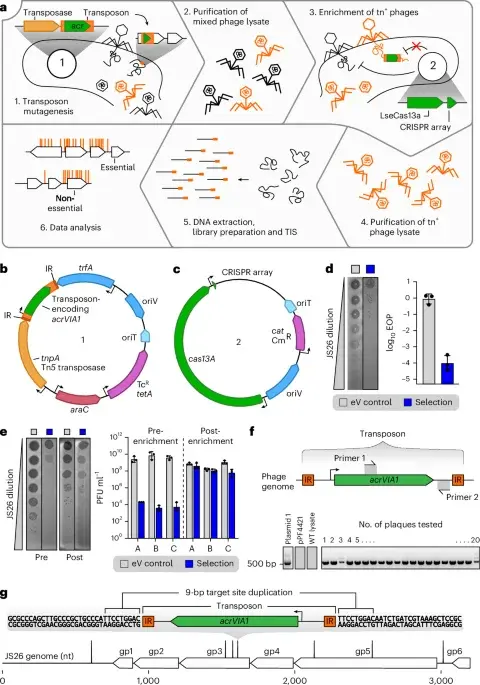
Researchers at the University of Otago developed 'phage Tn-seq,' a method that uses transposon mutagenesis and anti-CRISPR selection to identify essential genes in diverse bacteriophages. The technique also allows rapid insertion of new genetic cargo, such as fluorescent markers or anti-defense proteins, into phage genomes within days, overcoming previous barriers in phage engineering and functional genomics.
Key points
- Phage Tn-seq uses Tn5 transposons and anti-CRISPR counter-selection to map gene essentiality across diverse phages, including jumbo phages.
- The method enables rapid delivery of new genetic cargo, such as fluorescent labels or additional anti-CRISPR genes, into phage genomes.
- Insertion biases in the transposon data allow prediction of transcription direction and identification of highly expressed regions.
- The tool works even in phages with hypermodified DNA, expanding its applicability to viruses that evade host immune systems.
- Data and plasmids are publicly available via NCBI SRA, PRIDE, and Addgene to support further research.
Background
This development follows recent advances in phage functional genomics, including CRISPRi-based screens and other transposon approaches, which have begun to address the 'dark matter' of unannotated phage genes. Earlier studies, such as the 2026 Nature paper on phage ΦX174, highlighted the limitations of AI in predicting viral genome effects, underscoring the need for experimental tools like phage Tn-seq to generate high-quality data for phage therapy and biocontrol applications.
How outlets are covering it
Nature Microbiology emphasizes the technical versatility of phage Tn-seq, highlighting its success across diverse phages, including nucleus-forming jumbo phages, and its ability to predict transcriptional direction. Bioengineer.org focuses on the method's dual role as both a functional genomics tool and a rapid engineering platform, noting its potential to accelerate phage therapy development. News-Medical.net frames the tool as a 'big leap' for combating antimicrobial resistance, with Professor Peter Fineran comparing current phage knowledge to 1950s antibiotic understanding. Genengnews.com highlights the CRISPR-based selection mechanism but provides limited detail compared to the other sources. All sources agree on the tool's broad applicability and its potential to bridge the gap between phage biology and therapeutic applications.
Why it matters
Phage Tn-seq addresses a critical bottleneck in phage therapy and biocontrol by enabling rapid, unbiased mapping of essential genes and efficient insertion of new genetic cargo. This could accelerate the development of engineered phages for treating drug-resistant infections and improving sustainable agriculture, while also expanding our understanding of phage biology, which remains largely uncharacterized due to the vast diversity and complexity of phage genomes.
What to watch
Researchers will likely apply phage Tn-seq to engineer therapeutic phages with enhanced anti-defense capabilities, altered host ranges, or reporter genes for diagnostics. The public availability of data and plasmids may spur further development of orthogonal transposon systems and AI-designed anti-CRISPR proteins, potentially leading to standardized tools for phage engineering in clinical and agricultural settings.
- Defining the essential genome of diverse phages with phage Tn-seq Nature
- New tool closes gap in harnessing untapped potential of phages Phys.org
- New CRISPR-Based Tool Enables Genome-Wide Mutagenesis of Bacteriophages genengnews.com
- Transposon tool maps the essential genes of diverse phages Bioengineer.org
- New tool to mutate phages boosts the fight against superbugs news-medical.net
Want the full story? Read the original reporting
Read on Nature