
Single Brain Implant Enables Simultaneous Speech and Gesture Decoding in Paralysis
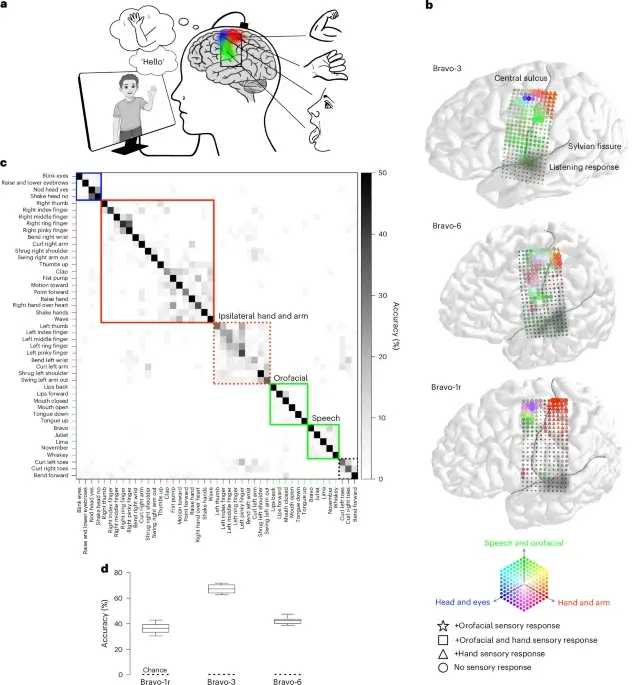
Researchers at the University of California, San Francisco, have demonstrated that a single high-density electrocorticography implant can simultaneously decode intended speech and hand gestures in individuals with paralysis. By training machine learning models on both isolated and concurrent behavioral data, the system achieved high accuracy in controlling a personalized virtual avatar. This proof-of-concept suggests that future brain-computer interfaces could restore natural, multimodal communication for patients who have lost both vocal and motor function.
Key points
- A single electrocorticography implant recorded neural activity from three participants with paralysis, including cases of stroke and amyotrophic lateral sclerosis.
- Parallel decoders successfully interpreted simultaneous speech and gesture attempts, with offline accuracy reaching 88% for gestures and 84% for speech in one participant.
- Training models on a combination of isolated and simultaneous behavioral data significantly improved performance compared to models trained on only one context.
- The system drove a personalized virtual avatar in real-time, allowing participants to communicate via animated gestures and on-screen text.
- Cross-modality training reduced false positive rates, ensuring that speech decoders remained inactive during gesture attempts and vice versa.
Background
This development builds on earlier BCI advancements, such as Paradromics’ wireless implant enabling a 68-year-old patient to speak via imagined words, and previous UCSF studies that demonstrated single-implant speech and gesture decoding in isolation. While prior work focused on isolated behaviors, this study addresses the challenge of concurrent multimodal communication, a key barrier for naturalistic interaction.
How outlets are covering it
Nature and New Scientist emphasize the technical breakthrough of simultaneous decoding from a single implant, highlighting the importance of training on concurrent data to handle overlapping neural signals. The New York Times and KEYE focus on the practical application, noting that Paradromics’ wireless device allows patients to converse in real-time, even when merely imagining speech. While Nature and New Scientist stress the need for larger vocabularies and higher accuracy for daily use, the New York Times and KEYE highlight the immediate impact on patient autonomy and family communication. All sources agree that this represents a significant step toward multifunctional BCIs, but differ in their emphasis on technical robustness versus clinical utility.
Why it matters
This research demonstrates that a single brain implant can support multi-effector control, moving beyond isolated speech or gesture decoding. By enabling simultaneous speech and gesture communication, it addresses a critical gap in BCI technology, potentially restoring natural, nuanced communication for millions of people with paralysis. The success of context-inclusive training suggests that future systems could be more robust and adaptable, reducing the need for exhaustive data collection and improving real-world usability.
What to watch
Researchers are working to expand the vocabulary of phrases and gestures, improve accuracy for daily use, and develop systems that can move a patient’s own body or produce synthetic speech. Future studies will likely focus on longitudinal stability, generalization to new speech-gesture pairings, and the integration of BCIs with existing assistive technologies. The field is also moving toward wireless, fully implantable devices to enhance patient comfort and autonomy.
- Simultaneous speech and gesture decoding for multimodal communication in paralysis Nature
- ‘I Have a Lot to Say’: Brain Implant Helps a Disabled Patient Speak The New York Times
- A new device lets severely paralysed patients communicate more effectively The Economist
- 'I have a lot to say': Austin brain implant helps patient communicate in real time KEYE
- Brain implant lets people with paralysis speak and gesture at the same time New Scientist
Want the full story? Read the original reporting
Read on Nature