A new study published in Science demonstrates that Wernicke’s area, traditionally associated only with speech comprehension, also plays a critical role in planning speech production. Researchers found that a specific subregion activates before speaking, suggesting a unified mechanism for hearing and talking.
On November 10, 2026, the BCI Pioneers Coalition released 'OUR BCI,' a set of ethical guidelines for brain-computer interface (BCI) trials. The document, co-developed by implant recipients and academics, demands that neural data be treated as personal information, that participants retain access to their own data, and that researchers provide long-term device maintenance. It also calls for fair compensation and recognition of participants as research collaborators, addressing concerns that current trials leave patients vulnerable to device removal and data exploitation.
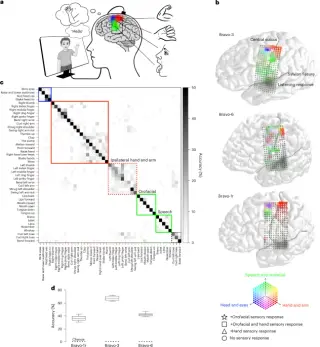
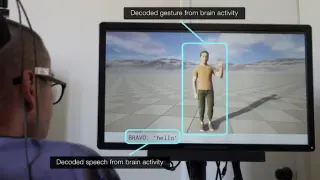
Researchers at the University of California, San Francisco, have demonstrated that a single high-density electrocorticography implant can simultaneously decode intended speech and hand gestures in individuals with paralysis. By training machine learning models on both isolated and concurrent behavioral data, the system achieved high accuracy in controlling a personalized virtual avatar. This proof-of-concept suggests that future brain-computer interfaces could restore natural, multimodal communication for patients who have lost both vocal and motor function.
Recent breakthroughs in brain-computer interfaces (BCIs) have enabled paralyzed individuals to communicate through digital avatars and synthetic voices. A University of California, San Francisco (UCSF) team demonstrated a system that decodes speech and body gestures simultaneously from a single brain implant, while Paradromics reported a patient using a wireless implant to converse in real time by imagining words. These advancements aim to restore natural communication for those affected by stroke or ALS, though significant hurdles remain regarding scalability and surgical accessibility.
Silicon Valley is accelerating the development of non-invasive neurotechnology devices that monitor brain activity, raising urgent concerns about the commodification of mental data. While current EEG headsets are used for workplace productivity, education, and wellness, the technology is moving toward decoding thoughts and emotions. Major companies like Apple, Meta, and Snap are developing neural interfaces, while a 2026 study found that most consumer neurotech firms lack robust data protection policies. In response, advocates are pushing for 'neurorights' legislation to protect mental privacy, with Chile and US states like Colorado and California already enacting legal safeguards against the extraction and sale of brain data.
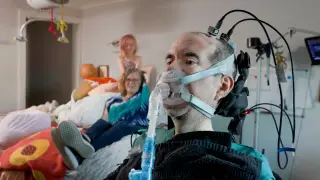
Casey Harrell, an ALS patient who had lost his voice, regained a functional means of communication through a brain-implant in the BrainGate2 trial, enabling him to spell and speak from home for about two years and producing nearly 2 million words; the Nature Medicine study highlights how brain-computer interfaces can restore conversation for paralyzed individuals and transform daily life for patients and families.
Researchers identify the ventral premotor cortex as the neural substrate for action symbols, showing macaques recombine discrete shape units into new drawings rather than simply tracing, effectively acting as a high-level mental typewriter that translates symbolic plans into movement and paving the way for advanced BCIs and diagnostics.
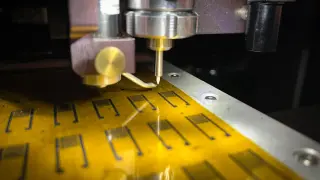
Northwestern University researchers have printed flexible artificial neurons using MoS2 memristive nanosheets on a polymer substrate that generate neuron-like spikes and can directly activate living brain cells in mouse brain slices, marking a step toward brain–machine interfaces and energy-efficient AI hardware. The low-cost aerosol-jet process creates complex firing patterns, and the work, published in Nature Nanotechnology, suggests future devices could perform advanced tasks with far less power than today’s silicon systems.
A sponsored Visual Capitalist feature highlights breakthroughs in brain mapping and brain-computer interfaces (BCIs), noting the BCI market could grow to about $8.7 billion by 2033 with applications in health, entertainment, disability restoration, and cognitive health, and situates these advances within the Dubai Future Forum’s Exploring the Unknown framework as part of a broader mind-tech frontier.
Neuralink, led by Elon Musk, is at a crossroads between developing technology to help people with disabilities and pursuing broader ambitions like AI integration and potential future AI conflicts, with recent leadership moves fueling questions about its true priorities.
Brain-computer implant technology is rapidly advancing with increased clinical trials, expanding applications beyond paralysis to mental health, and a surge of startups, especially in China, driven by regulatory approvals and investor interest, signaling a significant growth phase by 2026.
The article discusses the potential for digital immortality through AI and brain-computer interfaces, highlighting how China and Russia are exploring these technologies to extend the influence of leaders like Xi Jinping and Vladimir Putin beyond their physical lives, raising concerns about authoritarian control and ethical implications.
A study published in Cell reveals that brain implants can decode not only attempted speech but also imagined inner speech, raising privacy concerns about mental privacy as technology advances. Researchers found that AI can translate faint brain signals associated with inner speech into words, which could make communication easier for paralyzed individuals but also pose risks of unintentional mind-reading. Protective measures like wake words were tested, but experts warn that the boundary between private and public thoughts may become blurred, especially with future consumer devices.
Alexandr Wang, founder of Scale AI, plans to wait until Neuralink and similar brain-computer interfaces are available before having children, believing that early access to such technology could significantly enhance children's learning and development.
Neuralink, a neurotechnology company founded by Elon Musk, raised $650 million in its latest Series E funding round to develop brain-computer interfaces that enable control of electronic devices.