
PsychAD Consortium Maps 6.3 Million Brain Cells to Link Genetic Risk with Cellular Disease Mechanisms
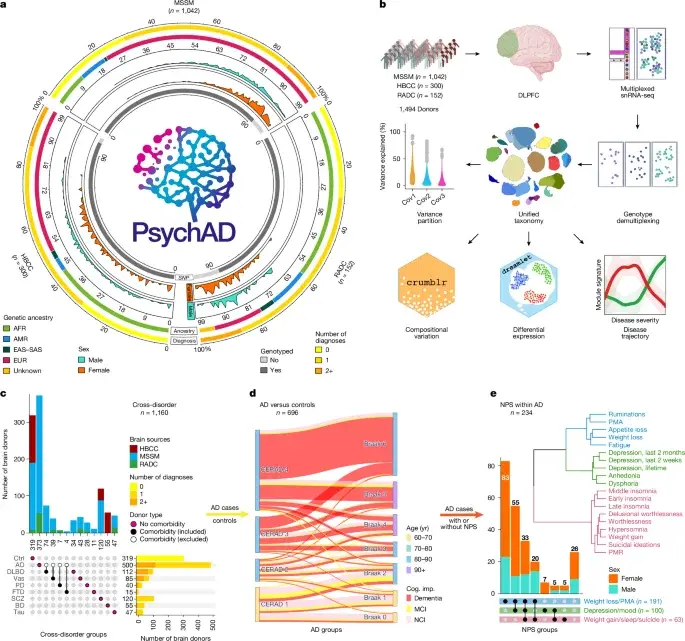
A coordinated series of nine papers led by the PsychAD Consortium has released the largest single-cell transcriptomic atlas of the human brain to date. The primary study, published in Nature, analyzes over 6.3 million nuclei from 1,494 donors to map molecular changes across eight brain disorders, including Alzheimer’s, Parkinson’s, and schizophrenia. The research identifies shared cellular vulnerabilities across diseases, particularly in immune and vascular cells, while distinguishing specific signatures for neurodegenerative versus psychiatric conditions. Complementary studies link genetic risk variants to specific cell types and develop AI frameworks for personalized Alzheimer’s progression. The findings suggest that while many brain disorders share common molecular pathways, distinct cellular responses drive individual disease trajectories, offering new targets for therapeutic intervention.
Key points
- The PsychAD Consortium analyzed 6.3 million nuclei from 1,494 donors to create a population-scale atlas of the dorsolateral prefrontal cortex.
- The study covers eight disorders: Alzheimer’s, Lewy body disease, vascular dementia, Parkinson’s, tauopathy, frontotemporal dementia, schizophrenia, and bipolar disorder.
- Interindividual variation accounts for 7.5% of gene expression variance, while cell type differences explain 50.5% of the total variation.
- Neurodegenerative diseases show increased abundance of vascular and immune cells, whereas psychiatric disorders are linked to changes in deep-layer excitatory neurons.
- Shared transcriptomic signatures across diseases are enriched in basic cellular functions like mRNA processing and correlate with genetic co-heritability.
- The H1 MAPT haplotype was associated with increased Parkinson’s disease risk, with an odds ratio of 4.125 in this cohort.
Background
This release follows recent advancements in single-cell analysis, including the development of 'Malva,' a search engine for transcriptomic data, and studies on aging as a programmed cellular remodeling process. The PsychAD Consortium, launched in 2019 with NIA support, builds on earlier cross-disorder atlases to provide a more comprehensive view of brain biology across the lifespan.
How outlets are covering it
Nature emphasizes the biological convergence of disorders, highlighting shared vulnerabilities in basic cellular functions and the distinct cellular trajectories of Alzheimer’s progression. Mount Sinai frames the work as a foundational resource for precision medicine, stressing the translation of genetic risk into specific therapeutic targets and the importance of understanding individual molecular diversity in Alzheimer’s patients. While both sources agree on the scale and significance of the data, Nature focuses on the mechanistic overlap between diseases, whereas Mount Sinai highlights the clinical implications for personalized treatment and the development of new AI frameworks like PASCode.
Why it matters
This atlas provides a critical reference for understanding the molecular underpinnings of complex brain disorders. By identifying shared and distinct cellular responses, it offers potential targets for therapies that could address multiple conditions simultaneously or tailor treatments to individual patient biology. The integration of genetic data with single-cell transcriptomics bridges the gap between broad genetic risk and specific cellular dysfunction, potentially accelerating the development of biomarkers and precision therapies for neurodegenerative and psychiatric diseases.
What to watch
Researchers will likely use the PsychAD atlas and new computational tools to identify specific therapeutic targets for neurodegenerative and psychiatric disorders. The integration of genetic risk with cellular data may lead to the development of personalized biomarkers for early disease detection. Further studies will explore the clinical application of the PASCode AI framework for predicting Alzheimer’s progression and the long-term impact of age-related circadian changes on brain health.
- Single-cell atlas of transcriptomic vulnerability across brain disorders Nature
- Lifespan single-cell transcriptomic atlas of the human prefrontal cortex Nature
- Scientists map gene activity in brain's prefrontal cortex reuters.com
- Nine Studies Led By Mount Sinai Investigators Featured in Coordinated Collection of Papers That Map the Molecular and Cellular Architecture of Brain Disorders Mount Sinai
- Cell map shows the brain ‘changes gear’ twice, aged 24 and 60 The Times
Want the full story? Read the original reporting
Read on Nature