
Brain ripples synchronize distant neurons to hold working memory
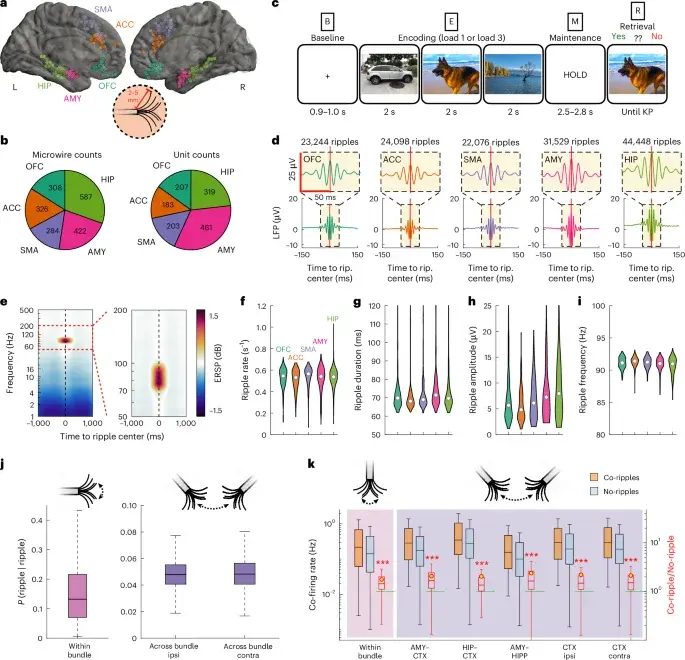
A new study in Nature Neuroscience reveals that high-frequency ripple oscillations coordinate neural activity across distant brain regions to support working memory. By analyzing intracranial recordings from 35 patients, researchers found that simultaneous ripples increase cross-region neuron co-firing by 30%, even across distances up to 220 mm. This coordination scales with memory load and helps reinstate stimulus-specific firing patterns during retrieval, suggesting ripples act as a timing mechanism for distributed cognitive representations rather than just local memory consolidation.
Key points
- Ripple oscillations (~90 Hz) occur simultaneously across the hippocampus, amygdala, prefrontal cortex, and other regions during encoding, maintenance, and retrieval phases of working memory tasks.
- Co-occurring ripples between distant brain regions lead to a 30% increase in neuron co-firing, a effect that persists without decrement over distances up to 220 mm.
- The strength of cross-regional ripple coordination and associated co-firing scales with memory load, indicating a direct link between oscillatory dynamics and cognitive demand.
- During retrieval, co-ripples facilitate the reinstatement of stimulus-specific co-firing patterns observed during encoding, particularly during rapid recognition, supporting the idea that ripples carry content-specific information.
- The study utilized simultaneous single-unit and local field potential recordings from 35 patients with intracranial microwire electrodes, providing a unique dataset for analyzing long-range neural integration.
Background
Previous research established that ripple oscillations, initially identified in the hippocampus during sleep, are associated with memory consolidation. While ripples have been detected widely in the cortex, their role in active cognition and long-range coordination remained debated. This study builds on earlier findings that ripples facilitate replay of neuronal sequences in rodents, extending the concept to human working memory and demonstrating that ripples can synchronize distributed neural networks during active tasks.
How outlets are covering it
The primary source, Nature Neuroscience, emphasizes the mechanistic role of ripples in coordinating long-range neural co-firing and linking this to cognitive load and stimulus-specific reinstatement. Secondary source Bioengineer.org highlights the conceptual shift from localized memory circuits to distributed networks, framing ripples as a 'temporal scaffolding' that refreshes memory without continuous firing. News-Medical focuses on the clinical implications, suggesting that understanding ripple coordination could help distinguish healthy cognitive signals from abnormal activity in disorders like Alzheimer's and ADHD. All sources agree on the core finding of 30% increased co-firing during co-ripples, but differ in emphasis: Nature focuses on the single-unit data and statistical rigor, Bioengineer.org on the theoretical implications for memory representation, and News-Medical on potential applications in neurological disease.
Why it matters
This research provides a concrete mechanism for how the brain maintains working memory across distributed networks, challenging the traditional view of memory as a localized process. It suggests that disruptions in ripple timing or propagation could contribute to cognitive deficits in neurological and psychiatric conditions, offering new targets for diagnostic and therapeutic interventions.
What to watch
Future research may explore how ripple-mediated coordination is affected in patients with epilepsy, schizophrenia, or neurodegenerative diseases. Researchers could also investigate whether modulating ripple activity through stimulation or pharmacological means can improve working memory performance, potentially leading to new treatments for cognitive disorders.
Want the full story? Read the original reporting
Read on Nature