
First Human Tissue Study Maps Deep Brain Stimulation’s Genetic Effects on Memory Circuits
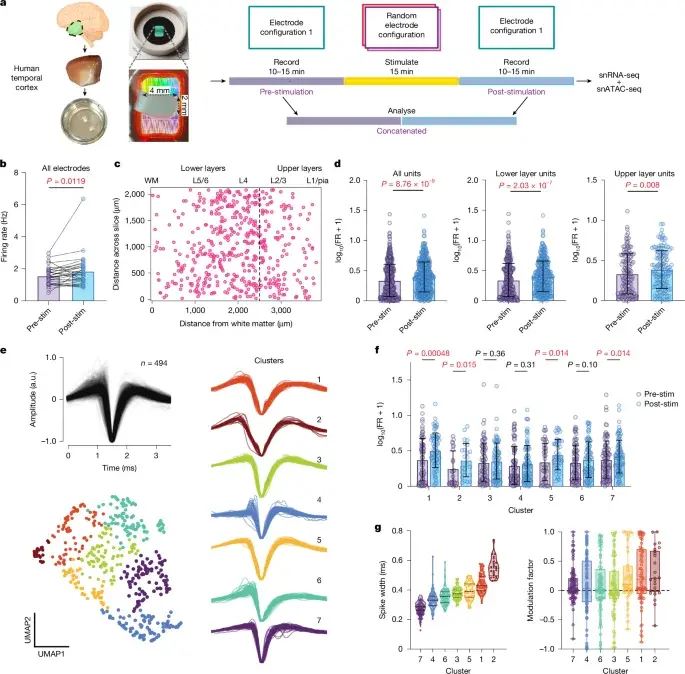
Researchers at UCLA and UT Southwestern Medical Center published a study in Nature demonstrating that electrical stimulation of human temporal cortex tissue strengthens neural cell assemblies and triggers cell-type-specific gene expression changes. By using ex vivo tissue from neurosurgery patients, the team linked stimulation-induced firing synchronization to distinct genetic programs in neurons and astrocytes, validating these findings with in vivo patient data. This work provides the first direct molecular map of how deep brain stimulation (DBS) affects human brain cells, offering potential targets for therapies aimed at preserving memory and slowing cognitive decline.
Key points
- The study is the first to apply DBS-like electrical stimulation to living, human-derived temporal cortex tissue maintained ex vivo for several days.
- Stimulation increased the synchronization of neuronal firing, a pattern associated with memory formation and synaptic plasticity.
- Single-nucleus genomics revealed that stimulation activates distinct gene regulatory networks in specific cell types, including excitatory neurons and astrocytes.
- Gene expression signatures observed in the ex vivo model matched those found in tissue from patients who had previously undergone in vivo DBS.
- The findings suggest that DBS influences memory not just through immediate electrical changes, but by altering the molecular machinery for long-term adaptation.
Background
This research builds on prior investigations into neuromodulation therapies, such as the 2026 Iowa stroke survivor case involving vagus nerve stimulation and the 2026 JAMA Network Open trial on theta-burst stimulation for depression. While those studies focused on clinical outcomes and durability, this new work addresses the fundamental biological mechanisms of how electrical impulses reshape brain circuits at the genetic level in humans, a gap previously filled only by animal or lab-grown cell models.
How outlets are covering it
Neuroscience News and Bioengineer.org emphasize the novelty of using living human tissue to bridge the gap between electrophysiology and genetics, highlighting the potential for precision pharmacological therapies. Mirage News focuses on the broader implication for cognitive decline, quoting senior author Genevieve Konopka on the value of identifying specific genetic targets. All sources agree on the core finding that stimulation affects both neurons and non-neuronal cells like astrocytes, but differ in emphasis: Bioengineer.org stresses the limitations of short-term observation, while Neuroscience News highlights the clinical potential for combination therapies.
Why it matters
Understanding the specific genetic responses to DBS in human brain cells could lead to more precise stimulation protocols and new drug targets. This knowledge may help clinicians optimize treatments for Parkinson’s disease, obsessive-compulsive disorder, and potentially cognitive decline, moving beyond trial-and-error approaches to targeted neuromodulation.
What to watch
Researchers plan to investigate the long-term persistence of these genetic changes, how stimulated cells interact with neighboring populations, and whether similar responses occur in deeper brain regions that are difficult to access. Future studies will also explore combining DBS with neuropharmaceuticals to enhance cognitive benefits.
- Stimulation modulates gene-linked cell assemblies in the human brain Nature
- Brain Stimulation Triggers Cell-Specific Genetics in Living Brains Neuroscience News
- Human brain tissue reveals how electrical stimulation changes neurons and gene activity Bioengineer.org
- Electric Stimulation's Impact on Neurons Uncovered Mirage News
- Electrical Stimulation’s Effects on Neurons, Gene Expression Mapped in Living Human Brain Tissue Genetic Engineering and Biotechnology News
Want the full story? Read the original reporting
Read on Nature