
Polo remnants trigger flash flood emergency in New Mexico as storm remnants sweep across U.S.
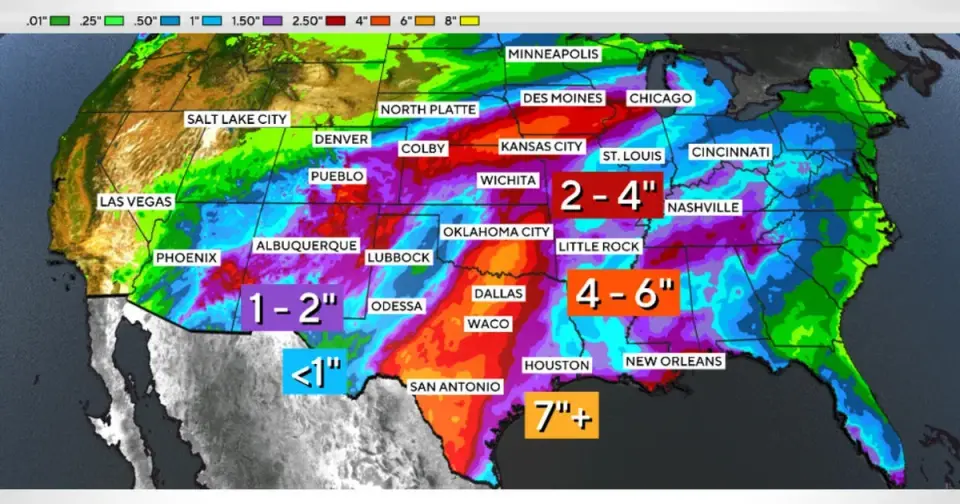
Hurricane Polo, which briefly reached Category 5 status, has dissipated over Mexico but its remnants are now driving severe flooding across the southwestern United States. The storm made landfall in Baja California Sur on Monday and moved northeast into Sonora, bringing heavy rain to the U.S. border. As of Tuesday, more than 30 million people from Arizona to Iowa face flash flood risks. In southern New Mexico, the McLeod Dam in Doña Ana County is under critical stress, prompting evacuation orders and emergency pumping operations. The National Weather Service has issued flash flood watches spanning over 1,200 miles, with rainfall rates reaching 4 inches per hour in some areas. While the storm has weakened, its moisture is combining with other weather systems to create a significant threat through the week.
Key points
- Hurricane Polo downgraded to a tropical storm and dissipated over northwest Mexico on Tuesday night after making landfall in Baja California Sur and Sonora.
- The storm's remnants are causing flash floods across the Southwest, with over 60 incidents reported between Monday and Tuesday night.
- The McLeod Dam in Doña Ana County, New Mexico, is at risk of failure, leading to evacuation orders and the deployment of pumps to relieve pressure.
- Flash flood watches extend from Phoenix, Arizona, to Des Moines, Iowa, affecting more than 14 million people, with some areas in Texas potentially receiving over 7 inches of rain.
- Polo underwent extreme rapid intensification, with winds jumping from 45 mph to 150 mph in 24 hours, and reached maximum sustained winds of 180 mph, tying 2009's Hurricane Rick as the third-strongest on record for the region.
Background
The 2026 Atlantic hurricane season has been active, with Tropical Storm Dolly forming in August. In late September, Hurricane Polo emerged as a major threat in the Pacific, previously reaching Category 5 status before weakening. Concurrently, Hurricane Nolo impacted Hawaii. The current event follows the dissipation of Polo over Mexico, shifting the focus to inland flooding in the U.S. Southwest.
How outlets are covering it
CBS News emphasizes the immediate danger to the U.S. population, highlighting the 30 million people at risk and the critical situation at the McLeod Dam. The Washington Post focuses on the geographic spread of the threat, noting that flood watches cover 28 million people from Arizona to the Plains, with specific risks for states like Kansas and Oklahoma. Colorado Public Radio provides a regional perspective, noting that while the rain may offer some relief to drought conditions, the dry ground increases the risk of flooding rather than absorption, particularly in the San Luis Valley and southern Colorado. All sources agree on the severity of the rainfall and the potential for life-threatening flash floods, but differ in their emphasis on specific regional impacts and the broader atmospheric conditions driving the storm's intensity.
Why it matters
The remnants of Hurricane Polo pose a significant threat to infrastructure and public safety across a vast area of the United States. The potential for dam failure in New Mexico and widespread flash flooding in the Southwest and Plains could lead to significant property damage, displacement, and loss of life. The extreme rapid intensification of Polo highlights the increasing power of Pacific storms, potentially linked to warmer waters and El Niño conditions. Understanding the path and impact of such storms is crucial for emergency preparedness and response in vulnerable regions.
What to watch
The National Weather Service expects the rain from Polo's remnants to continue through the week, with specific areas in Texas potentially seeing heavy rainfall through Thursday. Authorities will monitor the McLeod Dam closely to prevent failure. The combination of Polo's moisture with other weather systems may prolong the flooding risk in the Four Corners Region and Central Plains. Residents in affected areas should continue to follow evacuation orders and stay informed through local weather services.
- Tropical Storm Polo is expected to impact the U.S. after slamming into Mexico. See its path. CBS News
- Hurricane Polo’s moisture will trigger flooding in Southwest The Weather Channel
- Timeline: When will dangerous, tropically enhanced flooding reach the Southwest, Southern Plains and Midwest? FOX Weather
- Remnants of Hurricane Polo will reach Colorado this week. Here’s what to expect. Colorado Public Radio
- Life-threatening flash floods may soon hit the Southwest, driven by Polo remnants The Washington Post
Want the full story? Read the original reporting
Read on CBS News