
Record El Niño Sets Stage for Intense West Coast Winter
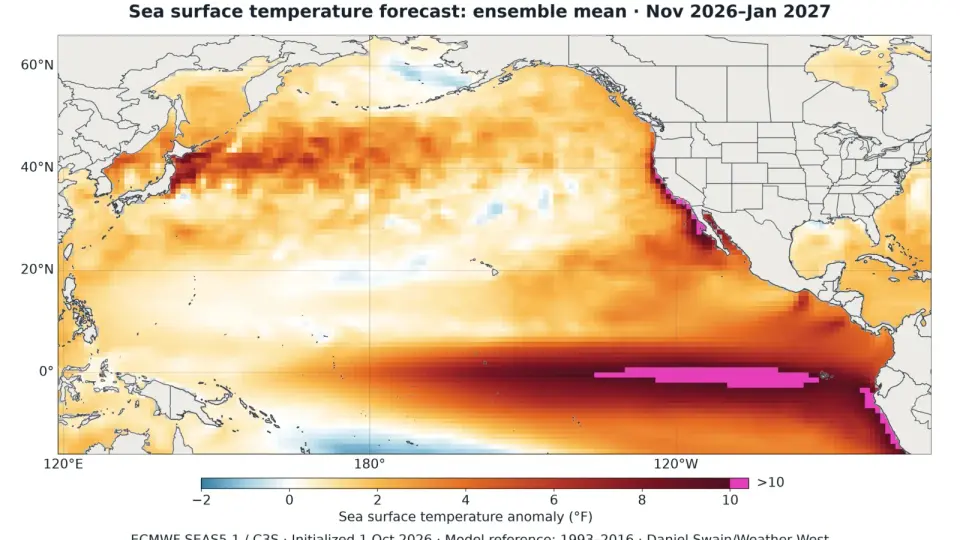
A historic El Niño is expected to intensify atmospheric rivers, bringing severe storms to the U.S. West Coast. San Jose is upgrading infrastructure to prevent a repeat of 2017 floods, despite federal funding cuts.
Key points
- NOAA forecasts a 100% chance of a strong El Niño persisting through March, with an 83% probability of it ranking among the most powerful on record since 1950.
- Climate scientists warn that this El Niño will not increase the number of atmospheric rivers but will significantly intensify them, leading to heavier rain and snow in California.
- San Jose officials are fortifying creeks and expanding their Emergency Operations Center to mitigate risks, citing the 2017 floods that damaged over 500 homes and displaced 14,000 residents.
- The Pacific hurricane season remains active, with remnants of Hurricane Rachel already causing flash floods and record rainfall in parts of the Southwest and California.
- Local leaders express concern over reduced federal support, including cuts to FEMA and NOAA, forcing cities to rely on local reserves for disaster response.
Background
Recent studies have linked tropical ocean warming and atmospheric circulation patterns to extreme weather events, including record snowfall in Antarctica and historic floods in California. These phenomena highlight the complex interactions between global climate systems and regional weather extremes.
How outlets are covering it
USA Today emphasizes the meteorological mechanics, noting that while atmospheric rivers may not occur more frequently, their intensity will increase due to the strong El Niño. The Mercury News focuses on local preparedness, highlighting San Jose's efforts to upgrade infrastructure and coordinate emergency responses, while also raising concerns about the lack of federal aid and the need for better communication between agencies and residents.
Why it matters
The potential for a record-setting El Niño poses significant risks to the West Coast, including severe flooding, beach erosion, and infrastructure damage. Effective local preparedness and coordination are crucial to mitigating these impacts, especially in the face of reduced federal support.
What to watch
Forecasters expect the first atmospheric rivers to arrive as early as mid-November, with peak activity in January and February. San Jose and other West Coast cities will continue to monitor weather patterns and implement emergency measures as the winter season progresses.
- A dramatic El Niño effect is headed for the West Coast USA Today
- After devastating flooding almost a decade ago, is San Jose prepared for a ‘Super El Niño?’ The Mercury News
- Thanks to El Niño, California is getting a grim preview of its climate change future San Francisco Chronicle
- El Nino could mean trouble for Ripon farmers & residents in parts of Manteca, Lathrop Manteca Bulletin
- El Nino Effect: How the climate pattern could reshape California's winter possibly leading to more flooding, landslides and rain ABC7 Bay Area
Want the full story? Read the original reporting
Read on USA Today