
Tropical Storm Rachel Targets San Diego Amid Record El Niño Conditions
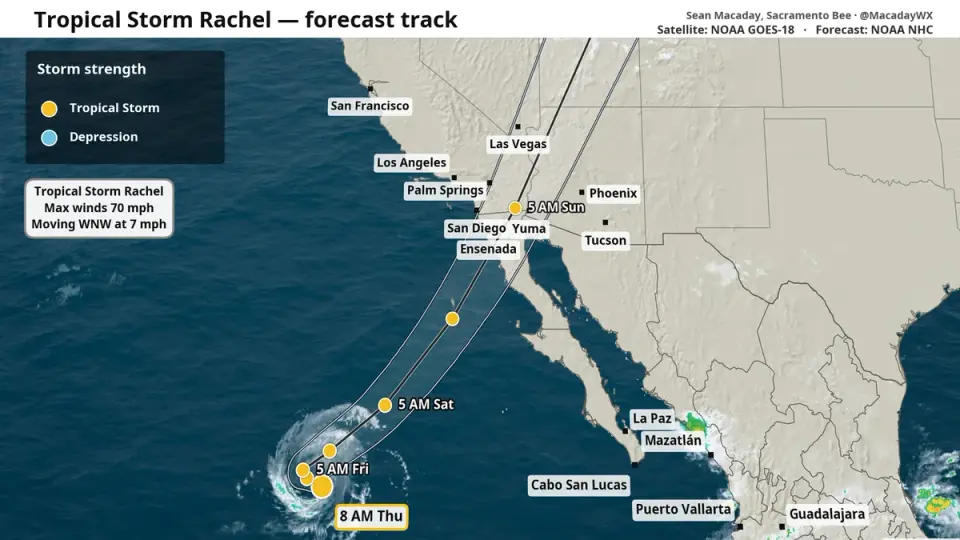
Tropical Storm Rachel is forecast to make landfall near the San Diego-Tijuana border late Saturday night, marking the first tropical storm to hit California since 1939. The system will bring significant rain, wind, and coastal flooding to Southern California, exacerbated by an El Niño-driven Kelvin wave that is elevating sea levels by up to 12 inches. While the storm weakens as it moves inland, its remnants are expected to deliver heavy precipitation to Utah and Nevada, offering critical relief for drought-stricken regions despite flooding risks.
Key points
- Rachel is expected to make landfall just south of San Diego late Saturday night, potentially maintaining tropical characteristics until impact due to rapid movement.
- The storm will bring widespread rainfall, with totals exceeding one inch in some areas, and wind gusts above 40 mph in rugged terrain and the Mojave Desert.
- A Kelvin wave associated with El Niño is raising sea levels by 6 to 12 inches, significantly increasing the risk of coastal flooding and beach erosion in Southern California.
- Remnants of the storm are forecast to move into Utah and Nevada, where heavy rain could alleviate severe drought conditions but also pose flash flood risks in urban and desert areas.
- The 2026 Pacific hurricane season is among the most active on record, driven by unusually warm ocean temperatures and El Niño conditions.
Background
This event follows a series of tropical impacts in 2026, including Hurricane Polo in Baja California and Tropical Storm Marie in September. The current storm is part of an unusually active season fueled by El Niño, which has also led to record-high ocean temperatures and a Kelvin wave that is elevating sea levels along the West Coast. Previous storms have already caused significant coastal damage, and forecasters warn that the combination of Rachel and the Kelvin wave could lead to unprecedented flooding.
How outlets are covering it
The Sacramento Bee emphasizes the historical significance of Rachel's landfall, noting it would be the first tropical storm to hit California since 1939. The Long Beach Post focuses on the immediate coastal impacts, highlighting the vulnerability of the Long Beach Peninsula to swells and the city's preparations with sandbags and emergency pumps. The Los Angeles Times underscores the broader climate context, linking the storm's impacts to El Niño and the Kelvin wave, and warns of potential long-term sea level rise. KSL News highlights the positive aspect of the storm's remnants for Utah, where heavy rain could help alleviate severe drought, while also warning of flooding risks. The outlets differ in their emphasis, with some focusing on the immediate weather impacts and others on the broader climate and historical context.
Why it matters
Tropical Storm Rachel's impact on Southern California and the broader region highlights the increasing frequency and intensity of extreme weather events driven by climate change and El Niño. The storm's potential to cause significant flooding, erosion, and wind damage underscores the need for robust emergency preparedness and infrastructure resilience. Additionally, the storm's remnants offer a chance for drought-stricken areas like Utah to receive critical moisture, illustrating the complex and often contradictory impacts of extreme weather events.
What to watch
Forecasters expect Rachel to weaken quickly after landfall, but its remnants will continue to bring heavy rain and wind to Southern California, Arizona, and Utah through the weekend and into early next week. The Kelvin wave is expected to keep sea levels elevated for months, increasing the risk of coastal flooding. In Utah, heavy rain is forecast to continue into early next week, with potential for flash flooding in urban and desert areas. The Climate Prediction Center forecasts a wetter-than-average winter for Southern California, and scientists warn that the current conditions could lead to record coastal flooding in the coming months.
- Tropical Storm Rachel set to impact Southern California this weekend Sacramento Bee
- High swells are hitting Long Beach again, and weekend rain is on the way thanks to another hurricane Long Beach Post
- Remnants of Hurricane Rachel head to Utah. How much water will it provide? KSL News
- Tropical Storm Rachel, Kelvin wave combine to bring rain, winds, coastal dangers to Southern California Los Angeles Times
- Dangerous surf, coastal flooding expected along Southern California coast KBAK
Want the full story? Read the original reporting
Read on Sacramento Bee