
Ancient Turkish Clay Fragments Reveal 11,000-Year-Old Pottery Experiments
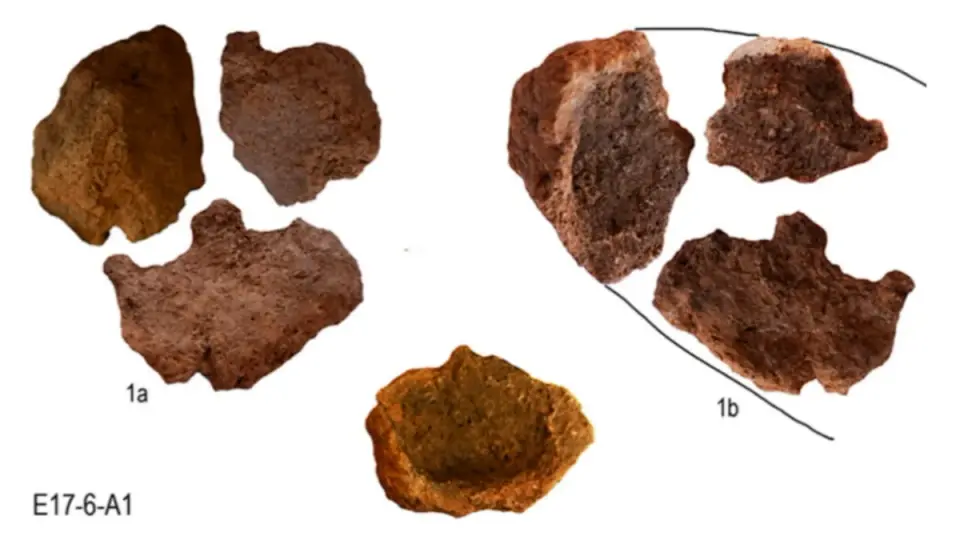
Researchers in southeastern Turkey identified 46 fired clay fragments dating to approximately 9350 BCE at the Çemka Höyük settlement. These artifacts, which predate widespread pottery use in the region by over 2,000 years, represent early experimental attempts to create containers rather than a standardized production tradition. Analysis confirms the clay was deliberately heated to 600–700°C, marking a transitional phase in the development of ceramic technology in Southwest Asia.
Key points
- The fragments were recovered from a building level at Çemka Höyük in Mardin province, Turkey, dated to around 9350 BCE.
- Microscopic and X-ray diffraction analysis confirmed the clay underwent irreversible mineral changes from deliberate firing, distinguishing it from sun-dried clay.
- The artifacts include clay coatings on organic objects, attachments to stone vessels, and thick-walled containers made from layered slabs.
- The findings suggest a period of experimentation rather than an established pottery industry, as the community had not yet adopted ceramics for routine storage or cooking.
- The study highlights that pottery emerged through diverse regional trials, balancing practical needs with social acceptance, rather than following a single linear path.
Background
The Pre-Pottery Neolithic period in Southwest Asia is traditionally defined by the absence of widespread ceramic use, despite the existence of early villages. While pottery became common around 7000 BCE, evidence from sites like Çemka Höyük and others in Turkey and Iran indicates that clay manipulation began earlier. Previous discoveries, such as a woman buried with animals at Çemka Höyük around 9300 BCE, have already highlighted the site's significance in understanding early Neolithic social structures. This new study adds to the growing body of evidence that technological adoption in the ancient world was a gradual, experimental process rather than a sudden invention.
How outlets are covering it
All four sources agree that the 46 fragments from Çemka Höyük represent deliberate, early experiments in pottery-making rather than accidental firing or sun-dried clay. Archaeology News Online and Phys.org emphasize the technical analysis, noting that mineral changes confirm firing at 600–700°C. La Brújula Verde provides additional context on the site's discovery through road construction for the Ilısu Dam and notes that the fragments predate widespread pottery by 2,300 years. Sci.News highlights the social aspect, quoting researchers who argue that the adoption of new technologies requires integration into daily life and community norms. While all sources confirm the experimental nature of the finds, La Brújula Verde uniquely mentions that the site’s discovery was partly accidental due to dam-related roadwork, a detail not present in the other reports.
Why it matters
This discovery challenges the traditional view that pottery emerged suddenly in the Pottery Neolithic period. Instead, it reveals a long, gradual process of experimentation where communities tested clay's possibilities before fully adopting it. Understanding this transition helps archaeologists reconstruct how technological innovations spread and were integrated into daily life, offering insights into the social and practical factors that drive the adoption of new materials in ancient societies.
What to watch
Further microscopic analysis and experimental archaeology may help determine the specific functions of the containers and whether the experiments at Çemka Höyük directly influenced later pottery traditions in the region. Researchers also aim to clarify if these early attempts were a technological dead end or a precursor to the widespread ceramic use that emerged around 7000 BCE.
- 11,000-year-old fired clay fragments point to early pottery-making experiments Archaeology News Online Magazine
- Archaeologists Find the Oldest Fired Clay Containers in the Near East, Made 2,000 Years Before Pottery Became Common La Brújula Verde
- Clay Fragments from Türkiye Point to Pottery Experiments 11,000 Years Ago Sci.News
- 11,000-year-old clay fragments reveal early experiments in pottery-making Phys.org
Want the full story? Read the original reporting
Read on Archaeology News Online Magazine