
Solar Plant Prep in Spain Uncovers 5,000-Year-Old Fortress and Roman Soldier Burial
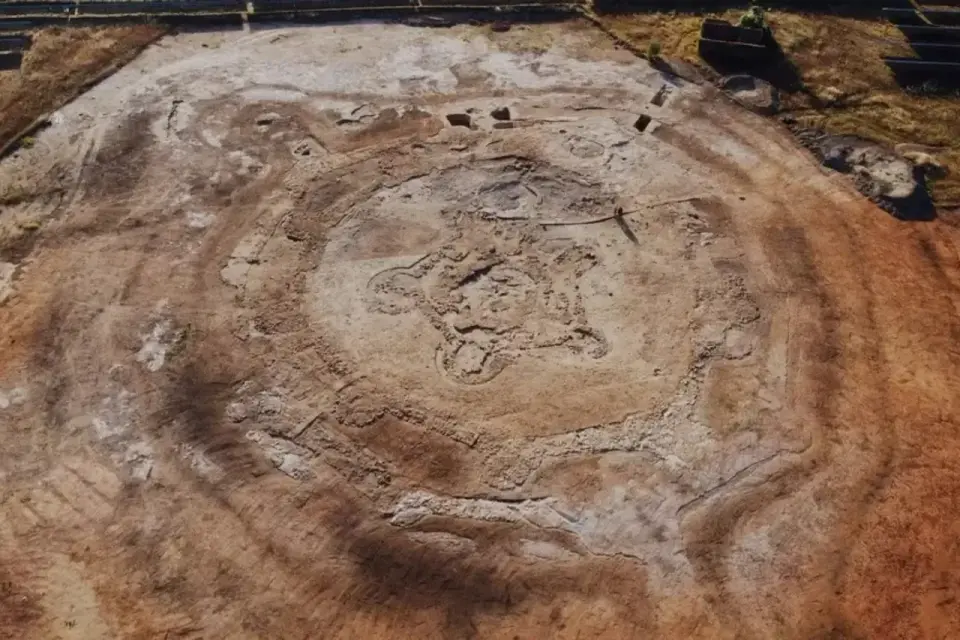
Preventive excavations for a solar power plant near Almendralejo, Spain, revealed a sophisticated 5,000-year-old Copper Age fortress. Archaeologists also discovered a Roman-era burial within the abandoned site, including a man aged 25 to 35 buried with a military dagger, raising questions about the site's later use.
Key points
- Discovery occurred in 2021 during preventive excavations for a solar plant in Extremadura, Spain.
- The site, identified as Cortijo Lobato, features a nine-sided outer wall and bastions dating to approximately 3000 BC.
- The largest enclosure measures 77 meters across, with internal defensive structures and ditches.
- A Roman-era male burial was found within the abandoned fortress, approximately 2,500 years after its original occupation.
- The burial included a pugio, a standard Roman legionary dagger, suggesting a military connection for the deceased.
Background
Recent archaeological findings in Europe have highlighted the intersection of ancient history and modern infrastructure or forensic analysis. In Scotland, researchers digitally reconstructed the face of a headless Roman-era man buried near a fort, revealing details about his non-combat role and potential cultural rituals. Meanwhile, excavations in Mongolia uncovered a Xiongnu tomb with artifacts linking it to Rome, China, and Korea, illustrating extensive ancient trade networks. In Italy, a reconstructed wardrobe from Pompeii offered insights into daily life during the AD 79 eruption, while in Israel, a newly uncovered aqueduct section linked to the Temple Mount provided evidence of water systems from the Hasmonean period. These discoveries, like the Spanish fortress, demonstrate how modern projects or advanced techniques can uncover layers of history spanning millennia.
Why it matters
The discovery underscores the importance of preventive archaeology in modern infrastructure projects, ensuring that development does not destroy historical sites. The sophisticated design of the Copper Age fortress challenges assumptions about early military architecture, showing advanced planning centuries before similar systems emerged in later periods. The Roman burial adds a layer of mystery, illustrating how ancient sites were repurposed or used as shelters long after their original function, providing a tangible link between prehistoric and Roman-era human activity in the same location.
What to watch
Further forensic examinations of the Roman-era remains are expected to clarify the man's identity, military status, and cause of death. Archaeologists will continue to analyze the daily life artifacts found at Cortijo Lobato to better understand the Copper Age inhabitants. The site may also be subject to additional preservation efforts or public exhibitions, given its significance in understanding prehistoric defensive architecture and Roman-era interactions with ancient monuments.
Want the full story? Read the original reporting
Read on Futura, le média qui explore le monde