
Astrophotographer Captures Milky Way and Nebulae Above ESO's Atacama Telescopes
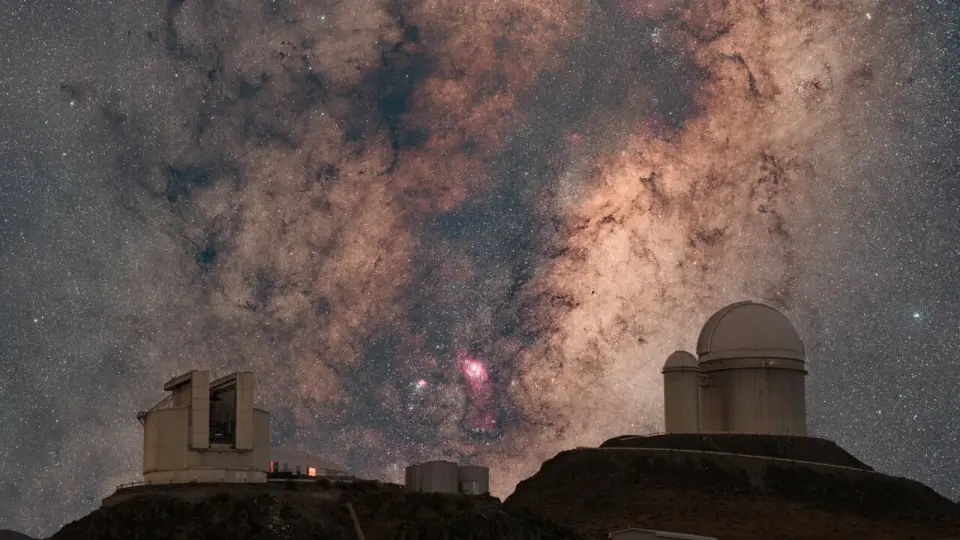
Astronomer José Rodrigues captured a striking image of the Milky Way arching over the European Southern Observatory's La Silla site in Chile's Atacama Desert. The photograph features the Trifid and Lagoon Nebulae within the Sagittarius constellation, positioned above the New Technology Telescope and the 3.6-meter telescope. Rodrigues, who studies exoplanets, noted the personal significance of the 3.6-meter scope, which houses instruments used to detect worlds outside our solar system.
Key points
- The image was taken by astronomer José Rodrigues at the ESO La Silla Observatory in Chile's Atacama Desert.
- The photo displays the Milky Way, dark dust clouds, and the Trifid and Lagoon Nebulae in the Sagittarius constellation.
- The foreground features the New Technology Telescope (NTT) and the 3.6-meter telescope.
- The 3.6-meter telescope hosts the HARPS and NIRPS instruments, which are used for exoplanet detection and study.
- Rodrigues stated that he grew up dreaming of using the 3.6-meter telescope for his exoplanet research.
Background
This visual highlights the strategic importance of the Atacama Desert for astronomical observation, a region recently featured in coverage of the Extremely Large Telescope (ELT) construction. While the ELT is slated for operational use by 2030 to search for biosignatures, the existing La Silla facilities, including the 3.6-meter telescope, continue to support critical exoplanet research. Recent studies have also utilized the region's clear skies to trace the Milky Way's motion toward the Great Attractor and to analyze chemical fossils in ancient stars.
Why it matters
The image underscores the vital role of ground-based observatories in the Atacama Desert for exoplanet research. While space telescopes like JWST provide deep-space data, instruments like HARPS on the 3.6-meter telescope remain essential for precise radial velocity measurements needed to detect and characterize exoplanets. This photograph serves as a reminder of the infrastructure supporting the ongoing search for worlds beyond our solar system.
What to watch
The European Southern Observatory continues to operate its Atacama facilities, including the La Silla Observatory, while construction of the Extremely Large Telescope (ELT) progresses. The ELT is expected to be completed by 2027 and become operational by 2030, which will significantly enhance the ability to study exoplanet atmospheres and potentially detect signs of life.
Want the full story? Read the original reporting
Read on Space