Tag

Astrophotography

All articles tagged with #astrophotography

Pink Moon and Comets: April 2026 Turns Night Sky into a Photographer's Playground
photography11 days ago

Pink Moon and Comets: April 2026 Turns Night Sky into a Photographer's Playground

April 2026 offers a dramatic night sky for astrophotographers: the Pink Moon rises with sunset near Spica, a chance for striking foreground shots; Comet MAPS (C/2026 A1) may appear in twilight low in the western sky around perihelion; mid-April (10–20) provides dark skies for galaxy imaging (Leo Triplet, M104, M101, M81, M82); crescent Moon–Mercury–Mars conjunctions around Apr 13–15, and Venus with a crescent Moon on Apr 18; the Lyrid meteor shower peaks Apr 21–22 under good skies (15–20 meteors/hr); southern hemisphere observers may see Eta Aquariids. Practical tips include using a 300–600mm lens for close Moon shots, 200–400mm for Moon-and-planet pairs, and wide 14–24mm glass for meteors, with ISO 800–1600 and 20–30 second exposures; plan with a moonrise calculator and scout an eastern horizon foreground for best results.

Cosmic Tug-of-War: Antennae Galaxies Dazzle in Merging Dance
space14 days ago

Cosmic Tug-of-War: Antennae Galaxies Dazzle in Merging Dance

Astrophotographer Greg Meyer captured a near-21-hour deep-space image of the Antennae Galaxies (NGC 4038/NGC 4039) in Corvus as they violently merge into a single elliptical galaxy, revealing orange-yellow cores, tangled dust, and sweeping tidal tails that fuel bursts of star formation; shot with a Sky-Watcher Esprit 120 at Starfront Observatory in Texas, the photo highlights the dramatic gravitational tug-of-war and the likely dispersion of most newly formed star clusters over time.

Satellites Flood the Night Sky: A Photographer’s Heartbreak and a Widening Light-Pollution Crisis
photography17 days ago

Satellites Flood the Night Sky: A Photographer’s Heartbreak and a Widening Light-Pollution Crisis

A 30‑minute composite by Alan Dyer shows satellite trails across the night sky, illustrating how the rapid growth of orbital satellites is increasing light pollution for astrophotography. A 2025 survey found 90% of astrophotographers affected; with Starlink's 10,000th satellite launched and estimates of tens of thousands more, experts warn the practice could degrade night-sky photography unless shooters time sessions to minimize satellite trails.

Hubble Revisits Crab Nebula, Revealing Evolving Gas Clouds After 25 Years
space17 days ago

Hubble Revisits Crab Nebula, Revealing Evolving Gas Clouds After 25 Years

NASA’s Hubble Space Telescope released new 2024 images of the Crab Nebula (Messier 1), taken 25 years after the initial look, showing moving gas clouds and changes in temperature, density, and chemistry as the remnant continues to expand (about 3.4 million mph) from its 1054 supernova, located roughly 6,500 light-years away in Taurus.

Thor’s Helmet Nebula Glows 15,000 Light-Years Away in Stunning Deep-Space Photo
space18 days ago

Thor’s Helmet Nebula Glows 15,000 Light-Years Away in Stunning Deep-Space Photo

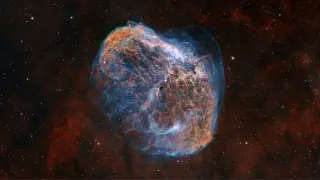
Space.com reports astrophotographer Ronald Brecher captured the 30-light-year emission nebula NGC 2359, known as Thor’s Helmet, about 15,000 light-years from Earth in Canis Major. The helmet-like bubble is sculpted by winds from a central Wolf–Rayet star; Brecher photographed it from Guelph, Canada using a Celestron 14-inch EDGE HD telescope with a monochrome camera and narrowband filters, accumulating more than 8 hours across 124 exposures and stacking the data with PixInsight to reveal the nebula’s blue glow and wing-like structures.

SpaceX Reaches 10,000 Satellites, Night Sky Art Exposes Light Pollution
space20 days ago

SpaceX Reaches 10,000 Satellites, Night Sky Art Exposes Light Pollution

SpaceX hit a milestone by launching its 10,000th satellite into low-Earth orbit, and photographer Joshua Rozells captured the night-sky impact in a 343-frame composite that highlights satellite trails. The image amplifies concerns about satellite light pollution affecting astrophotography and astronomy, and it spotlights regulatory gaps while acknowledging the benefits of widespread internet access.

Nearly 70 Hours Unveil Orion’s Delicate Blue Reflection Nebula
stargazing26 days ago

Nearly 70 Hours Unveil Orion’s Delicate Blue Reflection Nebula

Astrophotographer Emil Andronic spent 69 hours 15 minutes gathering HaLRGB data from the UK to photograph the blue Cederblad 51 reflection nebula near Orion’s head, revealing intricate dust structures amid the surrounding red emission. Using two 8-inch telescopes with RGB and H-alpha filters and cooled cameras, he stacked and processed the data with PixInsight and Adobe Photoshop to produce a detailed image of the nebula and its stellar backdrop.

Starry Nights, Simple Gear: A Beginner's Guide to Astrophotography Essentials
space1 month ago

Starry Nights, Simple Gear: A Beginner's Guide to Astrophotography Essentials

Space.com’s sponsored guide outlines five beginner-friendly paths to astrophotography—smartphones, tripod-mounted mirrorless/DSLR cameras, star trackers, smart telescopes, and traditional deep-sky imaging—with practical tips on settings (RAW, wide apertures, ISO/shutter duration) and a reminder that dark skies, patience and composition matter as much as gear.

Pocket-Sized Telescope Dwarfs Galaxy S26 Ultra in Deep-Space Imaging
technology1 month ago

Pocket-Sized Telescope Dwarfs Galaxy S26 Ultra in Deep-Space Imaging

Sponsored by Tomoundation? Wait not. Actually, this Tom's Guide piece promotes the Dwarflab Dwarf Mini smart telescope as a pocket-sized, easy-to-use device that automates astrophotography with on-device stacking to deliver deep-space images (galaxies, nebulae, star clusters). It claims the Dwarf Mini can outperform the Galaxy S26 Ultra0x Space Zoom for distant targets, weighs about 1.85 pounds, and costs $399. The setup is app-driven, with features like a solar ND filter for daytime sun photography and timelapse capability, making it a compelling, affordable alternative to expensive rigs or flagship phones. The article is sponsor-labeled and positions the telescope as a convenient, high-value option for amateur and casual astrophotographers.

Scarlet A62Q: a pocket-friendly gateway to beginner astrophotography
technology1 month ago

Scarlet A62Q: a pocket-friendly gateway to beginner astrophotography

365Astronomy’s NOVAStar Scarlet A62Q is a compact, budget-friendly 62mm quadruplet refractor (~£195) aimed at beginners in astrophotography. It arrives in a sturdy case, features a Crayford single-speed focuser, and weighs about 1.5 kg, making it easy to transport and set up on small mounts. Daytime views are sharp, and its lunar imaging via a color camera shows good detail; for deep-sky work, the scope provides a flat field and pleasant color correction but exhibits chromatic aberration on the brightest stars. Longer exposures are needed for faint nebulae, though the overall performance exceeds expectations for its price. A versatile, travel-friendly instrument suitable for visual use, guiding, and quick astrophotography sessions.

OM System’s OM-3 Astro Brings Nebulas to Life with In-Camera Stacking
photography2 months ago

OM System’s OM-3 Astro Brings Nebulas to Life with In-Camera Stacking

OM System unveils the OM-3 Astro, a nebula-focused variant of the OM-3 with an adjusted IR-cut filter that enables 100% transmission of Hα light for vivid nebulae, plus COLOR1/COLOR2 profiles tailored for astro and starry landscape work. It adds Starry Sky AF, Live Composite for in-camera light painting, Night Vision UI, and a 50MP in-camera High-Res composite created from 12 shots (usable on tripod/equatorial mounts). Two new body-mount filters—BMF-LPC01 light-pollution suppressor and BMF-SE01 soft filter—will work with OM-3 Astro and multiple OM bodies. Pricing is US $2,499.99 and CAD $2,999.99, with filters at US $339.99 and CAD $279.99, shipping in March (filters launching next month).

Ablaze in Auriga: Stunning Shot of the Flaming Star Nebula Around AE Aurigae
space2 months ago

Ablaze in Auriga: Stunning Shot of the Flaming Star Nebula Around AE Aurigae

Astrophotographer Greg Meyer captured a dramatic long‑exposure view of the Flaming Star Nebula around the runaway star AE Aurigae in Auriga, about 1,500 light-years away. The flame-like glow comes from radiation emitted by AE Aurigae ionizing surrounding hydrogen; the image, captured with a Radian Raptor 61 mm telescope and nearly 21 hours of exposure, was processed in Adobe Lightroom and Photoshop with PixInsight to reveal a sprawling nebula scene that includes the Tadpole Nebula at the bottom.

Pelican Nebula glows near the Las Vegas Strip in a stunning backyard astrophotography shot
space2 months ago

Pelican Nebula glows near the Las Vegas Strip in a stunning backyard astrophotography shot

Astrophotographer Jason Livingston captured a detailed view of the Pelican Nebula, about 2,000 light-years away in the Cygnus constellation, from his Henderson, Nevada backyard near the Las Vegas Strip, using 27 hours of narrowband imaging across several August 2025 nights; the image reveals a colorful patch of star-forming gas behind a dark molecular cloud, shaped by radiation from newborn stars, with bright stars 57 Cygni and 56 Cygni visible near Deneb.