
Chandra and eROSITA Reveal Treble Clef as a Black Hole Expelled Cloud Re-energized by Cluster Collision
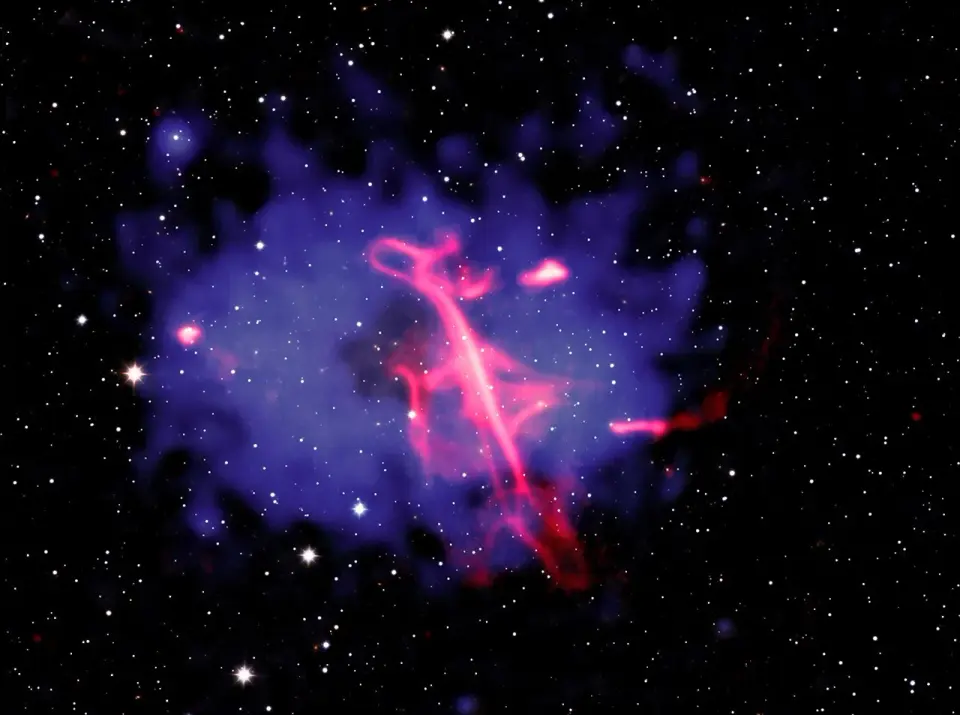
Astronomers have identified the nature of the radio source known as Treble Clef, a structure spanning 2 million light-years that resembles a musical symbol. Previously unexplained since its 2004 discovery, the object is now hypothesized to be a cloud of charged particles originally ejected by a supermassive black hole. Recent data from the Chandra X-ray Observatory and eROSITA suggest that after the initial radio emission faded, the particles were re-energized by a shock wave from the collision of two galaxy clusters. This finding provides new insights into how galaxy clusters interact and evolve.
Key points
- The radio source VLSS J0318.9+5755, nicknamed Treble Clef, extends over 2 million light-years and was first examined in 2004.
- Its visible light is obscured by the Milky Way Galaxy, making it difficult to study with optical telescopes.
- New observations from Chandra and eROSITA indicate the central cloud of charged particles was initially expelled by a supermassive black hole.
- The hypothesis suggests that after the radio emission faded, the particles were reinvigorated by a shock wave from a galaxy cluster collision.
- The composite image displays radio emission in red and newly discovered X-rays in blue, highlighting the object's dual nature.
Background
This discovery follows recent NASA APOD features on X-ray astronomy, including the identification of 'hypersoft' X-ray sources in nearby galaxies using the Chandra telescope in September 2026. It also aligns with broader efforts to understand high-energy phenomena, such as the James Webb Space Telescope's identification of the host galaxy for a record-breaking fast radio burst in October 2026. These studies collectively enhance our understanding of how galactic cores, black holes, and intergalactic interactions influence cosmic evolution.
Why it matters
Understanding the origin and evolution of objects like Treble Clef helps scientists decipher the dynamics of galaxy cluster collisions and the role of supermassive black holes in shaping the universe. It provides a concrete example of how high-energy processes can re-energize matter long after initial events, offering clues about the general evolution of cosmic structures.
What to watch
Further analysis of the X-ray and radio data may refine the timeline of the black hole ejection and the subsequent cluster collision. Researchers may also look for similar objects in other galaxy clusters to test the hypothesis that shock waves from collisions are a common mechanism for re-energizing charged particle clouds.
Want the full story? Read the original reporting
Read on NASA Science (.gov)