
New study suggests Sun may have consumed a super-Earth, leaving detectable chemical traces
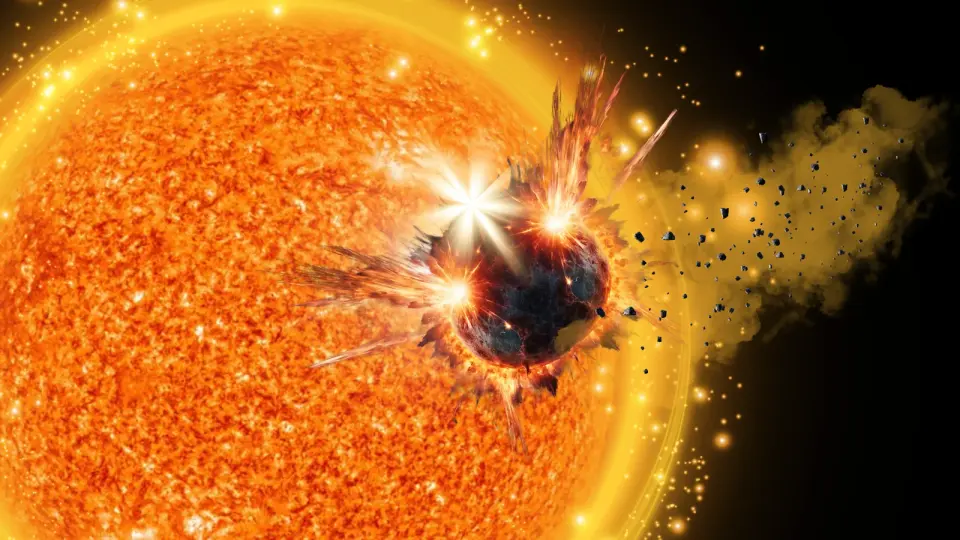
A new study proposes that the Sun swallowed a super-Earth-sized planet early in its history, potentially explaining long-standing discrepancies between solar models and observations, including the Sun's depleted lithium levels and internal structure.
Key points
- Researcher Mutlu Yildiz of Ege University published a study in the Monthly Notices of the Royal Astronomical Society suggesting the Sun engulfed a planet 5 to 10 times Earth's mass.
- The hypothesis addresses three persistent mismatches in solar models: the depth of the convection zone, sound-speed anomalies, and the Sun's unusually low surface lithium abundance.
- Yildiz used the MESA stellar-evolution code to simulate scenarios where the young Sun accreted heavy-element-rich material, finding that a swallowed planet of approximately 5.6 Earth masses best fits current observations.
- The study suggests the chemical 'fingerprints' of this event may still be detectable within the Sun's interior, though it does not confirm the event actually occurred.
- This scenario may also explain why our solar system lacks super-Earths, a common planet type in other systems, as the planet may have formed inside Mercury's orbit and migrated inward.
Background
Previous coverage noted that super-Earths are the most common planet type in the galaxy, yet our solar system lacks them, a discrepancy that has puzzled astronomers for decades. The Sun's dominance in mass and the chaotic nature of early solar system formation provide the backdrop for this new hypothesis.
How outlets are covering it
Space.com and Gizmodo emphasize the potential for detecting 'fingerprints' of the engulfed planet within the Sun's interior, highlighting the mystery of the Sun's missing lithium. EarthSky focuses on the chaotic early history of the solar system and the possibility that the planet survived its initial plunge into the Sun's outer atmosphere. StudyFinds provides the most detailed technical breakdown, noting that the best-fitting model involves a planet of 5.6 Earth masses and that the study uses a Bayesian Information Criterion to validate the model against alternatives. All sources agree that while the hypothesis is plausible, it is not yet confirmed, and further observational work is needed to detect the predicted chemical signatures.
Why it matters
This research offers a potential solution to long-standing discrepancies in solar models, which could improve our understanding of stellar evolution and planetary formation. It also provides a possible explanation for the absence of super-Earths in our solar system, a unique feature compared to other planetary systems.
What to watch
Future research will focus on detecting the predicted chemical 'fingerprints' of the engulfed planet within the Sun's interior. This may involve new observational techniques or more detailed simulations of the planet's plunge into the Sun.
- The sun may once have swallowed a super-Earth planet and could still be hiding the evidence Space
- 'Fingerprints' inside the sun could reveal if it once swallowed a planet Phys.org
- Our Sun Might Actually Be a Planet Killer Gizmodo
- Did the sun swallow a planet early in its history? EarthSky
- The Sun May Have Swallowed A Planet 5.6 Times As Massive As Earth, Study Finds studyfinds.com
Want the full story? Read the original reporting
Read on Space