
Dust Veil Explains Why Hubble Missed Betelgeuse’s Companion Star
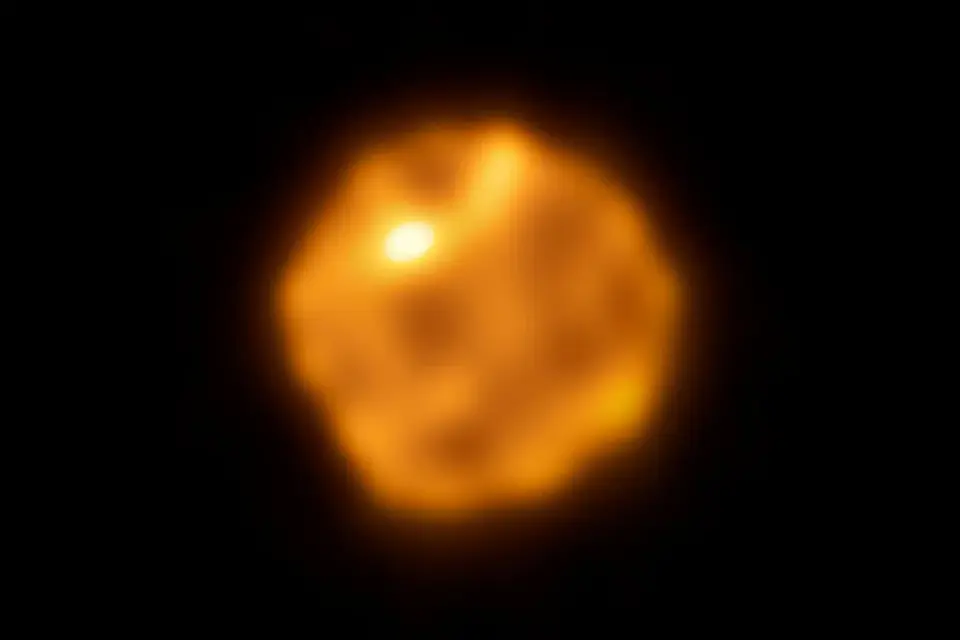
New research suggests that Betelgeuse’s companion star is hidden from Hubble’s ultraviolet view not because it is too faint, but because it is obscured by a dusty wake stirred up as it orbits through the red giant’s extended atmosphere. This explains the discrepancy between ground-based detections and Hubble’s non-detections.
Key points
- Betelgeuse is confirmed to have a companion star, likely weighing a few solar masses, based on European Very Large Telescope (VLT) imaging.
- The Hubble Space Telescope has failed to detect this companion in ultraviolet wavelengths, a result that contradicts expectations for a star of that mass.
- A new study by Jared Goldberg, Meredith Joyce, and collaborators proposes that the companion is hidden by dense clumps of dust it disturbs while moving through Betelgeuse’s low-density outer layers.
- The observed brightness may be reflected light from Betelgeuse bouncing off this dust, rather than direct emission from the companion itself.
- This mechanism allows for a smaller, cooler companion star that would naturally be invisible in ultraviolet light, resolving the observational conflict.
- Future observations will test this theory by looking for polarized light, which would confirm the presence of scattered dust.
Background
Betelgeuse underwent a significant 'great dimming' in 2019, prompting intensified study of the star. In August 2026, astronomers using the VLT captured the clearest image yet of the suspected companion, Betelgeuse B, estimating its mass at 2–3 solar masses. This discovery raised questions about why Hubble had not detected it, leading to the current hypothesis regarding dust interference.
Why it matters
Understanding the true nature of Betelgeuse’s companion is critical for predicting the star’s future evolution and potential supernova. If the companion is smaller and cooler than previously thought, it alters models of how the binary system will interact as Betelgeuse approaches the end of its life. Additionally, resolving this observational discrepancy improves our understanding of how dust and gas dynamics in red giant atmospheres can obscure nearby objects.
What to watch
Astronomers will wait for the companion’s orbit to carry it away from the dusty region surrounding Betelgeuse, making it directly observable again. A key upcoming test involves analyzing the light for polarization, which would confirm whether the observed brightness is due to dust scattering rather than direct stellar emission.
Want the full story? Read the original reporting
Read on BBC Sky at Night Magazine