
Gas Stream from Molecular Cloud Tilts Orion's Triple-Star Disk
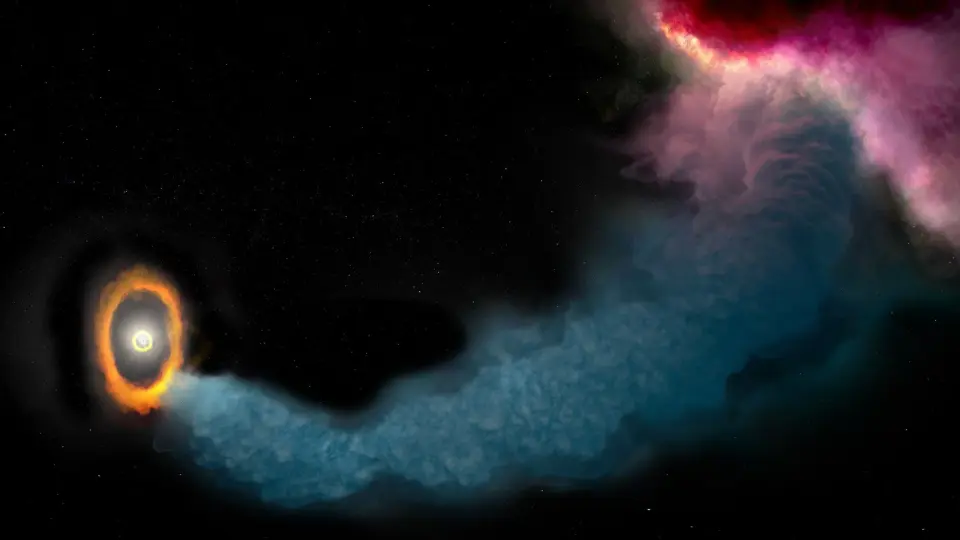
ALMA observations reveal a 1.6 trillion-kilometer gas stream from the surrounding molecular cloud is tilting the outer ring of the GW Orionis protoplanetary disk. This discovery explains the misaligned orbits of the system's rings, challenging previous theories that an unseen planet caused the disturbance and offering a new explanation for misaligned exoplanet systems.
Key points
- The GW Orionis system, located 1,300 light-years away in the Lambda Orionis star-forming ring, consists of three pre-main-sequence stars.
- ALMA detected a massive finger of gas extending from the surrounding molecular cloud into the system's outer protoplanetary ring.
- This gas stream is transferring angular momentum, causing the outer ring to tilt at a different angle than the inner and middle rings.
- The finding resolves a previous mystery where astronomers suspected an unseen gas giant was perturbing the outer ring.
- The discovery provides a potential explanation for why many exoplanet systems exhibit orbits misaligned with their stars' rotational axes.
Background
Recent studies have explored various mechanisms for planetary formation and stability, including the potential for rogue moons to sustain subsurface oceans via tidal heating and the prevalence of free-floating rogue planets in the Milky Way. While these topics address planetary dynamics, the current finding focuses on the early formation stages of protoplanetary disks, specifically how external environmental factors like gas streams can influence orbital alignment before planets fully form.
Why it matters
Understanding the origin of misaligned orbits in young star systems helps astronomers interpret the architecture of mature exoplanet systems. If external gas streams can tilt disks, it suggests that many observed exoplanet misalignments may be remnants of early formation dynamics rather than results of later planetary interactions. This insight refines models of how multi-star systems evolve and how planetary orbits are established.
What to watch
Researchers will likely use ALMA and other telescopes to search for similar gas streams in other young star systems to determine if this mechanism is common. Further studies may analyze how the exchange of angular momentum from these streams affects the long-term stability and evolution of protoplanetary disks.
Want the full story? Read the original reporting
Read on Space