
Hubble and Webb Combine Data to Reveal the Counter-Rotating Structure of Messier 64
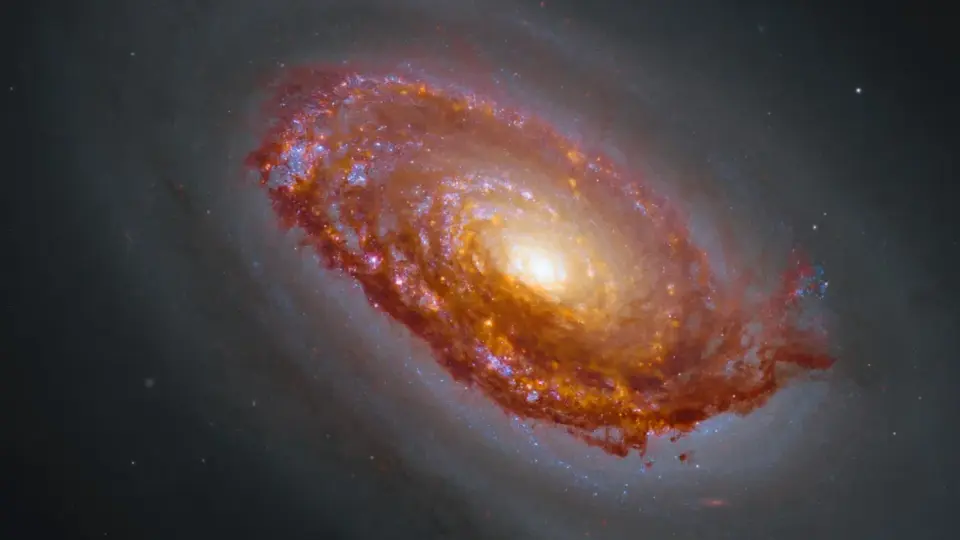
Astronomers have released a new composite image of the 'Black Eye Galaxy' (Messier 64) that merges data from the James Webb Space Telescope (JWST) and the Hubble Space Telescope. The image highlights the galaxy's unusual internal dynamics, specifically the counter-rotation of gas in its outer regions compared to its center. This collaboration demonstrates how different telescopes complement each other to provide a more complete view of celestial objects.
Key points
- Messier 64, also known as the 'Black Eye Galaxy,' is located 17 million light-years away in the constellation Coma Berenices.
- The galaxy was first discovered in 1779 and is characterized by a dark dust lane that gives it its distinctive appearance.
- The new image combines near and mid-infrared observations from JWST with ultraviolet, visible, and near-infrared data from Hubble.
- The composite reveals that the gas in the galaxy's outer reaches rotates in the opposite direction to the gas and stars near its center.
- This counter-rotation creates a unique swirling motion that distinguishes Messier 64 from many other spiral galaxies.
Background
This release follows recent collaborative efforts between Hubble and JWST, such as the identification of the first stellar-mass black hole in the Omega Centauri globular cluster in July 2026. That discovery relied on two decades of Hubble astrometry combined with recent JWST data to track a star's motion around an unseen companion. The current Messier 64 image further illustrates the value of combining these two observatories, as they capture different wavelengths that provide complementary insights into galactic structure and dynamics.
Why it matters
The composite image underscores the importance of multi-wavelength observations in astronomy. By combining data from Hubble and JWST, scientists can better understand complex phenomena like counter-rotation in galaxies, which may indicate past mergers or interactions. This approach also sets the stage for future missions, such as the Nancy Grace Roman Space Telescope, which will benefit from the foundational data provided by current observatories.
What to watch
Astronomers will continue to analyze the combined data from Hubble and JWST to refine our understanding of Messier 64's dynamics. Future observations with the Nancy Grace Roman Space Telescope are expected to provide even more detailed insights into the galaxy's structure and history.
Want the full story? Read the original reporting
Read on Space