
Hubble and Webb Reveal the 'Cat's Head' Nebula in the Carina Complex
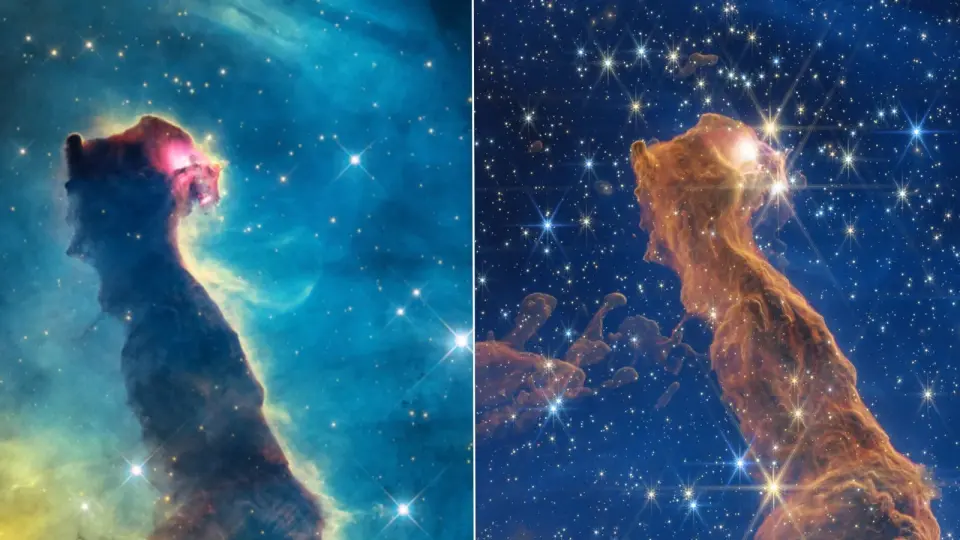
NASA’s James Webb Space Telescope (JWST) and the Hubble Space Telescope have released new images of the Cat’s Head Nebula, a star-forming region within the larger Carina Nebula. Located approximately 7,500 light-years from Earth, the nebula features a distinctive shape resembling a cat’s head, sculpted by intense ultraviolet radiation and stellar winds. While Hubble’s visible-light view shows a dark dust pillar, JWST’s infrared images reveal embedded young stars, including a glowing 'eye' and potential outflows, offering a detailed look at active star formation.
Key points
- The Cat’s Head Nebula is located within the Carina Nebula, about 7,500 light-years from Earth.
- Hubble’s visible-light image shows the nebula as a brown dust pillar with a glowing red 'eye,' likely a young star.
- JWST’s near-infrared and mid-infrared images reveal hidden stars, dust structures, and polycyclic aromatic hydrocarbons (PAHs).
- The nebula’s shape is being eroded by ultraviolet radiation from massive nearby stars, a process known as photoevaporation.
- A faint jet-like feature near the 'cat’s belly' suggests the presence of another young star or outflow.
Background
Recent astronomical coverage has highlighted various nebulae, including the Shark Nebula, which won the 2026 ZWO Astronomy Photographer of the Year. The Carina Nebula, home to the Cat’s Head, is also known for Eta Carinae, a binary star system that experienced a 'Great Eruption' in the 1840s and is monitored for potential supernova activity. The Cat’s Head Nebula is part of this larger, dynamic star-forming region.
How outlets are covering it
Space.com and ESA emphasize the complementary nature of Hubble and JWST observations, with Hubble showing visible-light dust structures and JWST revealing infrared details like embedded stars and molecular emissions. Universe Today focuses on the broader context of the Carina Nebula, noting that the Cat’s Head is actively forming stars while being eroded by radiation from Eta Carinae. All sources agree that the 'cat’s head' shape is temporary and will change as the nebula evolves.
Why it matters
These images provide critical insights into the process of star formation, showing how massive stars sculpt surrounding gas and dust. The combination of visible and infrared data helps astronomers understand the lifecycle of stars and the dynamics of nebular erosion, contributing to our knowledge of how stellar clusters evolve over time.
What to watch
Astronomers will continue to analyze the Cat’s Head Nebula to track the evolution of its embedded stars and the effects of photoevaporation. Future observations may reveal more about the outflows and jets associated with young stars in the region, as well as the long-term impact of Eta Carinae’s radiation on the surrounding nebula.
- Ghostly Cat's Head Nebula haunts the cosmos photo of the day for Oct. 30, 2026 Space
- NASA’s James Webb Space Telescope Captures Eerie Cat’s Head NASA (.gov)
- It's a Ghost! No, It's a Stellar Crèche! Universe Today
- Ghostly Cat’s Head Nebula lurks within sight of Hubble and Webb European Space Agency
- Helpful Cosmic Ghost Brings Stellar Birth, Not Death | Newswise Newswise
Want the full story? Read the original reporting
Read on Space