
Hubble Captures Ancient Globular Cluster M30, Hinting at Milky Way's Accretion History
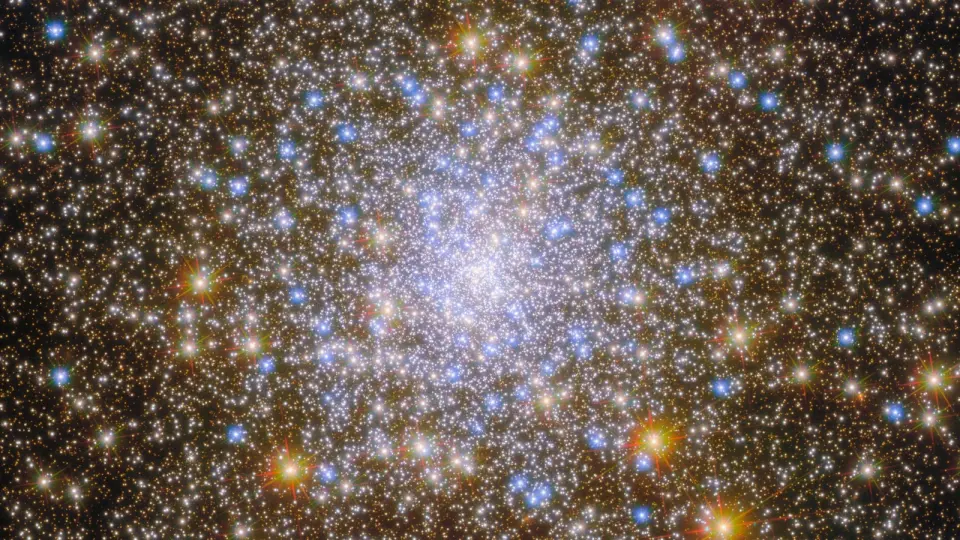
The European Space Agency (ESA) released a new Hubble Space Telescope image of Messier 30 (M30), a globular cluster located 27,500 light-years away in the constellation Capricornus. The image highlights thousands of ancient stars, some estimated to be 11.5 to 13.5 billion years old. Astronomers note that M30 orbits the Milky Way in the opposite direction of the galaxy's rotation, suggesting it may have been captured from another galaxy billions of years ago rather than forming within the Milky Way itself.
Key points
- ESA released a Hubble image of Messier 30 on November 5, 2026, showing a dense, spherical collection of stars in the constellation Capricornus.
- M30 is located approximately 27,500 light-years from Earth and contains stars that are nearly as old as the universe, which is 13.8 billion years old.
- The Milky Way hosts at least 150 such globular clusters, with ages ranging from 11.5 to 13.5 billion years.
- M30 and several other globular clusters orbit the Milky Way in the opposite direction to the galaxy's primary rotation.
- This retrograde motion suggests M30 may have formed outside the Milky Way and was later gravitationally captured by our galaxy.
- Globular clusters serve as 'cosmic time capsules,' preserving chemical clues about the conditions present when they formed, aiding in the reconstruction of the Milky Way's early history.
Background
Recent Hubble and James Webb Space Telescope observations have focused on various celestial phenomena, including the Cat's Head Nebula and a 'Phoenix' planet formed from a dying star's debris. These studies, along with the current M30 release, continue to utilize Hubble data to understand stellar evolution and galactic history. The current image adds to a series of Hubble 'photo of the day' releases in 2026, which have also featured a 'superbubble' and a 'cat's tail' nebula.
Why it matters
Understanding the origins and orbital paths of globular clusters like M30 provides critical insights into the formation and evolution of the Milky Way. The retrograde motion of these clusters suggests a history of galactic mergers and accretion, helping astronomers piece together how our galaxy assembled its components over billions of years. Additionally, the chemical signatures preserved in these ancient stars offer a window into the conditions of the early universe.
What to watch
Astronomers will continue to analyze the chemical compositions and orbital dynamics of globular clusters to refine models of the Milky Way's formation. Further observations may reveal more about the capture history of these clusters and the conditions that existed in the early universe. The Hubble Space Telescope will likely continue to release high-resolution images of such objects, contributing to the broader understanding of galactic evolution.
Want the full story? Read the original reporting
Read on Space