Tag

Esa

All articles tagged with #esa

Cosmic Smile: SMILE Launch Signals China–EU Space Cooperation Era
space6 days ago

Cosmic Smile: SMILE Launch Signals China–EU Space Cooperation Era

The Vega-C rocket successfully launched the SMILE satellite, a joint China–ESA mission led by the Chinese Academy of Sciences and ESA, featuring a new Soft X-ray Imager to study how the solar wind interacts with Earth's magnetosphere. The mission marks the first mission-level China–Europe space-science collaboration, with coordinated ground control and plans for future joint initiatives like the CATCH microsatellite constellation.

Vega C Delivers EU–China SMILE Space Weather Satellite Into Orbit
space-exploration7 days ago

Vega C Delivers EU–China SMILE Space Weather Satellite Into Orbit

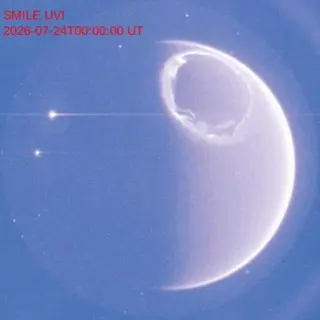
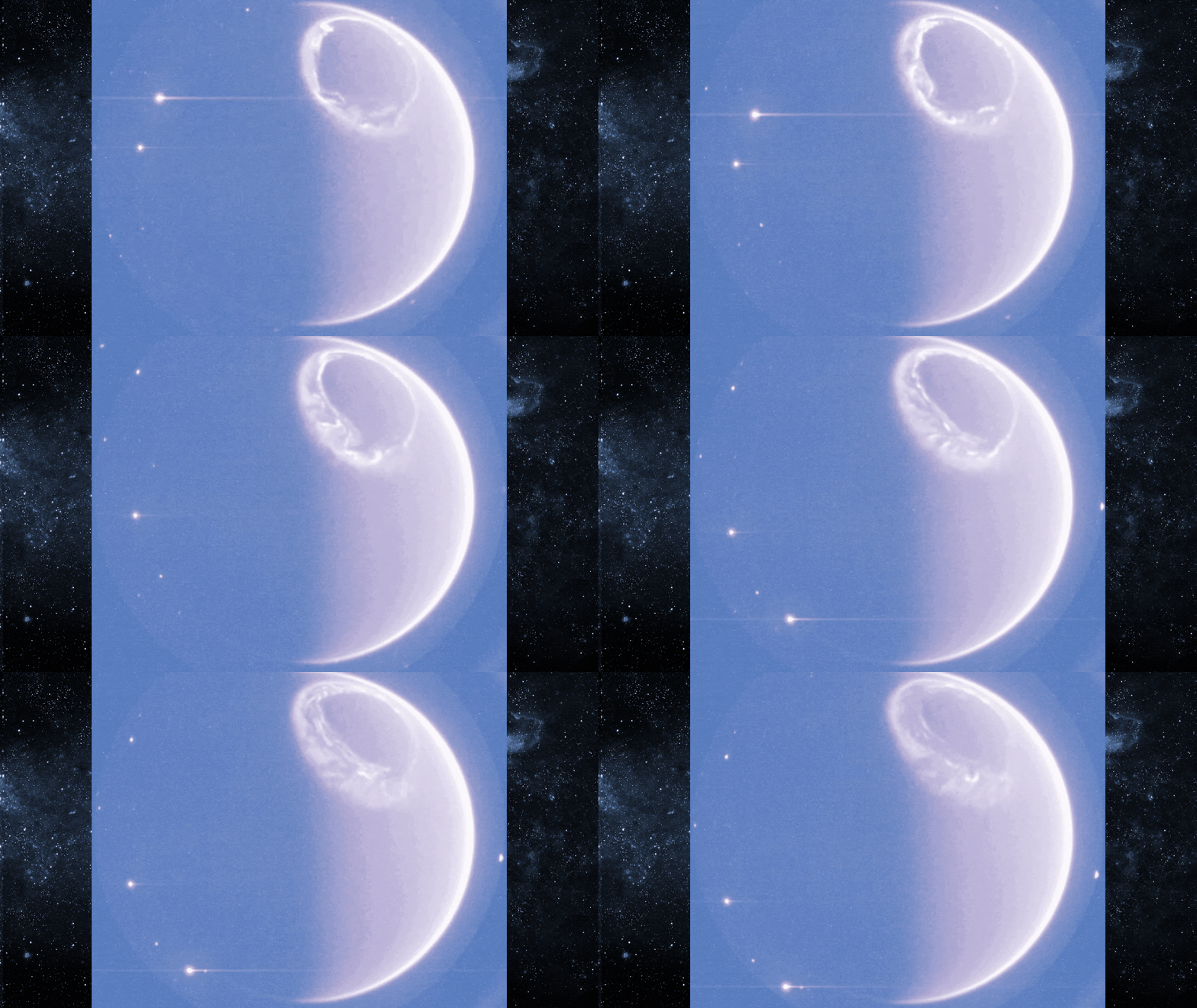
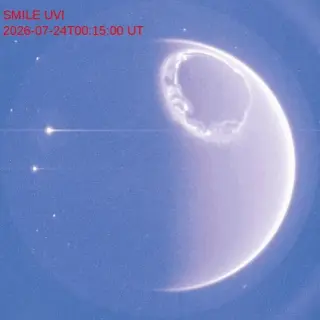
A European-Chinese space weather mission SMILE (Solar wind Magnetosphere Ionosphere Link Explorer) launched on May 18 atop a Vega C rocket from Kourou, deploying into a 707 km circular orbit about 56 minutes after liftoff. Over the next ~25 days SMILE will perform 11 engine burns to place the spacecraft into a highly elliptical orbit up to roughly 121,000 km above the North Pole and 5,000 km above the South Pole. SMILE’s four instruments (UVI, LIA, MAG on the platform and SXI on the payload) will study how the solar wind affects Earth’s magnetosphere to improve understanding of solar storms and space weather. The Chinese Academy of Sciences leads the satellite platform and three instruments, while ESA provides the payload module and will assist with orbit operations. The mission is planned for three years. Vega C, ESA’s 115-foot-tall rocket debuting in 2022, now has seven flights; Avio operates this first Vega C mission.

Dragon cargo ship arrives at the ISS with new science payloads
space-exploration8 days ago

Dragon cargo ship arrives at the ISS with new science payloads

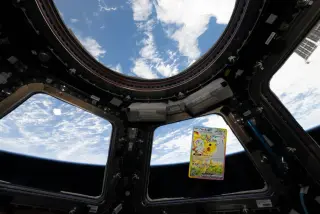
SpaceX's CRS-34 Dragon cargo capsule docked autonomously at the International Space Station’s Harmony module at 6:37 a.m. EDT, carrying about 6,500 pounds of cargo and science experiments, including bone scaffolding research for osteoporosis, Earth-mimicking microgravity studies, red blood cell and spleen research, a charged-particle instrument to study near‑Earth space, and a device to measure sunlight reflected by Earth and the Moon. NASA astronaut Jack Hathaway and ESA astronaut Sophie Adenot watched from the Cupola as the crew prepares to unpack the science and supplies over the coming weeks and then return results, equipment and waste to Earth in mid‑June.

Tiny Mars Capsule Tests Big Mars Mission: ESA Validates ExoMars EDLM
space14 days ago

Tiny Mars Capsule Tests Big Mars Mission: ESA Validates ExoMars EDLM

ESA used 20 three‑inch micro‑capsules fired from a bore gun at about 2,600 mph to simulate entering Mars’ atmosphere. Despite their toy-like size, the capsules withstood up to ~17,000 g’s and collected data on acceleration, trajectory and stability to validate the Entry, Descent and Landing Module (EDLM) that will carry the Rosalind Franklin rover to Mars in 2028.

ESA and JAXA Seal Ramses Collaboration to Study Apophis Before the 2029 Flyby
space15 days ago

ESA and JAXA Seal Ramses Collaboration to Study Apophis Before the 2029 Flyby

The European Space Agency and the Japan Aerospace Exploration Agency have formalized a Ramses collaboration to study asteroid Apophis during its 2029 Earth flyby: Ramses is set to launch in 2028 on an H3 rocket, with JAXA supplying solar arrays and a thermal infrared imager and OHB Italia as prime contractor. The mission would reach Apophis in February 2029, about two months before its close approach to Earth at roughly 32,000 kilometers, enabling detailed observations of the asteroid’s surface and the flyby’s gravitational effects for science and planetary defense insights.

ESA and JAXA Unite on Ramses: A Historic Mission to Study Apophis and Boost Planetary Defense
space16 days ago

ESA and JAXA Unite on Ramses: A Historic Mission to Study Apophis and Boost Planetary Defense

ESA and JAXA signed an agreement to launch the Ramses mission to the near-Earth asteroid Apophis, with a planned 2028 launch and a 2029 rendezvous during its close Earth flyby at about 32,000 km. The mission aims to study how Apophis behaves under Earth's gravity and to collect data that could improve asteroid deflection and monitoring strategies, informing future planetary-defense efforts. ESA will lead spacecraft design and operations, JAXA will contribute lightweight solar arrays and an infrared imager, and ESA’s NEO Coordination Centre will refine orbital predictions ahead of the flyby. This collaboration showcases international partnership as a cornerstone of global space safety.”,

Space Rider inches closer to first flight with heat tests and drop studies
space19 days ago

Space Rider inches closer to first flight with heat tests and drop studies

ESA’s Space Rider, Europe’s first reusable orbital vehicle, is moving toward its first flight after validating its thermal protection system in a plasma wind tunnel at about 1,600 C and building a full‑size drop test model to practice a precise runway-style landing with a steerable parafoil. The helicopter drop tests planned over Sardinia will simulate the final descent phase and assess debris damage resilience, marking a shift from component tests to mission-level simulation as Europe gears up for unmanned microgravity experiments in low Earth orbit before returning payloads to Earth.

ESA Responds to NASA on Gateway Module Corrosion
space1 month ago

ESA Responds to NASA on Gateway Module Corrosion

ESA has clarified the status of the HALO and I-HAB modules delivered for NASA's Gateway, confirming HALO arrived at Northrop Grumman with corrosion signs and that I-HAB has a similar issue but has not yet shipped. An ESA spokesperson said the corrosion likely stems from forging, surface treatment, and material properties and is technically manageable, not a showstopper. ESA also noted other Gateway components, such as the life-support system and thermal control pump, are experiencing delays, and while NASA is exploring repurposing Gateway elements for a future surface base, the schedule impact remains unresolved.

Smile mission set for May 19 launch to map Earth's response to solar wind
science-and-exploration1 month ago

Smile mission set for May 19 launch to map Earth's response to solar wind

The European-Chinese Smile mission, a joint ESA-CAS project to study how Earth reacts to solar wind using an X-ray camera for magnetosphere observations and a UV imager for auroras, is rescheduled to launch on May 19, 2026, aboard a European Vega-C rocket from Europe’s Spaceport in French Guiana after a precautionary delay due to a Vega-C subsystem issue. The launch time is 05:52 CEST / 04:52 BST / 00:52 local, with Smile released after about 57 minutes into a low-Earth orbit and solar panels unfolding around 63 minutes after liftoff, before entering an elongated orbit peaking about 121,000 km above the North Pole and extending to roughly 5,000 km above the South Pole to deliver data to ground stations. The mission aims to shed light on space weather, solar storms and geomagnetic processes through its four instruments, as ESA and CAS collaborate on this Solar wind Magnetosphere Ionosphere Link Explorer.

Apophis: Naked-eye near-Earth visitor set for a historic 2029 pass
science1 month ago

Apophis: Naked-eye near-Earth visitor set for a historic 2029 pass

NASA says the 1,230-foot asteroid Apophis, nicknamed the God of chaos, will skim past Earth in 2029 at about 20,000 miles (roughly 32,000 kilometers) away — closer than many satellites and potentially visible to the naked eye in the Eastern Hemisphere if weather cooperates. There is no risk to Earth, and radar observations have ruled out impact for at least a century. ESA plans to deploy the Rapid Apophis Mission to study its gravity-induced effects, and Apophis will return in 2036 at a much safer distance.

Falcon Heavy chosen to launch ESA's Rosalind Franklin Mars rover amid NASA budget fight
civil1 month ago

Falcon Heavy chosen to launch ESA's Rosalind Franklin Mars rover amid NASA budget fight

NASA has tapped SpaceX’s Falcon Heavy to launch Europe’s Rosalind Franklin Mars rover under the ROSA program, with NASA supplying braking engines for the descent stage and RHUs, plus rover electronics and a mass spectrometer. The late-2028 mission is backed by a $175.7 million launch contract, even as NASA’s proposed 2027 budget seeks to cancel ROSA and faces broader pressure over planetary-science funding amid strong congressional opposition.

Apophis to skim Earth in 2029, unlocking new asteroid science
space1 month ago

Apophis to skim Earth in 2029, unlocking new asteroid science

Earth’s giant near-Earth asteroid Apophis, about a quarter-mile long, will pass within about 20,000 miles of Earth on April 13, 2029—the closest approach of a large known asteroid—offering a rare chance to study its surface and motion as NASA and ESA prepare dedicated observations (OSIRIS-APEX and Ramses) while the initial risk of impact has been ruled out for at least a century.