
Hubble Captures Dusty Edge of Spiral Galaxy NGC 1827
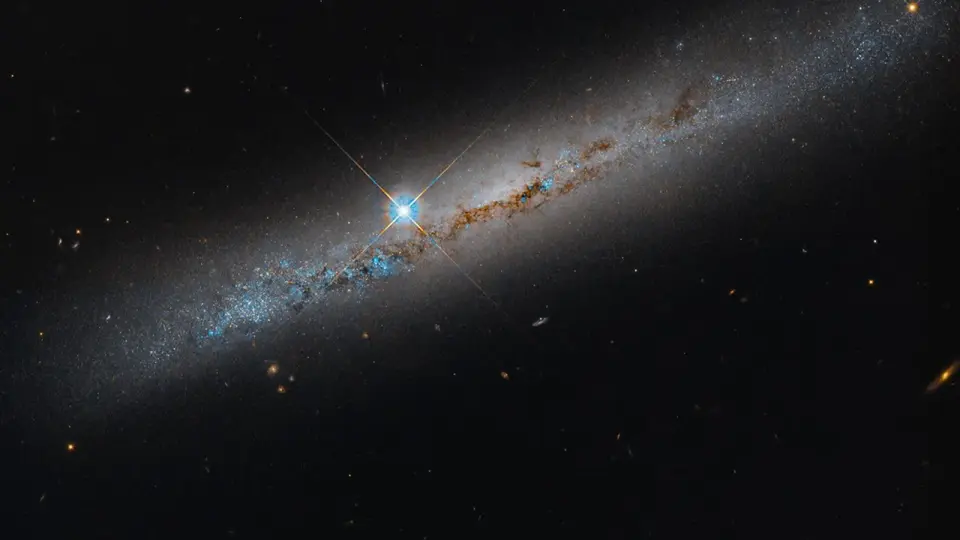
NASA’s Hubble Space Telescope has released a new edge-on image of the spiral galaxy NGC 1827, located 37 million light-years away in the constellation Columba. The image, captured by the Advanced Camera for Surveys, highlights dark dust lanes and blue star-forming regions. This observation is part of a broader survey of 260 low-mass satellite galaxies orbiting Milky Way-like hosts, aiming to refine cosmological models. Hubble has already observed 111 of the target galaxies, with 149 remaining. A bright foreground star in the image is a diffraction artifact, not part of the galaxy.
Key points
- Hubble’s Advanced Camera for Surveys captured an edge-on view of NGC 1827, an intermediate spiral galaxy 37 million light-years away.
- The image reveals dark dust lanes and bright blue regions indicating active star formation within the galaxy’s disk.
- The observation is part of a survey of 260 satellite galaxies around 22 Milky Way-like host galaxies within 32 million light-years of Earth.
- Hubble has observed 111 of the 260 target galaxies; the remaining 149 require one orbit each to complete.
- A bright star with four diffraction spikes in the image is a foreground object in the Milky Way, not part of NGC 1827.
Background
This release follows recent Hubble imagery of other spiral galaxies, such as the Triangulum Galaxy (M33) and the Whirlpool Galaxy (M51), which have been featured in recent astronomy coverage. These images help astronomers understand galaxy structure and evolution, particularly in the context of the Local Group and larger cosmic scales.
How outlets are covering it
Space.com emphasizes the visual beauty of NGC 1827’s edge, noting its 'sparkling' appearance and the distinction between barred and unbarred spirals. NASA Science focuses on the scientific utility of the survey, highlighting how low-mass galaxies test cosmological models. Sci.News provides historical context, noting NGC 1827 was discovered by John Herschel in 1837. PTTL.gr clarifies that the bright star with diffraction spikes is a foreground object, not part of the galaxy, and distinguishes the 37-million-light-year distance of NGC 1827 from the 32-million-light-year radius of the survey area.
Why it matters
This image contributes to a larger effort to understand the properties of low-mass galaxies, which are difficult to observe and test the predictions of cosmological models. By studying satellite galaxies around Milky Way-like hosts, astronomers can refine models of galaxy formation and evolution, improving our understanding of the universe’s structure.
What to watch
Hubble will continue observing the remaining 149 satellite galaxies in the survey, requiring one orbit per galaxy. The data will be used to refine cosmological models and better characterize low-mass galaxies in Milky Way-like systems.
- The view from the edge of a sparkling spiral galaxy photo of the day for Oct. 20, 2026 Space
- NASA’s Hubble Spies Spiral’s Edge NASA Science (.gov)
- Hubble Space Telescope Spots Dusty Spiral Galaxy: NGC 1827 Sci.News
- Hubble captures the edge of a galaxy and reveals what lies in its dust PTTL.gr
- Hubble photographs spiral galaxy NGC 1827 Mezha.net
Want the full story? Read the original reporting
Read on Space