
Archival Hubble Data Reveals First Stellar Stream Beyond Milky Way, Offering New Dark Matter Tool
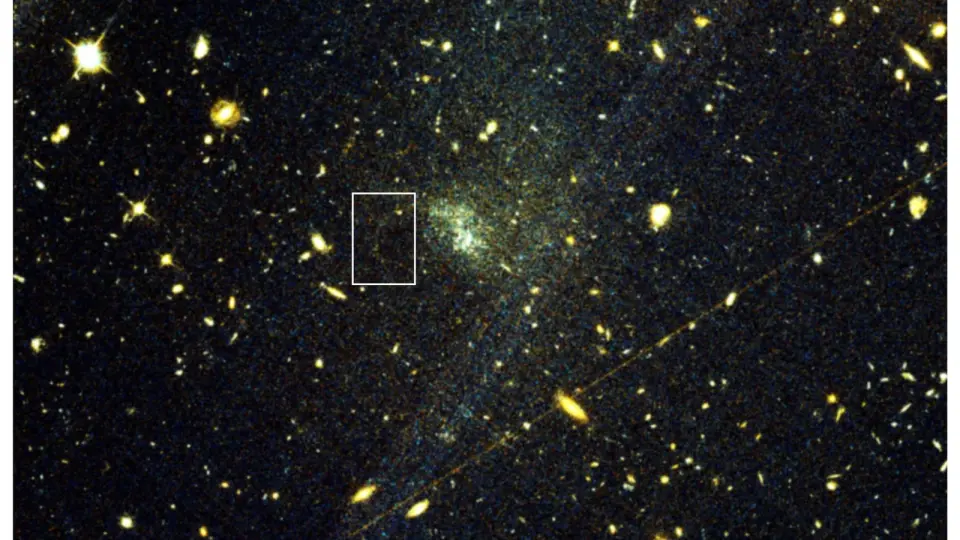
Astronomers have identified the first stellar stream from a globular cluster outside the Milky Way, using archival Hubble Space Telescope data. The faint structure, named Oyasio, was spotted in the ultra-diffuse galaxy UGC 9050-Dw1, located 115 million light-years away. This discovery provides a new method to measure dark matter distribution in distant galaxies by analyzing how gravity shapes these star trails.
Key points
- David Hendel discovered the faint stellar stream in June 2023 while reviewing a paper on a train in New York City.
- The stream, named Oyasio, extends over 3,000 light-years from a globular cluster in the ultra-diffuse galaxy UGC 9050-Dw1.
- The finding was confirmed using archival data from both the Hubble Space Telescope and the Canada-France-Hawaii Telescope.
- Researchers used thousands of computer simulations to model the stream's shape and estimate the galaxy's total mass and dark matter content.
- The discovery, published in Nature on August 12, 2026, offers a new tool to study dark matter beyond the Milky Way.
Background
This discovery builds on previous findings that stellar streams in the Milky Way can reveal dark matter distribution. Earlier coverage noted the Vera C. Rubin Observatory and NASA's Nancy Grace Roman Space Telescope as future tools for mapping dark matter and detecting similar structures. The Roman Space Telescope, launching in August 2026, has a field of view 100 times larger than Hubble's, promising to find more such streams.
How outlets are covering it
Space.com emphasizes the serendipitous nature of the discovery by David Hendel and its potential to reveal dark matter's secrets. Universe Today highlights the team led by Julie Kiel Holm and Sarah Pearson, noting the galaxy's 'disturbed' nature and the implications for studying ultra-diffuse galaxies. Science Daily focuses on the methodological breakthrough, explaining how the stream's shape allows researchers to reconstruct the galaxy's gravitational field and estimate dark matter. UA.News provides a concise summary, noting the team's caution that alternative explanations, such as chance star arrangements, cannot be fully ruled out.
Why it matters
This discovery provides a new, practical method to measure dark matter in galaxies beyond the Milky Way. By analyzing stellar streams, astronomers can infer the gravitational influence of dark matter, helping to understand its distribution and behavior across the universe. Future telescopes like the Roman Space Telescope may detect many more such streams, significantly advancing our understanding of dark matter.
What to watch
Astronomers plan to search for similar stellar streams in other galaxies using new telescopes like the European Space Agency's Euclid mission and NASA's Nancy Grace Roman Space Telescope. These instruments will survey larger areas of the sky, increasing the likelihood of detecting more streams and providing a broader understanding of dark matter distribution.
- Chance gaze at old Hubble Telescope image leads to discovery that could reveal dark matter's secrets Space
- A Distant Stream of Stars May Offer New Clues to Dark Matter Universe Today
- A ghostly ribbon of stars reveals hidden dark matter Science Daily
- Star stream beyond the Milky Way found in Hubble archival data UA.NEWS
- Breakthrough in a Bizarre Galaxy Could Help Unlock the Mystery of Dark Matter SciTechDaily
Want the full story? Read the original reporting
Read on Space