
Astronomers Confirm First Three-Lobed Asteroid, Challenging Standard Formation Models
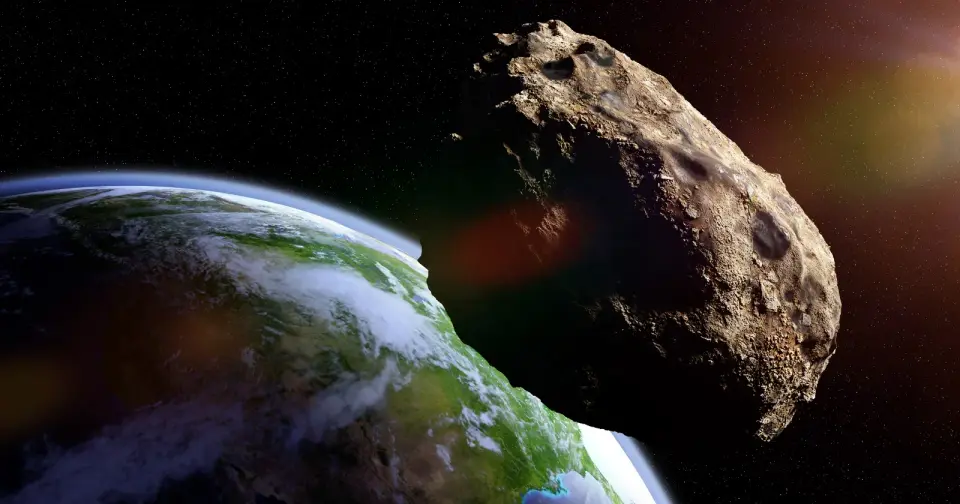
Astronomers have identified asteroid (44) Nysa as the first known three-lobed body in the main belt, breaking the long-standing pattern of two-lobed contact binaries. New high-resolution ground-based imaging also revealed a previously unknown moon orbiting the asteroid. This discovery challenges existing models of asteroid formation and highlights the limitations of previous observational data.
Key points
- Asteroid (44) Nysa, a 75-kilometre body in the main belt, has been confirmed to have three connected lobes instead of the typical two found in other 'necked' asteroids like Itokawa and Kleopatra.
- The discovery was made using adaptive optics on the Large Binocular Telescope in Arizona and the Very Large Telescope in Chile, achieving resolution comparable to spacecraft imaging from over 200 million kilometres away.
- The team also discovered a small moon, designated S/2026 (44) 1, roughly one kilometre across, orbiting Nysa at a distance of at least 170 kilometres.
- Two competing theories exist for Nysa's shape: it may be a contact trinary formed by low-speed re-accumulation of fragments, or the remnant of a larger body reshaped by a high-speed glancing collision.
- The finding suggests that previous light-curve data may have missed subtle structural features in other well-studied asteroids due to insufficient resolution.
Background
Previous coverage in July and August 2026 established that Nysa is the first triple-lobed asteroid identified in the main belt, with its moon S/2026 (44) 1 orbiting approximately 106 miles away. Earlier reports noted that Nysa is an enstatite rock roughly 47 miles wide, located about 27 million miles from Earth, and emphasized that its unusual shape could provide insights into solar system formation 4.5 billion years ago. While some earlier reports mentioned potential planetary defense implications, the primary focus remained on the structural anomaly and its implications for understanding early solar system dynamics.
Why it matters
The discovery of a three-lobed asteroid challenges the prevailing assumption that contact binaries naturally form with only two lobes. This finding necessitates a re-evaluation of formation models for small bodies in the solar system and suggests that other known asteroids may have hidden structural complexities that were previously unresolved due to instrument limitations. Additionally, the detection of a new moon around a well-studied object underscores the potential for undiscovered features in the solar system, impacting our understanding of planetary formation and the early history of the solar system.
What to watch
Researchers will likely re-examine other apparently two-lobed asteroids using improved ground-based imaging to check for hidden second necks. Further study of Nysa's moon, S/2026 (44) 1, will help determine the asteroid's mass and density, providing crucial data to distinguish between the competing formation theories. This could lead to a broader re-assessment of asteroid shapes and formation processes in the main belt.
Want the full story? Read the original reporting
Read on Space Daily