
Stellar Spin May Explain Why Repeating Black Hole Flares Dim
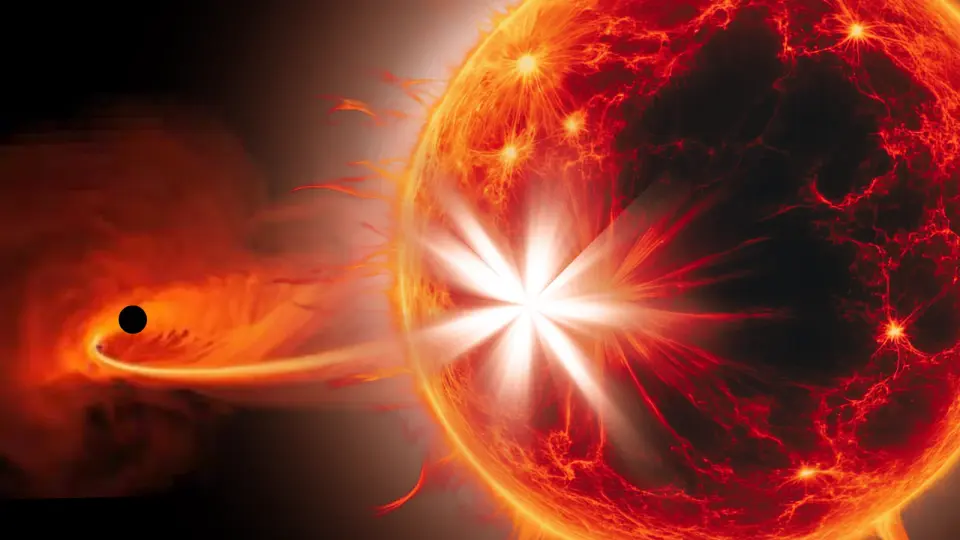
Researchers from Syracuse University have identified a potential reason why repeated flares from stars partially consumed by supermassive black holes grow dimmer over time. The study suggests that the spin of the star and the presence of a binary partner play a crucial role in these 'repeating partial tidal disruption events' (rpTDEs), offering a new explanation for a long-standing observational puzzle.
Key points
- Some stars survive close encounters with supermassive black holes, losing material in repeated 'bites' rather than being fully destroyed in a single tidal disruption event (TDE).
- These events, known as repeating partial tidal disruption events (rpTDEs), produce flares of light, but observations show that successive flares often become dimmer.
- A team from Syracuse University proposes that the spin of the star and the dynamics of a binary partner are key factors in this dimming effect.
- The research suggests that an escaping binary partner may leave the star more vulnerable to being stripped by the black hole, influencing the intensity of subsequent flares.
- This finding helps explain why not all rpTDEs follow the same pattern, resolving a puzzle that had puzzled scientists for approximately two years.
Background
This development builds on recent advancements in understanding the interactions between stars and supermassive black holes. Earlier this year, astronomers confirmed the first optical tidal disruption event at the edge of a galaxy, involving a wandering black hole, and identified star S301, which orbits the Milky Way's central black hole, Sagittarius A*, at extreme speeds. These discoveries have enhanced the ability to test general relativity and measure black hole properties, such as spin, in extreme gravitational fields. The current research adds a new dimension to this understanding by focusing on the long-term behavior of stars that survive partial disruption.
Why it matters
Understanding the mechanics of repeating partial tidal disruption events provides critical insights into the physics of accretion and the behavior of stars in the extreme gravitational environments near supermassive black holes. This knowledge helps astronomers better interpret observational data from distant galaxies, refine models of black hole growth, and potentially identify new methods for detecting and studying these cosmic phenomena. The resolution of this dimming puzzle also contributes to a more comprehensive understanding of stellar lifecycles in the vicinity of galactic centers.
What to watch
Future research will likely focus on verifying the role of stellar spin and binary dynamics in rpTDEs through more detailed observations and simulations. Astronomers may also use this framework to analyze existing data from other rpTDEs to see if the proposed mechanism holds across different systems. Additionally, continued monitoring of stars like S301 and other candidates near supermassive black holes could provide further tests of general relativity and black hole properties, potentially leading to new discoveries about the nature of spacetime and gravity.
Want the full story? Read the original reporting
Read on Space