
Sub-Neptune GJ 3090 b orbits in reverse, challenging standard planetary formation models
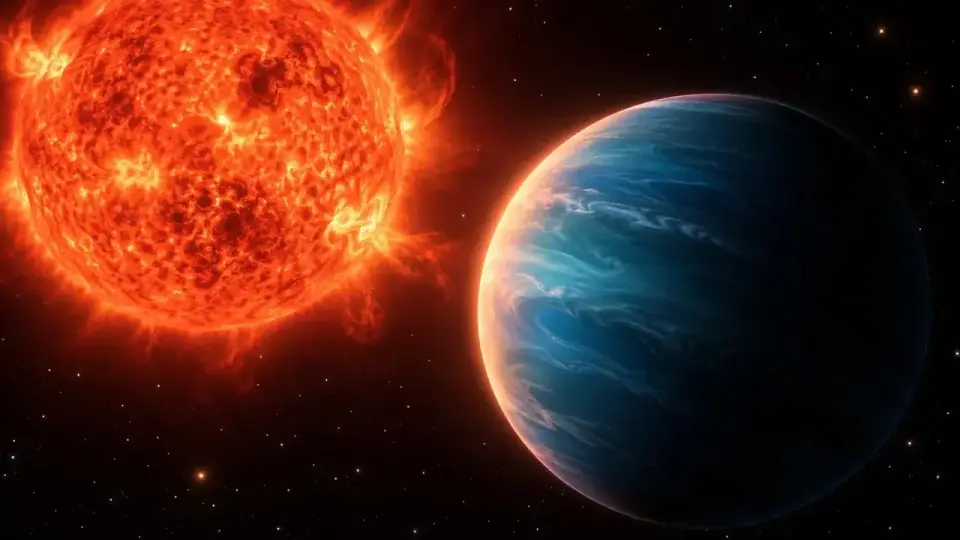
Astronomers have identified GJ 3090 b, a sub-Neptune located 73 light-years from Earth, that orbits its red dwarf star in the opposite direction to the star's rotation. This retrograde motion defies standard planetary formation theories, which predict planets should orbit in the same direction as their host star's spin. The discovery, published in Astronomy & Astrophysics, highlights ongoing mysteries in exoplanet dynamics, as current gravitational models within the system cannot fully explain the planet's misaligned orbit.
Key points
- GJ 3090 b is a sub-Neptune with a radius 2.2 times that of Earth and a mass 4.5 times Earth's, orbiting an M-type red dwarf star.
- The planet is located 73 light-years from Earth and orbits its star in a retrograde direction, opposite to the star's rotation.
- The discovery was confirmed using the radial velocity method via the NIRPS spectrograph at La Silla Observatory, Chile, complementing initial transit data from NASA's TESS.
- Standard planetary formation models predict planets should orbit in the same direction as their star's spin, making GJ 3090 b's behavior anomalous.
- Researchers from the University of Geneva suggest the star may have accreted a secondary, misaligned disk, though other planets in the system are too small to have caused the misalignment gravitationally.
Background
This finding follows recent discoveries of other exoplanets that challenge conventional models, such as the dense mega-Earth GJ 523b, which defies expectations regarding atmospheric retention and core formation. While the Pluto debate focused on classification, GJ 3090 b raises questions about the physical mechanisms that shape planetary orbits in multi-planet systems.
How outlets are covering it
Futura-Sciences and Inshorts both emphasize the anomaly of GJ 3090 b's retrograde orbit and its implications for planetary formation theories. Futura-Sciences provides detailed context on the detection methods (TESS and NIRPS) and quotes Vincent Bourrier from the University of Geneva regarding the possibility of a secondary accretion disk. Space.com's coverage was obscured by site navigation elements, but its title aligns with the core finding of the planet orbiting in the 'wrong direction.' All sources agree that the current gravitational influence of other planets in the GJ 3090 system is insufficient to explain the misalignment, leaving the cause unresolved.
Why it matters
Understanding why some exoplanets orbit in retrograde directions is crucial for refining models of planetary formation and evolution. GJ 3090 b provides a concrete case study for testing theories about disk accretion and gravitational interactions in multi-planet systems, potentially revealing new mechanisms that have not been observed in our solar system.
What to watch
Astronomers will continue to study GJ 3090 b and similar systems to determine if retrograde orbits are more common than previously thought. Further observations may help identify whether secondary disk accretion or other unobserved gravitational interactions are responsible for these anomalies, potentially leading to updated models of exoplanet formation.
- Astronomers stunned: this distant planet’s bizarre rotation defies all logic Futura, le média qui explore le monde
- Scientists find weird exoplanet that orbits its star in the wrong direction Space
- Neptune-Sized Exoplanet Mysteriously Orbits Its Star Backward, Raising Questions About Planetary Formation Discover Magazine
- First ‘backwards’ planet discovered around a small star challenges ideas about how planets form Queen Mary University of London
- Astronomers find exoplanet orbiting in opposite direction of its star | The angle Psi for GJ 3090 b is about 136 degrees | Inshorts Inshorts
Want the full story? Read the original reporting
Read on Futura, le média qui explore le monde