Tag

Exoplanets

All articles tagged with #exoplanets

Targeting nearby red dwarfs could guide a real 'Hail Mary' interstellar mission
space14 days ago

Targeting nearby red dwarfs could guide a real 'Hail Mary' interstellar mission

A new study in Monthly Notices of the Royal Astronomical Society narrows 45 exoplanets most likely to host life and argues that focusing on smaller, cooler red dwarfs increases the chance of finding habitable worlds. It highlights TRAPPIST-1 and Proxima Centauri as compelling nearby targets (the latter only 4.25 light-years away; the former with seven rocky planets in its habitable zone), while TOI-715 sits farther at about 139 light-years. The researchers also note 24 “planets on the edge” whose potential for life may not require Earthlike liquid water. Tau Ceti is unlikely to host habitable planets, but the study’s framework suggests where to send a hypothetical interstellar probe, echoing themes from Project Hail Mary and encouraging creative search strategies.

WISPIT 2: A Young Solar System Taking Shape
space14 days ago

WISPIT 2: A Young Solar System Taking Shape

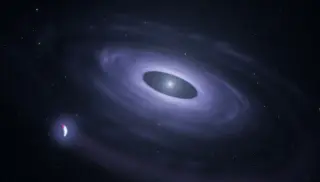
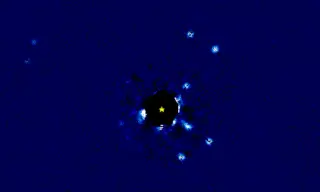
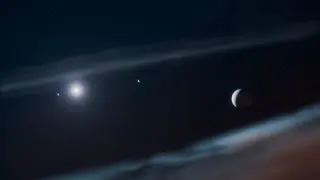
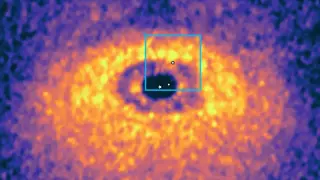
Astronomers directly observed two planets forming around the very young star WISPIT 2, about 437 light-years away. A distant giant, WISPIT 2b, sits at 57 AU with ~5 Jupiter masses, while a closer planet, WISPIT 2c, lies at 14 AU with 8–12 Jupiter masses. The system’s disk shows multiple rings and gaps, hinting at a possible third planet and offering a rare glimpse into how our Solar System may have formed; future imaging with the Extremely Large Telescope could reveal more.

Budding planets around a newborn star reveal early solar-system formation
space17 days ago

Budding planets around a newborn star reveal early solar-system formation

Astronomers studying the young star WISPIT 2, located about 437 light-years away and ~5.4 million years old, have directly detected two forming planets—WISPIT 2b and WISPIT 2c—in the star’s surrounding protoplanetary disk, carving gaps as they grow. Hints of a third planet farther out have researchers hopeful, and the system offers a rare look at how solar systems like our own form; observations via the VLT (with SPHERE and GRAVITY+ upgrades) suggest future clues may be revealed by the ELT.

Ancient lava world TOI-561 b cloaked in a surprising thick atmosphere
space20 days ago

Ancient lava world TOI-561 b cloaked in a surprising thick atmosphere

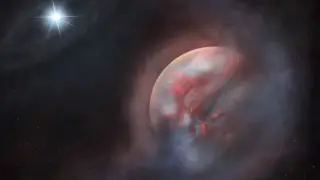
NASA’s James Webb Space Telescope detected signs of a relatively thick atmosphere around TOI-561 b, an ultra-hot, short-period rocky planet likely with a magma ocean. The planet’s dayside is cooler than a bare rock would be, indicating heat is redistributed by a volatile-rich atmosphere—potentially with water vapor and silicate clouds—challenging expectations that such extreme worlds would lose their atmospheres. The atmosphere may also help explain TOI-561 b’s lower-than-expected density, suggesting a recycling system between the magma ocean and the atmosphere and classifying the world as a “wet lava world.”

Astronomers map 45 rocky exoplanets as prime targets in the search for habitable worlds
science21 days ago

Astronomers map 45 rocky exoplanets as prime targets in the search for habitable worlds

Researchers using Gaia data and the NASA Exoplanet Archive identify 45 rocky exoplanets in the habitable zone (plus 24 near-edge worlds) that could sustain Earth-like conditions, spotlighting planets such as Proxima Centauri b and TRAPPIST-1 d–g. The list should guide observations with JWST, the Roman Space Telescope, ELT, LIFE and other missions to study atmospheres, test habitability limits, and refine the definition of the habitable zone.

Hunting Exotic Trojans Around Pulsars Could Rewrite Cosmic Orbits
space21 days ago

Hunting Exotic Trojans Around Pulsars Could Rewrite Cosmic Orbits

Astronomers are chasing exotrojans—hypothetical bodies that could orbit pulsars at Lagrange points—by cross-checking optical light curves with pulsar radio timing and analyzing NANOGrav data; so far no conclusive detections, two signals were false positives, and no object bigger than Earth has been found in seven systems, though one showed hints of a body up to eight Jupiter masses, leaving the search open for future data.

Astronomers Catch a Planetary Collision in Action, Leaving a Hot Debris Glow
space23 days ago

Astronomers Catch a Planetary Collision in Action, Leaving a Hot Debris Glow

Astronomers studying Gaia20ehk (Gaia-GIC-1) observed a star whose visible light dimmed while infrared emission surged, consistent with a hot debris cloud from a recent collision between two planetesimals about 1.1 AU from the star, roughly 11,000 light-years away. The infrared glow persisted for years, offering a rare live glimpse into rocky-planet formation; future monitoring with JWST and the Rubin Observatory could reveal more such impacts.

New exoplanet L 98-59 d unveils sulfurous magma oceans
space-exploration24 days ago

New exoplanet L 98-59 d unveils sulfurous magma oceans

Scientists using the James Webb Space Telescope and ground facilities have identified L 98-59 d as a new exoplanet with a sulfur-rich atmosphere and a semi-molten magma-ocean interior, a world that is unusually low in density for its size and unlike previously known rocky or watery planets. The study, published in Nature Astronomy, suggests a broader diversity of planet types and raises questions about other exotic, pungent planets, though the conditions are unlikely to support Earth-like life.

JWST uncovers a sulfur-rich lava-ocean exoplanet, redefining planet types
astronomy25 days ago

JWST uncovers a sulfur-rich lava-ocean exoplanet, redefining planet types

Space-based and ground observations reveal L 98-59 d as a 1.6× Earth's size exoplanet with a global magma ocean and a sulfur-rich atmosphere likely dominated by hydrogen sulfide and sulfur dioxide, suggesting it formed from a larger sub-Neptune and cooled over billions of years. This lava-world represents a new class of planets and highlights the surprising diversity of worlds beyond our solar system.

New Yardstick for Life: Complexity Over Signatures in Exoplanet Atmospheres
space25 days ago

New Yardstick for Life: Complexity Over Signatures in Exoplanet Atmospheres

Astrobiologists propose Assembly Theory as an Earth-agnostic metric for detecting life on exoplanets, evaluating how hard molecules are to assemble rather than simply listing atmospheric species. A high assembly index and interconnected chemistry would signal life, avoiding many Earth-centric false positives. Comparing Earth, Venus, and Mars shows Earth as the most chemically diverse, and the method would yield a continuous life-likelihood score obtainable from infrared spectra, compatible with NASA’s Habitable Worlds Observatory.

Earth-sized planet in a 355-day orbit emerges as top life-search candidate
science27 days ago

Earth-sized planet in a 355-day orbit emerges as top life-search candidate

Astronomers have identified HD 137010 b, an Earth-sized world orbiting a nearby K-dwarf in about 355 days. Discovered from a single transit and located 146 light-years away, it sits near the star’s habitable zone and offers a prime opportunity for atmospheric follow-up, though confirmation requires another transit or radial-velocity measurements. Its brightness and proximity make it an especially attractive target for future missions like ESA’s PLATO, potentially guiding the search for life beyond Earth.

NASA’s SPARCS CubeSat Captures First Ultraviolet Images of Common Milky Way Stars
space27 days ago

NASA’s SPARCS CubeSat Captures First Ultraviolet Images of Common Milky Way Stars

NASA's Star-Planet Activity Research CubeSat (SPARCS), launched in January 2026, has delivered the first ultraviolet images of nearby low-mass stars, confirming its UV-sensitive detectors and readiness for science operations. Over about a year it will monitor around 20 stars to study how their flares and UV activity affect orbiting exoplanets, a key step in understanding planetary atmospheres and habitability.