
Chandra Telescope Uncovers 84 'Hypersoft' X-ray Sources Hidden in Galaxies
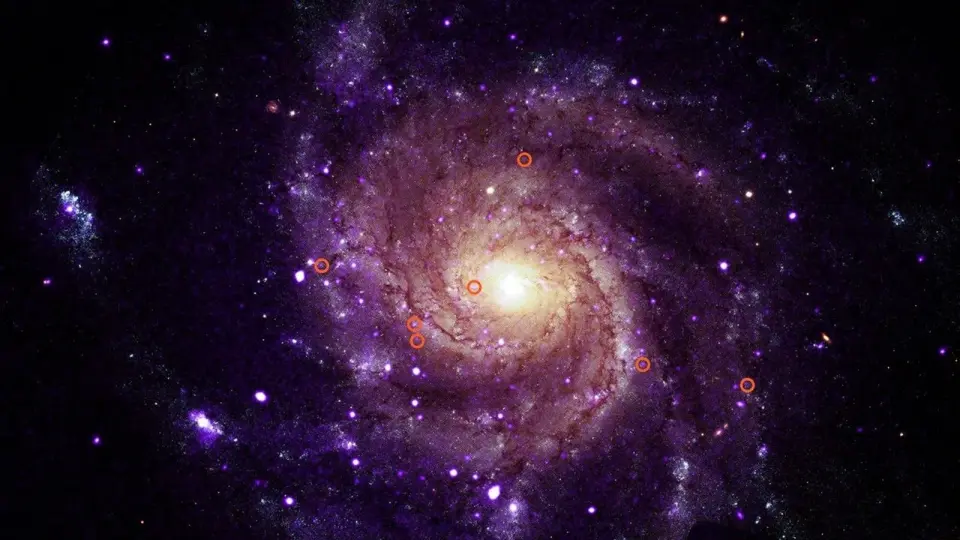
A team of astronomers has identified a new class of celestial objects called 'hypersoft X-ray sources' using data from NASA's Chandra X-ray Observatory. These 84 objects, found in six galaxies including Andromeda and the Pinwheel Galaxy, emit low-energy X-rays and likely peak in the extreme ultraviolet. The discovery, published in Nature Astronomy, suggests these compact binaries may have been overlooked for decades due to observational blind spots and could help explain gas ionization in galaxies lacking active supermassive black holes.
Key points
- NASA's Chandra X-ray Observatory detected 84 new objects emitting low-energy X-rays (below 0.3 keV) in six galaxies, including Andromeda (M31) and the Pinwheel Galaxy (M101).
- The objects, termed 'hypersoft X-ray sources,' are likely compact binaries involving black holes, neutron stars, or white dwarfs accreting gas from companion stars.
- The discovery was made by reanalyzing Chandra data from 1999 to 2017, focusing on low-energy channels previously dismissed as noise.
- The sources likely emit most of their energy in the extreme ultraviolet, which is absorbed by interstellar gas, making them difficult to detect from Earth.
- The findings suggest these objects may play a role in ionizing gas within galaxies, potentially explaining star formation in systems without active galactic nuclei.
Background
This discovery builds on previous efforts to map high-energy phenomena in galaxies. While earlier studies focused on high-energy X-ray binaries, this new class highlights a gap in observational capabilities. The archive notes that understanding cosmic objects often requires overcoming observational challenges, such as debris or absorption, which aligns with the current finding that interstellar hydrogen obscures these ultraviolet emissions.
How outlets are covering it
Space.com emphasizes the novelty of the objects, noting that scientists had never encountered such a group before. Scientific American highlights the historical oversight, explaining that researchers ignored low-energy data channels for decades, treating them as unimportant noise. The Nature Astronomy paper provides the technical framework, defining the sources as a luminous class of non-nuclear X-ray objects with bolometric luminosities near 10^38 erg/s. FreeYork focuses on the specific discovery in the Pinwheel Galaxy, detailing the seven sources found there and the temperature estimates of approximately 230,000 kelvins. While all sources agree on the existence of the objects, they differ in emphasis: Space.com and FreeYork focus on the discovery itself, while Scientific American and Nature Astronomy focus on the implications for galactic physics and the reasons for their prior invisibility.
Why it matters
The identification of hypersoft X-ray sources resolves a long-standing observational blind spot in astrophysics. By revealing that many luminous objects emit primarily in the extreme ultraviolet, the discovery helps explain how gas is ionized in galaxies that lack active supermassive black holes. This could refine models of galaxy evolution and star formation, as these sources may be more common than previously thought, with many remaining hidden due to interstellar absorption.
What to watch
Researchers will likely continue analyzing Chandra data to identify more hypersoft sources in other galaxies. Future missions with extreme ultraviolet capabilities may be needed to directly observe these objects, as current telescopes cannot penetrate the interstellar gas that obscures their primary emissions. The team may also investigate whether these sources are precursors to Type Ia supernovae, given the potential link to post-nova systems and accreting white dwarfs.
- Scientists discover mysterious new X-ray objects 'unlike any they have seen before' Space
- Astronomers reveal a new type of celestial object that has been hiding in plain sight for decades Scientific American
- Chandra uncovers 'hypersoft X-ray sources' that may solve two astrophysical puzzles Phys.org
- Hypersoft X-ray sources as a low-energy class of luminous cosmic emitter Nature
- Chandra Reveals Seven Hypersoft X-ray Sources in the Spiraling Arms of M101 freeyork
Want the full story? Read the original reporting
Read on Space