Tag

Galactic Evolution

All articles tagged with #galactic evolution

JWST reveals how giant star clusters sculpt galaxies through stellar feedback
science15 days ago

JWST reveals how giant star clusters sculpt galaxies through stellar feedback

Astronomers using the James Webb Space Telescope, with support from Hubble data, tracked about 9,000 young star clusters in four nearby galaxies and found that the most massive clusters clear their birth gas within ~5 million years (smaller clusters up to ~8 million), with intense ultraviolet radiation and stellar winds reshaping surrounding gas. This stellar feedback can regulate future star formation and potentially influence planet formation, offering new constraints on how star clusters drive galactic evolution, and the findings appear in Nature Astronomy.

Massive star clusters escape birth clouds first, sparking early UV glow in galaxies
science20 days ago

Massive star clusters escape birth clouds first, sparking early UV glow in galaxies

Webb and Hubble studied roughly 9,000 young star clusters in four nearby galaxies (M51, M83, NGC 4449, NGC 628) and found the most massive clusters clear their birth clouds and begin emitting ultraviolet light after about 5 million years, while less massive clusters emerge after 7–8 million years—offering new constraints on how stellar feedback drives galactic evolution and influences early planet formation.

Milky Way's true edge defined: star formation stops about 40,000 light-years out
space27 days ago

Milky Way's true edge defined: star formation stops about 40,000 light-years out

Astronomers mapped the Milky Way’s star-forming disk by analyzing stellar ages with Gaia data and ground-based surveys (LAMOST, APOGEE) and simulations. They found the outer edge of active star formation at about 35,000–40,000 light-years from the Galactic Center, marked by a U-shaped age pattern where ages dip closest to the center and rise beyond the edge. Beyond this boundary, most stars migrated outward rather than formed in situ, explaining why older stars populate the far outer disk. This defines the true edge of the Milky Way’s star-forming region and highlights inside-out growth and radial migration as key Galactic processes.

James Webb Telescope Reveals 'Sleeping Beauty' Galaxies from the Universe's Youth
science9 months ago

James Webb Telescope Reveals 'Sleeping Beauty' Galaxies from the Universe's Youth

The James Webb Space Telescope has discovered over a dozen dormant galaxies from the early universe, challenging previous assumptions about galaxy activity and suggesting that star formation can pause and resume in cycles, influenced by supermassive black holes and environmental factors, with future studies planned to explore these phenomena further.

Fossil Galaxy Remains Unchanged for 7 Billion Years
science10 months ago

Fossil Galaxy Remains Unchanged for 7 Billion Years

Astronomers have discovered a rare, ancient 'fossil galaxy' called KiDS J0842+0059, located 3 billion light-years away, which has remained largely unchanged for about 7 billion years, providing valuable insights into the early universe and galaxy formation. These relic galaxies are extremely rare, dense, and contain mostly ancient stars, offering a cosmic record of early galactic conditions.

"Newborn Black Hole Ignites Distant Galaxy with Stunning Brightness"
astronomy1 year ago

"Newborn Black Hole Ignites Distant Galaxy with Stunning Brightness"

The galaxy SDSS1335+0728 has been observed undergoing dramatic brightness changes due to the activation of its central supermassive black hole, providing a rare opportunity to study the transition to an active galactic nucleus. This event, first detected by the Zwicky Transient Facility, offers valuable insights into the behavior of black holes and their impact on host galaxies, enhancing our understanding of galactic evolution.

"Webb Telescope Unveils Dusty Starburst Secrets in Galaxy NGC 4449"
space2 years ago

"Webb Telescope Unveils Dusty Starburst Secrets in Galaxy NGC 4449"

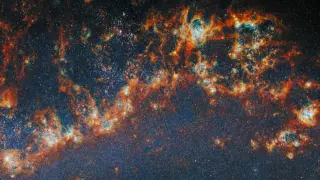
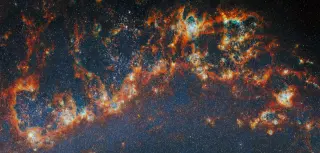
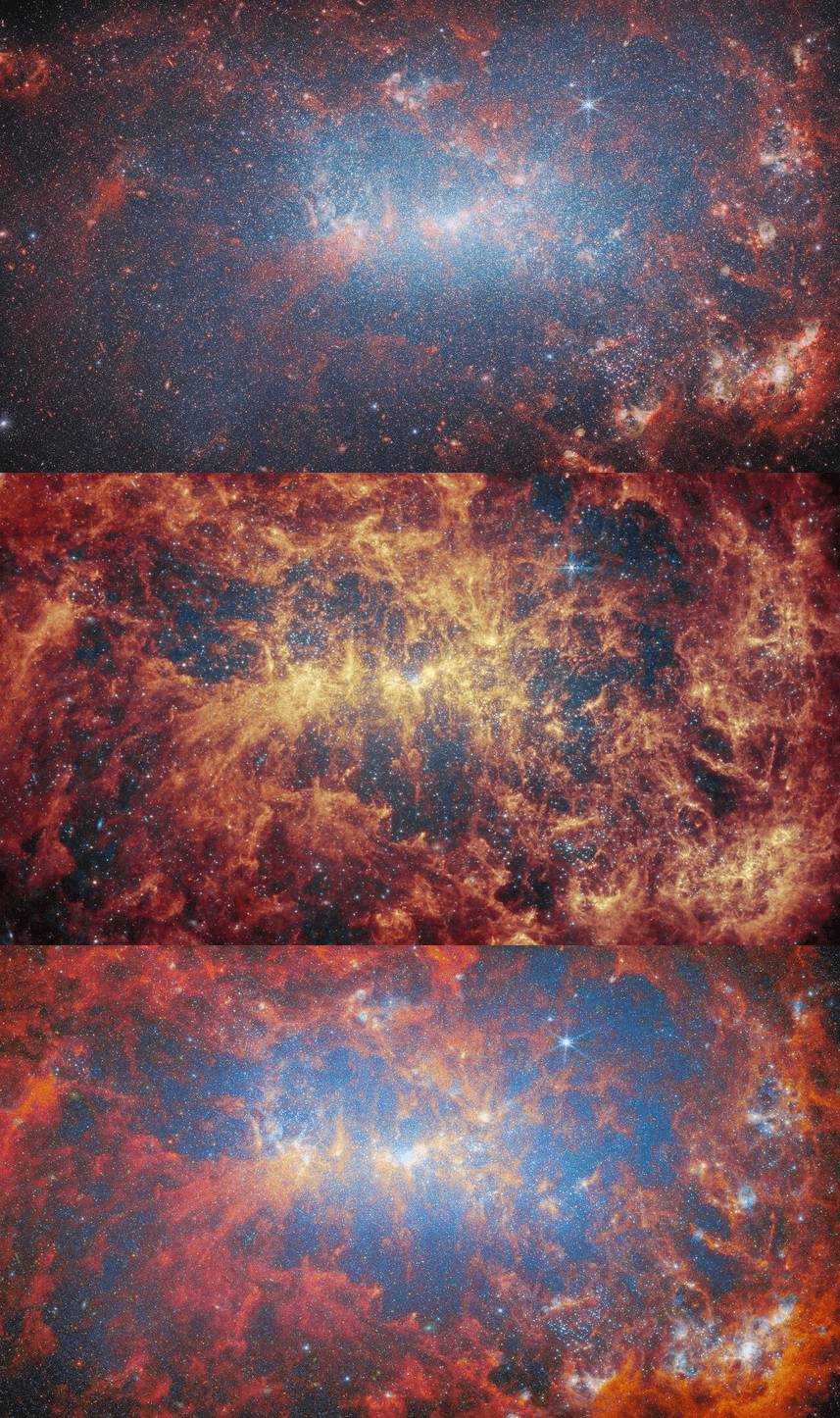
The James Webb Space Telescope has captured detailed images of the dwarf galaxy NGC 4449, revealing its intense star-forming activity and dusty structure. Located 12.5 million light-years away, NGC 4449 is undergoing a "starburst" due to gravitational interactions with neighboring galaxies, leading to the formation of numerous young star clusters. The combined data from JWST's NIRCam and MIRI instruments provide a comprehensive view of the galaxy's stellar and dusty components, offering insights into both past and future galactic evolution.

"Revealing Unexpected Magnetic Field Structures in the Milky Way"
astronomy2 years ago

"Revealing Unexpected Magnetic Field Structures in the Milky Way"

Astronomers have discovered surprising variations in the magnetic field structures within the Milky Way's Sagittarius arm, challenging previous galactic models and offering new insights into the role of magnetic fields in star formation. Leveraging advanced telescopes and the Gaia satellite, the study reveals that these magnetic fields are more complex and influential than previously thought, with significant implications for the evolution of galaxies. The findings suggest that further mapping of galactic magnetic fields could provide a better understanding of the nature and development of the Milky Way and other galaxies.