
Debate Intensifies Over Whether Culture Is Replacing Genes in Human Evolution
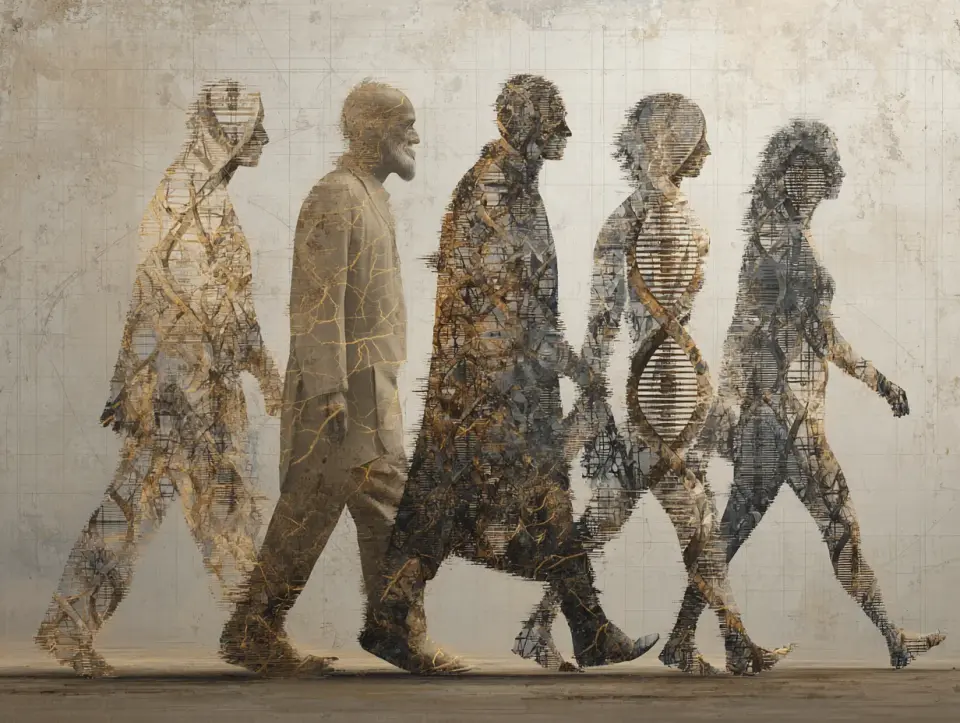
University of Maine researchers Timothy Waring and Zachary Wood argue that human evolution is shifting from genetic to cultural mechanisms, with institutions and technology now driving adaptation faster than natural selection. While they propose this could lead to a 'cultural superorganism,' peer-reviewed critiques challenge whether human societies meet the biological criteria for such an evolutionary transition.
Key points
- Waring and Wood published a 2025 paper in BioScience suggesting cultural systems like medicine and education are increasingly replacing genetic evolution as the primary driver of human adaptation.
- The researchers claim cultural innovations, such as cesarean sections and eyeglasses, can preempt genetic selection by altering survival outcomes without requiring DNA mutations.
- They hypothesize that humans may be evolving into a 'cultural superorganism,' where group-level cooperation and shared infrastructure become the primary unit of evolutionary success.
- Nejad Kourki published a peer-reviewed critique in October 2025, arguing that human societies lack the autonomous group-level reproduction required to qualify as true evolutionary individuals under the ETI framework.
- Waring is currently developing formal models at the Konrad Lorenz Institute to test the hypothesis quantitatively, acknowledging that empirical evidence for this transition remains limited.
Background
This debate follows recent discoveries in human biology, such as the Stanford study revealing the brain's dual-origin structure, which highlights complex evolutionary pathways. It also contrasts with earlier warnings about 'robotoid humanness,' where AI interaction was theorized to alter human behavior, though those effects remained untested. Unlike the genetic mutations in sperm cells that favor disease-causing traits, the cultural evolution theory focuses on external systems rather than internal biological changes.
Why it matters
If cultural systems are indeed replacing genetic evolution, it implies that human survival and well-being will depend less on biological adaptation and more on the stability and efficiency of shared institutions. This shift could redefine how we understand human individuality and collective responsibility, though experts caution that this transition is not inevitable and does not equate to moral progress.
What to watch
Waring and Wood are working on quantitative models to measure how much heritable variation is attributable to culture versus genes. The next step involves testing these metrics against deep-time and modern datasets to determine if the proposed evolutionary transition is a distinct biological phenomenon or merely a metaphorical description of social complexity.
Want the full story? Read the original reporting
Read on ZME Science