
Ribosome display yields robust protein-foldamer interface for precise hybrid assembly
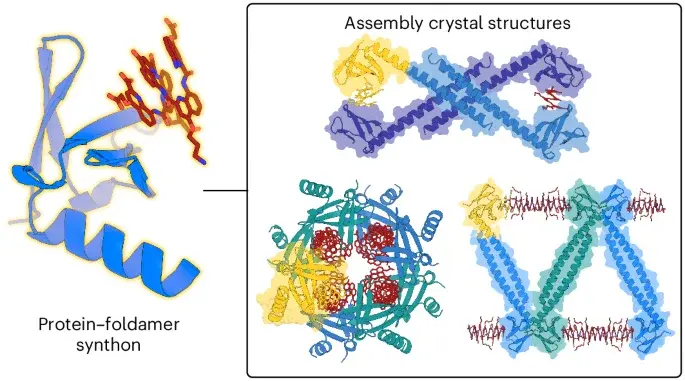
Researchers have developed a new supramolecular synthon that enables the precise assembly of hybrid architectures by combining artificial proteins with synthetic aromatic foldamers. Using ribosome display, they identified a 7-kDa protein, designated C10, that binds tightly to a helical foldamer with a dissociation constant of 91.7 nM. This complex features a large, well-defined binding interface exceeding 700 square angstroms, allowing for the construction of discrete aggregates and infinite lattices. The study demonstrates that this modular interface can hold proteins at precise distances and angles, facilitating the creation of porous solid-state frameworks and cyclic assemblies with high structural control.
Key points
- Ribosome display selection identified a 7-kDa artificial protein (C10) that binds a helical aromatic foldamer with high affinity (KD 91.7 nM) and selectivity.
- The protein-foldamer complex possesses a large binding interface (>700 Ų) that is stable yet dynamic, serving as a robust supramolecular synthon for architectural control.
- Modular design allows for the creation of hybrid architectures, including dumbbell-shaped complexes holding two proteins at precise distances and infinite 1D polymeric ribbons.
- Crystal structures reveal highly porous lattices with channel bottleneck radii up to 15.5 Å, demonstrating tunable spacing between protein components.
- The approach overcomes previous limitations of small-molecule ligands by providing a rigid, large-surface interface that prevents hinge motions and enables precise spatial positioning.
Background
This work advances the field of hybrid molecular assemblies, which seeks to combine biological proteins with synthetic ligands for applications in molecular glues, PROTACs, and porous frameworks. Previous efforts often relied on flexible linkers or small molecules that lacked the structural precision needed for architectural control. The use of Nanofitins, based on the Sac7d scaffold, provides a stable platform for display selection against synthetic targets, bridging the gap between protein and synthetic chemistry. This complements earlier developments in self-assembled molecular electronics and hybrid sequencing, which also aim to integrate precise structural control with functional outcomes.
Why it matters
This research provides a reliable method for constructing artificial assemblies with high structural precision, addressing a longstanding challenge in supramolecular chemistry. The ability to use synthetic foldamers as rigid spacers allows for the design of porous materials and nanocages with tunable dimensions, which could have applications in catalysis, drug delivery, and materials science. By demonstrating that both components can be further engineered without altering the core binding interface, the study opens pathways for creating complex, functional hybrid systems that leverage the modularity of synthetic chemistry and the specificity of protein interactions.
What to watch
Future work will likely focus on designing foldamer-protein nanocages and 3D porous lattices using computational tools for ab initio protein design. Researchers may also explore using foldamers to bring together or separate naturally occurring proteins tagged with foldamer-binding domains to alter biological functions. The inherent modularity of aromatic foldamers suggests that further optimization of side chains and helix lengths will allow for even more precise control over spatial organization and functional group incorporation.
Want the full story? Read the original reporting
Read on Nature