Tag

Self Assembly

All articles tagged with #self assembly

Protein–Foldamer Synthon Enables Precise Hybrid Architectures
science11 days ago

Protein–Foldamer Synthon Enables Precise Hybrid Architectures

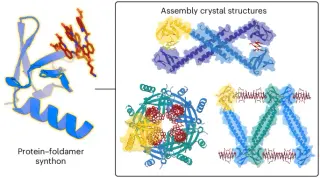
A Nature Chemistry study reports a ribosome-display–selected Nanofitin that binds a biotinylated helical aromatic foldamer with about 92 nM affinity, forming a well-defined 1:1 complex whose interface (>700 Å^2) enables modular assembly of discrete and extended protein–foldamer architectures. The work demonstrates foldamer–protein dimers, two-fold protein–foldamer constructs, cyclic assemblies, and higher-order lattices, validated by X-ray, NMR, MS, and CD. This establishes aromatic foldamers as large, programmable interfaces to organize proteins with precise spatial control, opening paths to foldamer–protein nanocages and porous lattices.

Self-assembled contacts push molecular devices toward near-perfect yields
technology25 days ago

Self-assembled contacts push molecular devices toward near-perfect yields

Researchers introduce self-assembled contacts that convert standard semiconductor-fabricated device structures into pristine molecule–metal interfaces, enabling over 1,000 electrically active metal–molecule–metal devices with yields up to 99% and stability across 10^5 measurement cycles, even for layers thinner than 1 nm. In situ Raman confirms molecular integrity, and the platform scales to system-level use, demonstrated by vector–matrix multiplication in a crossbar array of self-rectified molecular memory devices, bridging self-assembly with top-down manufacturing for scalable molecular electronics.

Gold, Light, and Salt Unveil Nanoscale Forces in Real Time
science6 months ago

Gold, Light, and Salt Unveil Nanoscale Forces in Real Time

Chalmers University researchers have developed a simple platform using micrometer-sized gold flakes in a salt solution between two gold-coated glass plates. When illuminated, light trapped in nanometer-scale liquid cavities creates color changes that reveal the balance between Casimir attraction and electrostatic repulsion, enabling direct study of nanoscale surface forces and self-assembly with potential applications in medicine, biosensing, and materials science.

Robots that Consume Each Other for Growth and Survival
technology1 year ago

Robots that Consume Each Other for Growth and Survival

Researchers at Columbia University have developed a robotic system that can self-assemble, grow, and reconfigure by 'eating' other robots, inspired by biological metabolism, with potential future applications in building structures like lunar colonies. The project explores the concept of robotic metabolism and survivability, though it currently lacks real-world utility and diverse modules, aiming instead to develop autonomous, adaptable robotic ecosystems.

Innovative Robot Design Inspired by Cheerios Effect
technology1 year ago

Innovative Robot Design Inspired by Cheerios Effect

Researchers have developed a novel robot design inspired by the "Cheerios effect," which involves the natural clumping of floating objects due to surface tension and buoyancy. By using ethanol to power tiny robots across liquid surfaces, these devices can potentially perform various environmental or industrial tasks. The study, posted on the physics arXiv, highlights how the "Cheerios effect" can facilitate self-assembly of these robots, leveraging capillary action and surface tension to enhance their movement and clustering capabilities.

"Guinness Record Broken: Scientists Tie World's Smallest Knot with 54 Atoms"
science-and-technology2 years ago

"Guinness Record Broken: Scientists Tie World's Smallest Knot with 54 Atoms"

Scientists have created the world's tightest molecular knot, a trefoil made of 54 atoms, which is 15 atoms smaller than the previous record. The accidental discovery, detailed in a study published in Nature Communications, has practical implications for understanding DNA and other naturally knotting molecules in the human body.

Atomic-Scale Self-Assembly Revolutionizes Nanotechnology with Light-Trapping Cavities
science-and-technology2 years ago

Atomic-Scale Self-Assembly Revolutionizes Nanotechnology with Light-Trapping Cavities

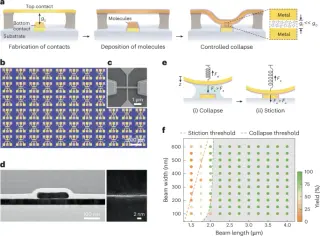
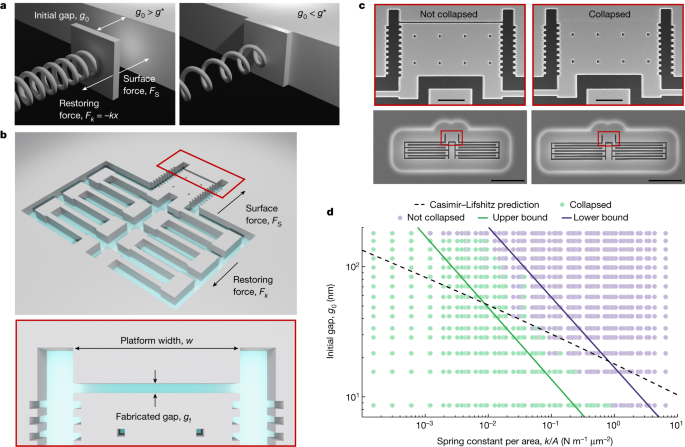
Researchers have developed a new method for manufacturing semiconductor devices using self-assembly and surface forces. By harnessing the pull-in instabilities between nearby objects, the researchers were able to fabricate nanostructures with few- or sub-nanometer dimensions. They demonstrated the application of this method by creating photonic nanocavities that confine light in air gaps in silicon membranes with aspect ratios exceeding 100. The self-assembled nanocavities exhibited high-quality factors and small mode volumes, surpassing previous experiments on dielectric cavities. The researchers also successfully integrated the self-assembled devices with photonic circuits, demonstrating the scalability and potential for interfacing with top-down planar technology.

Advancements in Fabricating Atomically-Precise Quantum Antidots through Vacancy Self-Assembly
science-and-technology3 years ago

Advancements in Fabricating Atomically-Precise Quantum Antidots through Vacancy Self-Assembly

Scientists at the National University of Singapore have achieved a breakthrough in fabricating atomically precise quantum antidots (QAD) using self-assembled single vacancies (SVs) in a two-dimensional transition metal dichalcogenide (TMD). By strategically introducing antidot patterns into carefully designed lattices, they created artificial structures with unique quantum phenomena and transport properties. The QADs, which can be used for quantum information technologies, were fabricated through the self-assembly of SVs into a regular pattern. The structures exhibited robustness against environmental influences and could potentially advance various material technologies.

Vibrating Particles Yield Bizarre New Material and Largest Quasicrystal
science-and-technology3 years ago

Vibrating Particles Yield Bizarre New Material and Largest Quasicrystal

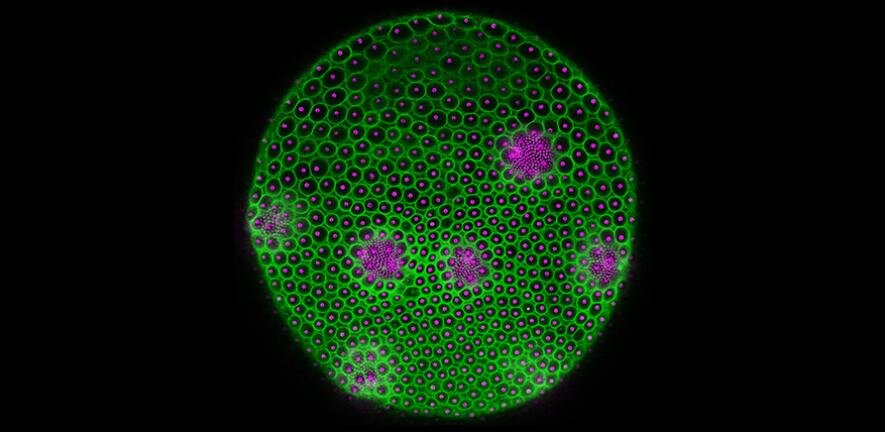
Physicists from the University of Paris-Saclay have observed the emergence of a quasicrystal, a combination of order and chaos, in a granular material for the first time on a millimeter-scale. The researchers used computer simulations to identify the necessary conditions for the formation of a quasicrystal and then conducted an experiment with vibrating steel spheres. The study found that small, localized configurations of differently sized spheres formed rapidly, but global alignment required rare collective rearrangements. The unexpected discovery suggests that quasicrystals can form in both atomic-scale and granular systems, opening up possibilities for applications in insulation and electronics.