
Resource-Rational Models and AI Gaps in Human Reading
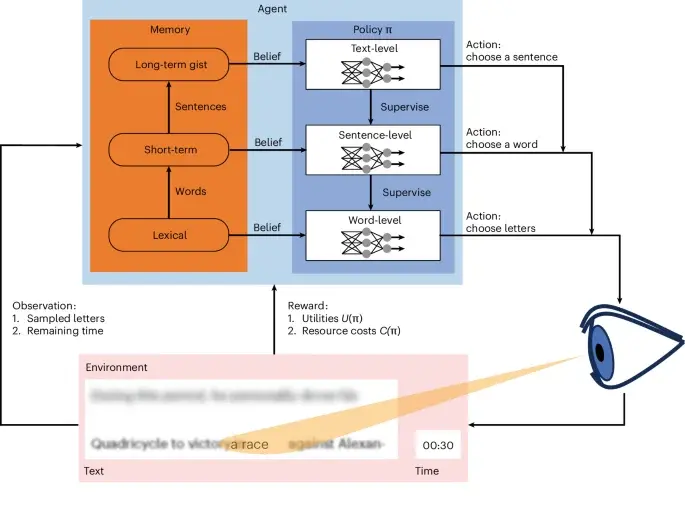
New research proposes that human reading is governed by 'resource rationality,' where eye movements optimize comprehension against time and memory costs. A separate study finds that while AI models predict initial word recognition, they fail to explain the cognitive friction and rereading required for complex sentence integration.
Key points
- A Nature study introduces a hierarchical model where reading is an optimization problem balancing comprehension gains against eye-movement and time costs.
- The model uses partial observable Markov decision processes to simulate word, sentence, and text-level processing, successfully replicating human gaze patterns.
- A PNAS study compares 368 human readers with over 400 AI language models, finding alignment in initial word recognition but divergence in handling syntactic complexity.
- AI models accurately predict processing speed for predictable words but drastically underpredict the time humans spend on 'garden-path' sentences that require structural repair.
- Backward eye movements, or regressions, account for roughly 20% of reading fixations, a mechanism absent in standard autoregressive AI architectures.
Background
This follows earlier findings on intuitive reasoning, such as the 'Intuitive Gamer' model, which showed that humans rely on fast, depth-limited simulations rather than exhaustive search to make decisions under uncertainty. The current studies extend this concept of bounded rationality to language processing, highlighting how cognitive constraints shape both human behavior and the limitations of current AI systems.
How outlets are covering it
The Nature study emphasizes a unified computational framework where eye movements are rational responses to resource constraints, successfully replicating a wide range of empirical effects including time-pressure adaptations. In contrast, the PNAS study focuses on the specific failure of AI to model human cognition, highlighting that while next-word prediction explains initial processing, it cannot account for the additional cost of structural integration. While the Nature model provides a general mechanism for adaptive reading, the PNAS research specifically identifies the gap between statistical prediction and the cognitive effort required for rereading and error correction in complex syntax.
Why it matters
Understanding reading as a resource-rational process offers a principled account of how humans manage attention and memory under constraints, potentially improving educational technologies and AI design. The identified gap between AI and human processing highlights that current language models lack the structural repair mechanisms necessary to fully replicate human comprehension, suggesting that future AI must incorporate multi-stage context integration to better model human thought.
What to watch
Researchers aim to develop computational models that more closely match human cognitive architecture, particularly in handling rereading and structural confusion. The findings may lead to improved language-learning technologies and a better understanding of reading difficulties, while the resource-rational framework may be applied to other knowledge-intensive human behaviors to explain how complex skills adapt to limited resources.
- Hierarchical resource rationality explains human reading behaviour Nature
- AI model captures how humans read, paving the way to personalized text and better augmented reality Tech Xplore
- Eye Tracking Reveals Where Human Reading and AI Processing Diverge neurosciencenews.com
- Why Do We Labor When Reading Some Words But Not Others? AI Offers a Partial Answer New York University
- AI sheds partial light on why some words demand more reading effort Bioengineer.org
Want the full story? Read the original reporting
Read on Nature