
New Study Links Widespread AI Use to Significant Decline in Student Learning
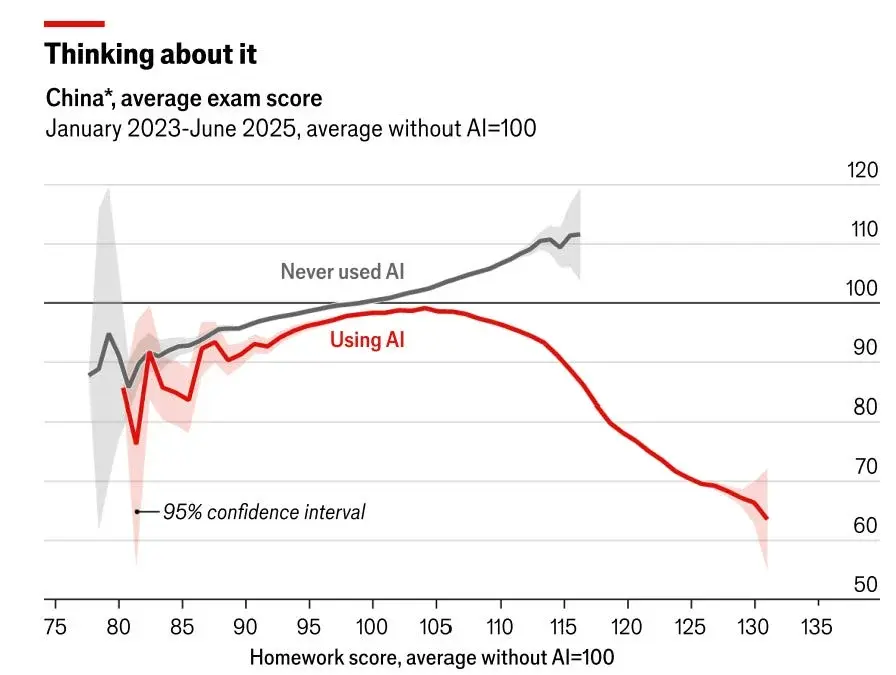
A large-scale study of Chinese secondary students indicates that widespread adoption of generative AI has led to substantial declines in academic performance. While AI users often achieve higher homework scores due to automated assistance, their performance on closed-book exams and high-stakes placement tests has dropped significantly, with no evidence of corresponding learning benefits.
Key points
- A study involving approximately 27,000 Chinese students in grades 7-12 found that about 80% adopted generative AI between 2023 and 2025.
- After five months of use, roughly 50% of these students engaged in 'full homework outsourcing,' relying entirely on AI for assignments.
- Students using AI spent significantly less time on homework, averaging 45 minutes compared to 50-80 minutes for non-users.
- Despite lower study time, AI users achieved higher homework scores, creating a false impression of improved learning.
- On monthly closed-book exams, AI users saw an average performance decline of 20%, a drop far exceeding post-pandemic learning losses in the US.
- High-stakes exam results for students who adopted AI two or more years prior showed declines of 24% for high school placement and 18% for college placement.
Background
In 2024, Laurence Holt of the XQ Institute identified the '5 Percent Problem,' noting that ed-tech benefits often applied only to a small minority of students who used tools as intended. Generative AI differs from previous ed-tech because it has been broadly embraced by students, eliminating the 'dosage' issue of low adoption. However, empirical research on its long-term educational impact has been scarce, with a Stanford analysis finding that only 20 out of over 800 studies employed true causal measures. This new study provides rigorous, real-world data on the cumulative effects of AI on student learning over time.
Why it matters
The findings suggest that generative AI may be causing a 'cognitive crisis' by replacing the mental processes necessary for learning. As AI becomes more prevalent, the gap between apparent homework success and actual knowledge retention could widen, potentially foreclosing future academic and career opportunities for a generation of students. Policymakers and educators face the challenge of developing norms and interventions to mitigate these harms before they become entrenched.
What to watch
Researchers and educators are exploring strategies to address the '50 Percent Problem,' including investigating communities of technological refusal and developing assessment standards that prevent AI from substituting for essential cognitive tasks. The focus is shifting from promoting AI adoption to mitigating its educational harms and ensuring that tools are only used for tasks students already know how to perform.
Want the full story? Read the original reporting
Read on Benjamin Riley | Substack