
Spin Fluctuations and Pseudogaps: Two New Studies Probe Cuprate Superconductivity
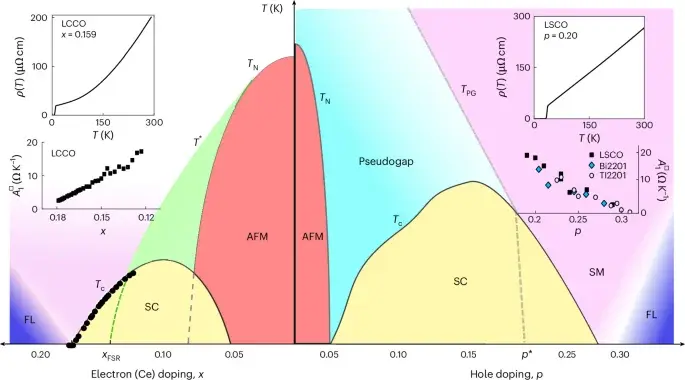
Two new studies published on October 20, 2026, offer distinct insights into the mechanisms of high-temperature superconductivity in cuprates. A study in Nature identifies antiferromagnetic spin fluctuations as the primary pairing mechanism in electron-doped cuprates, linking scattering rates to critical temperature. Simultaneously, a study in Nature Physics demonstrates that superconductivity and the pseudogap state compete rather than cooperate in hole-doped cuprates, challenging the idea that the pseudogap is a precursor to superconductivity.
Key points
- Nature study shows electron-doped La2−xCexCuO4 superconductivity is mediated by antiferromagnetic spin fluctuations.
- The Nature study finds a direct correlation between the strength of spin-fluctuation scattering and the critical temperature (Tc).
- Nature Physics study uses laser pulses to show that superconductivity and the pseudogap state compete in bismuth-based cuprates.
- The Nature Physics study finds that suppressing superconductivity with light causes the pseudogap to emerge, and vice versa.
- Both studies challenge existing theories, suggesting that hole-doped cuprates may require physics beyond standard Bardeen-Cooper-Schrieffer theory.
Background
Cuprate superconductors have been a focus of research since their discovery in 1986, with the goal of understanding how to achieve superconductivity at higher temperatures. Previous studies, including one from October 2026, have suggested that cuprates are not uniform crystals but rather patchworks of different atomic structures, complicating theoretical models. Another recent study on uranium ditelluride highlighted persistent electron patterns above the superconducting threshold, further illustrating the complex quantum states involved in high-temperature superconductivity.
How outlets are covering it
The two studies approach the cuprate superconductivity problem from different angles. The Nature study focuses on electron-doped cuprates, using magnetoresistance and resistivity measurements to identify spin fluctuations as the pairing mechanism. It argues that the coupling strength to these fluctuations directly determines Tc. In contrast, the Nature Physics study, reported by Quantum Zeitgeist, Mirage News, and Bioengineer.org, focuses on hole-doped cuprates and the pseudogap. It uses ultrafast spectroscopy to show that the pseudogap and superconductivity are competing states, not sequential ones. While the Nature study suggests a clear mechanism for electron-doped cuprates, it notes that this mechanism does not fully explain the higher Tc in hole-doped cuprates, implying a need for a new theoretical framework. The Nature Physics study challenges the 'precursor' hypothesis for the pseudogap, suggesting that suppressing it might be key to raising Tc. Both studies highlight the complexity and asymmetry of cuprate phase diagrams.
Why it matters
Understanding the pairing mechanism and the role of the pseudogap in cuprates is crucial for developing materials that superconduct at higher temperatures, potentially leading to lossless power transmission, advanced medical technologies, and quantum computing. These studies provide new experimental evidence that could guide future theoretical models and material design, moving closer to practical applications of high-temperature superconductivity.
What to watch
Researchers will likely focus on applying the findings from the Nature study to hole-doped cuprates to see if a similar spin-fluctuation mechanism can explain their higher Tc, or if a new theory is needed. The Nature Physics study's finding of competition between superconductivity and the pseudogap may lead to experiments aimed at suppressing the pseudogap to enhance superconductivity. Further computational modeling and experimental techniques will be needed to fully understand the non-equilibrium dynamics and the role of different electronic states in cuprates.
- Evidence for spin-fluctuation-mediated superconductivity in electron-doped cuprates Nature
- Quantum Tug-of-war Limits High-temperature Superconductivity Quantum Zeitgeist
- New Light on One of Modern Physics' Greatest Mysteries Mirage News
- Light reveals competing pseudogap in doped cuprate superconductors Bioengineer.org
- Researchers discover ‘smoking gun’ to help solve mystery of high-temperature superconductivity | Newswise Newswise
Want the full story? Read the original reporting
Read on Nature