
In situ observation captures a rapid seafloor-spreading burst at the Southeast Indian Ridge
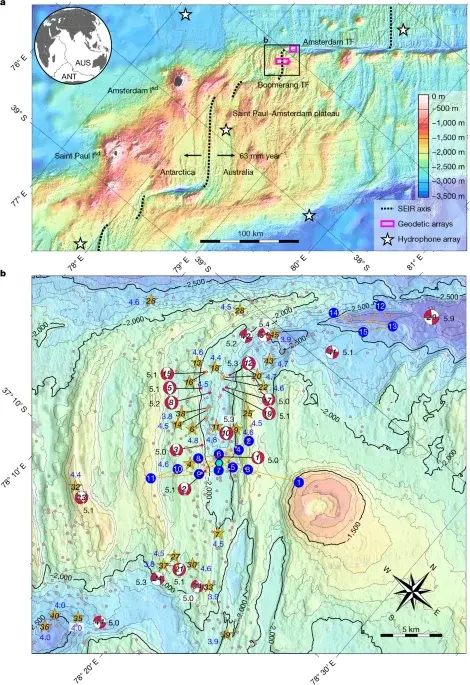
An autonomous seismogeodetic array on SEIR’s segment I1 captured a rapid seafloor spreading event beginning 26 April 2024, driven by a migrating swarm of extensional earthquakes that propelled a southeast- to northwest-propagating dyke from a deflating axial magma reservoir. This produced about 4 meters of subsidence and over 1 meter of horizontal extension in the axial valley, followed by the eruption of roughly 160 million cubic meters of lava on the seafloor over ~16 days, while triggering seismic and aseismic slip on valley-bounding normal faults and the adjacent transform fault. The multi-sensor data (hydrophones, acoustic ranging, bottom-pressure recorder, and swath bathymetry) suggest large-scale aseismic magmatic slip could be the primary mechanism driving MOR fault displacement, addressing long-standing questions about short-timescale MOR dynamics. 2D elastic-dislocation modeling of sill, dyke, and fault geometries supported the observed displacements.
- Anatomy of a seafloor spreading event captured by in situ seismogeodesy Nature
- In a First, Scientists Observe Creation of New Seafloor The New York Times
- World First: Scientists Witnessed a Piece of Earth's Oceanic Crust Being Born ScienceAlert
- Ocean rift zone saw spreading happen in a sudden burst Ars Technica
- New deep-sea measurements show how the ocean floor forms Phys.org
Want the full story? Read the original reporting
Read on Nature