Researchers using an underwater geodetic observatory documented a rare, coupled tectonic–magmatic event at a mid-ocean ridge: a massive magma sheet intruded beneath the seafloor, tearing crust apart at about 5 cm per minute, followed by surface collapse and seismic activity, offering new insight into how the ocean floor renews itself.
A French-led team deployed an underwater observatory in the southern Indian Ocean and directly measured the birth of new ocean floor, finding that seafloor spreading can occur largely without earthquakes and that much crust renewal happens aseismically, offering new insight into how Earth's crust forms at mid-ocean ridges.
The mid-ocean ridge is the Earth’s longest mountain range, a 65,000‑km system of underwater volcanoes that encircles the globe and lies mostly beneath the sea. It forms where tectonic plates pull apart and new ocean crust is created. Mapped in the 1950s by Marie Tharp and colleagues, with major atlases published in 1957 and 1977, the ridge reshapes our view of the planet. Despite decades of sonar and satellite work, only about 28–29% of the seafloor has high‑resolution mapping as of 2026, and explorers have seen a vanishingly small fraction of the deep ocean floor, underscoring how much of Earth remains unseen.
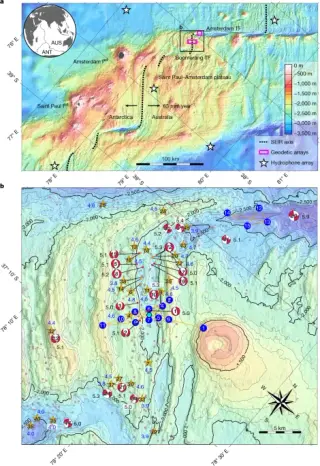
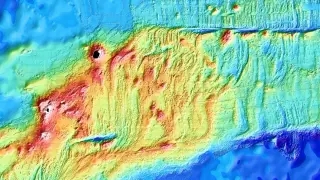
An autonomous seismogeodetic array on SEIR’s segment I1 captured a rapid seafloor spreading event beginning 26 April 2024, driven by a migrating swarm of extensional earthquakes that propelled a southeast- to northwest-propagating dyke from a deflating axial magma reservoir. This produced about 4 meters of subsidence and over 1 meter of horizontal extension in the axial valley, followed by the eruption of roughly 160 million cubic meters of lava on the seafloor over ~16 days, while triggering seismic and aseismic slip on valley-bounding normal faults and the adjacent transform fault. The multi-sensor data (hydrophones, acoustic ranging, bottom-pressure recorder, and swath bathymetry) suggest large-scale aseismic magmatic slip could be the primary mechanism driving MOR fault displacement, addressing long-standing questions about short-timescale MOR dynamics. 2D elastic-dislocation modeling of sill, dyke, and fault geometries supported the observed displacements.
Researchers operating an underwater observatory near Amsterdam Island recorded a rare, hours-long seafloor-spreading event in April 2024: sheet-like magma dikes injected around 150 million cubic meters of magma, forcing a 4.2-meter collapse of the ridge floor and rapid, up-to-5 cm-per-minute displacements. Much of the motion was aseismic, helping explain previously missing tectonic motion and providing a real-time test bed for seismic models. The findings, published in Nature, show seafloor spreading occurs in giant, episodic bursts rather than steady creep.
Geophysicists aboard the Meteor on Expedition M201 found flat-topped, submerged volcanoes along the Reykjanes Ridge off Iceland, indicating that mid-ocean ridges can erupt explosively at shallower depths when seawater flashes to steam; a mechanism that may explain phantom islands like Surtsey and suggests future surface eruptions could occur as ice and pressure conditions change.