
Tiny Caldera, Huge Hazards: Rapid Submarine Collapse at Hunga Tonga, 2022
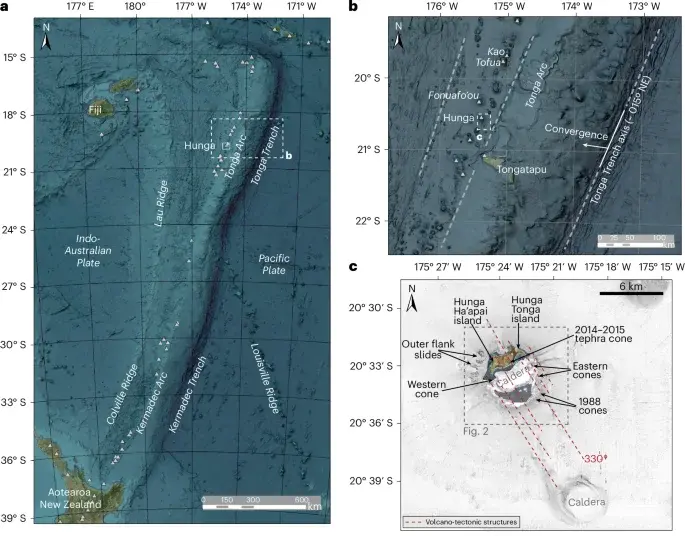
Time-series bathymetry shows the 2022 Hunga Tonga eruption caused a rapid, piston-like collapse of a ~4.8 km wide submarine caldera, deepening from ~150 m to ~850 m and displacing ~8.9 km³ (6.85 km³ from caldera collapse; the rest from erosion). Intercalated landslides and inward terraces indicate syn-eruptive, ring-fault–driven subsidence with minor wall collapse. About 7–8 km³ of Dense Rock Equivalent magma drove the collapse (roughly 30 MPa underpressure), suggesting a relatively small reservoir could trigger a large collapse. The eruption generated a record submarine tsunami (~40 m near source). Post-eruption surveys show limited geomorphic change after months, but ongoing shallow magmatic fluids imply continued magmatic activity. Globally, small submarine calderas can produce extreme tsunami hazards, underscoring the need for high-resolution repeat seafloor mapping, improved hazard assessments, and seafloor infrastructure protection.
- Rapid submarine caldera collapse during the 2022 climactic eruption of Hunga volcano (Tonga) Nature
- 1 km Collapse of the Ocean Floor During Tonga Volcanic Eruption: 'Piston-Type Collapse' That Amplified the Tsunami [Reading Science] asiae.co.kr
- Volcanic Tsunami Warning Systems Receive Collapse Signal; No Algorithm Converts It to Alert Tech Times
- Underwater Caldera Collapsed Vertically 1 km During Tonga Volcanic Eruption, Amplifying Tsunami finance.biggo.com
Want the full story? Read the original reporting
Read on Nature