
Abric Romaní Finds Redefine Neanderthal Technology Beyond Stone
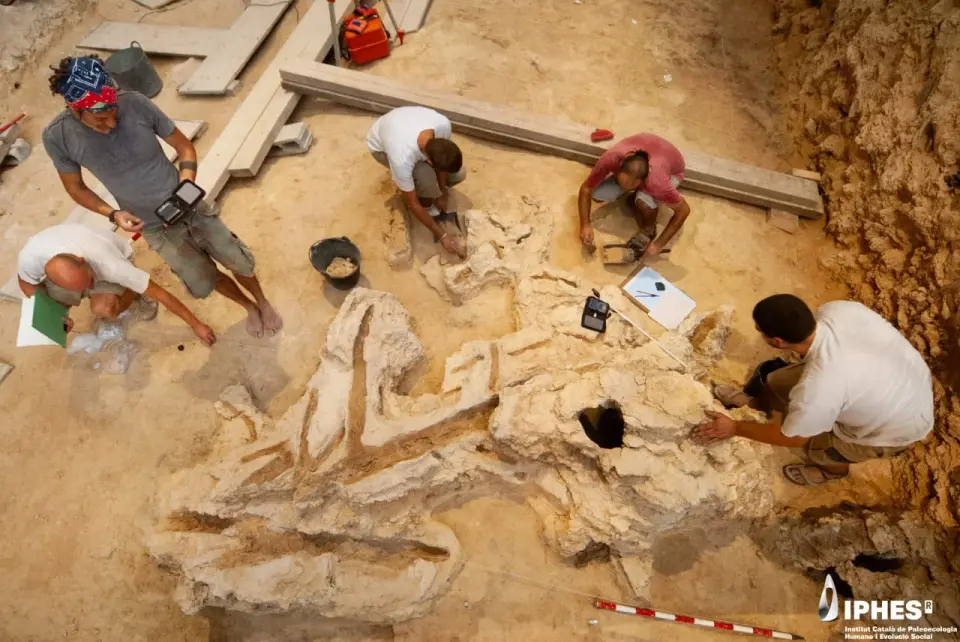
A comprehensive study of 597 wooden remains and imprints from the Abric Romaní rock shelter in Spain reveals that Neanderthals possessed a sophisticated woodworking tradition spanning 62,000 to 40,000 years ago. Published in Science Advances, the research identifies 13 distinct artifacts, including spears, a unique club-like object, and structural elements, challenging the long-held view that Neanderthal technology was primarily defined by stone tools.
Key points
- The study, led by Palmira Saladié of IPHES-CERCA, analyzes 597 wooden items recovered from 16 archaeological levels at Abric Romaní near Barcelona.
- Only 13 objects were identified as deliberately made or used by Neanderthals, including two spears (2.45m and 1.99m), a club-like object, bark containers, and a 5.10m structural pole.
- Wood preservation occurred through calcium carbonate deposits in travertine rock, which created precise molds of the original timber after it rotted away.
- The findings indicate that woodworking was a consistent part of daily life, not an occasional activity, with tools used for hunting, domestic tasks, and living space organization.
- The club-like object, featuring a narrow handle and enlarged head, has no known parallel in the prehistoric record, though its specific function remains unclear.
Background
Previous archaeological understanding of Neanderthals was heavily biased toward stone tools because organic materials like wood rarely survive. While other sites like Schöningen in Germany had yielded wooden spears, Abric Romaní offers the first long-term, multi-level analysis of wood use. The site has been excavated since 1983, allowing researchers to track technological changes over thousands of years. This new study fills a significant gap in the material culture record, revealing a 'hidden' aspect of Neanderthal life that was previously invisible due to the poor preservation of organic artifacts.
How outlets are covering it
Archaeology News Online and New Scientist emphasize the breadth of Neanderthal woodworking, highlighting that wood was a central, versatile material for daily life, not just weapons. New Scientist notes that the technological behaviors observed are comparable to those of Homo sapiens. Gizmodo focuses on the 'invisible' nature of Neanderthal life, stressing that stone tools dominated the record simply because they survived better, while wood was likely more important. UA.NEWS provides a more cautious perspective, noting that without clear traces of cutting or bark removal, it can be difficult to definitively distinguish natural branches from worked objects, as cautioned by archaeologist Dirk Leder. All sources agree that the Abric Romaní finds represent a major shift in understanding Neanderthal capabilities.
Why it matters
This discovery fundamentally alters the narrative of the Paleolithic era, demonstrating that Neanderthals had a complex, diverse toolkit that included wood, not just stone. It challenges the assumption that Neanderthals were technologically inferior to modern humans and provides a more accurate picture of their daily lives, including how they managed resources, organized living spaces, and handled fire. The findings also highlight the importance of organic material preservation in archaeology and suggest that many other 'missing' technologies from the past may be hidden in similar sites.
What to watch
Researchers at Abric Romaní are continuing excavations, with new wooden imprints still being discovered as more layers are exposed. The team plans to investigate further questions, such as the labor involved in creating and maintaining wooden tools and how these artifacts relate to other activities observed at the site. Future studies may also explore whether similar wooden technologies were used in other Neanderthal sites, potentially revealing a wider, parallel technology that ran alongside stone tools.
- Neanderthal woodworking was far more advanced than we thought, new study shows Archaeology News Online Magazine
- Neanderthal Europe was as much a wooden age as a stone age New Scientist
- A Wooden Club and Other Rare Finds Reveal ‘Invisible’ Side of Neanderthal Life Gizmodo
- A Broken Neanderthal Spear Survives as a 40,000-Year-Old Imprint Discover Magazine
- Traces of Neanderthal wooden objects found in Spain — Science News UA.NEWS
Want the full story? Read the original reporting
Read on Archaeology News Online Magazine