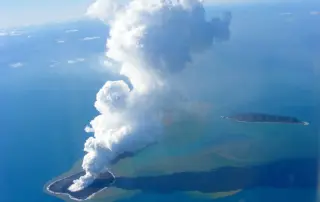
A new study links the 2022 Hunga Tonga eruption to a massive tsunami caused by a rapid, piston-style caldera collapse. Separately, satellite data reveals the eruption triggered unprecedented stratospheric methane destruction via chlorine reactions.
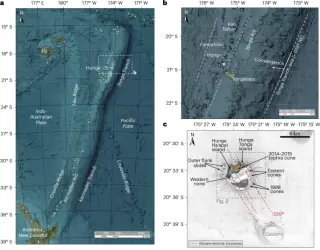
Time-series bathymetry shows the 2022 Hunga Tonga eruption caused a rapid, piston-like collapse of a ~4.8 km wide submarine caldera, deepening from ~150 m to ~850 m and displacing ~8.9 km³ (6.85 km³ from caldera collapse; the rest from erosion). Intercalated landslides and inward terraces indicate syn-eruptive, ring-fault–driven subsidence with minor wall collapse. About 7–8 km³ of Dense Rock Equivalent magma drove the collapse (roughly 30 MPa underpressure), suggesting a relatively small reservoir could trigger a large collapse. The eruption generated a record submarine tsunami (~40 m near source). Post-eruption surveys show limited geomorphic change after months, but ongoing shallow magmatic fluids imply continued magmatic activity. Globally, small submarine calderas can produce extreme tsunami hazards, underscoring the need for high-resolution repeat seafloor mapping, improved hazard assessments, and seafloor infrastructure protection.
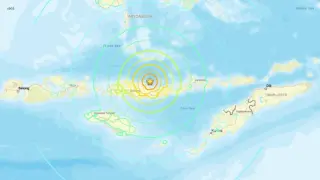
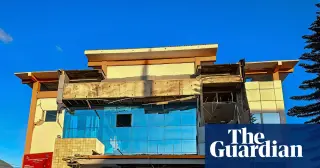
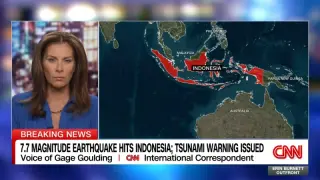
A powerful offshore magnitude-7.7 earthquake struck near Flores in Indonesia's East Nusa Tenggara, causing buildings to collapse, prompting evacuations and at least five deaths as aftershocks followed; a tsunami warning was briefly issued and later lifted after authorities found no significant sea-level change, while power outages and communications disruptions hampered rescue efforts.
Indonesia’s Flores region was hit by a 7.7-magnitude earthquake that prompted a tsunami warning which was later lifted; authorities ordered evacuations and dispatched search-and-rescue teams as aftershocks continued, with casualty reports ranging from one to two deaths and multiple injuries as rapid assessments proceeded.
A 7.7-magnitude earthquake struck Flores in eastern Indonesia at a shallow depth, triggering a tsunami warning with potential waves of 0.5–3 meters across East Nusa Tenggara, South Sulawesi, and West Nusa Tenggara. The quake, followed by aftershocks, prompted evacuations and reports of damaged buildings, but no casualties were immediately reported. Authorities noted sea level changes and warned residents to stay away from shores; Australia’s warning center said there was no tsunami threat to the mainland.
Indonesia issued a local tsunami warning after a 7.7-magnitude earthquake near Flores Island, followed by three aftershocks (5.9, 5.6, 6.1). Authorities urged coastal residents to move to higher ground and avoid beaches, while Australia reported no tsunami threat for now. The USGS warned casualties and damage are possible, with about 500,000 people exposed to very strong shaking; Indonesia sits on the Ring of Fire and has a history of major quakes, including the 2004 Sumatra disaster.
A tsunami warning was issued after a magnitude-7.7 earthquake struck Indonesia's Flores region, with the EMSC revising the quake's magnitude several times before concluding at 7.7; an additional, shallower earthquake (magnitude 5.5) followed in the same area, making this a developing situation.
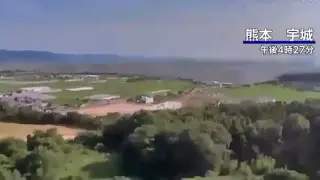
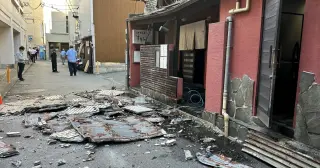
A powerful 7.1-magnitude earthquake struck southern Japan, causing building collapses including a mall, trapping people, injuring dozens, suspending train service, and prompting a brief tsunami advisory that was later lifted.
A magnitude 7.3 earthquake struck off southern Mexico near Puerto Madero, triggering a tsunami warning for parts of the Pacific; no deaths or major damage were reported in Mexico or Guatemala, though tremors were felt in El Salvador. Observed waves about 0.3 m were recorded along some Mexican coasts before the threat was downgraded. USGS put the depth at 15.2 km; aftershocks followed, and authorities urged residents to stay away from beaches and monitor guidance from NOAA and local officials.
A magnitude 7.3 earthquake struck near the coast of Chiapas, Mexico, at about 9.4 miles depth, triggering a tsunami warning for coasts in Mexico, Guatemala and El Salvador; aftershocks followed and authorities reported no immediate damage.
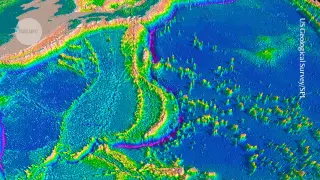
Scientists are unlocking the deep ocean with four key technologies: ocean-bottom seismometers mapping mantle convection; China’s Meng Xiang drilling ship to obtain pristine mantle samples; hydrophones enabling rapid, global tsunami prediction; and repurposed deep-sea cables transforming into a vast seismic surveillance network—together they aim to illuminate Earth’s mantle, plate tectonics and coastal hazards in a region still largely unmapped.
Researchers confirm the Silverpit Crater beneath the southern North Sea was formed by a hypervelocity asteroid or comet about 43–46 million years ago. Using advanced seismic imaging and rock samples with shocked minerals, scientists show a ~160-meter-wide impactor struck at a shallow angle, producing a 1.5-kilometer-high curtain of rock and water that collapsed into a tsunami over 330 feet tall. The finding resolves a two-decade-long debate and places Silverpit among Earth's rare, well-preserved underwater impact craters.
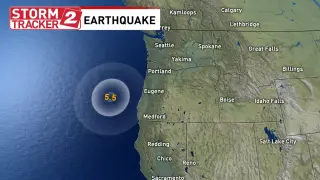
A magnitude 5.5 earthquake occurred in the Pacific Ocean off the southern Oregon coast near the Blanco Fracture Zone, about 175 miles southwest of Eugene, at a depth of roughly six miles. No coastal residents reported feeling it, and the National Weather Service says there is no tsunami threat.
NASA’s SWOT satellite captured unprecedented high‑resolution, wide‑swath observations of a Pacific-wide tsunami from the Kuril‑Kamchatka earthquake, showing dispersive wave behavior that challenges the traditional non‑dispersive view; by combining SWOT with DART buoy data and inversion analyses, researchers refined the earthquake rupture to about 400 km and highlighted how integrating multiple data sources could improve future tsunami forecasting and warnings.