
New Chinese Fossil Confirms Flight Evolved Independently in Birds and Dinosaurs
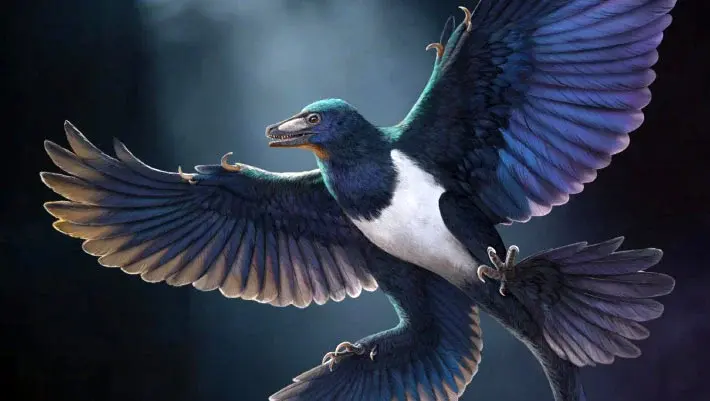
A newly described 57-centimeter dinosaur, Norellraptor barsboldi, from 120-million-year-old Chinese rock beds, provides strong evidence that flight evolved independently in birds and their closest non-avian relatives. While sharing about 30% of anatomical features with birds, the sequence of these adaptations differs, challenging the idea of a shared ancestral flight blueprint.
Key points
- Norellraptor barsboldi is a new microraptorine dinosaur species discovered in the Jiufotang Formation in Liaoning, China, dating to the Lower Cretaceous period.
- The fossil, nearly complete with plumage imprints, was analyzed for 194 anatomical changes; approximately 57 of these features are shared with the bird lineage.
- Despite the shared features, the order in which these flight-related traits evolved differs between microraptorines and birds, indicating independent evolutionary pathways.
- Bone histology suggests a unique limb growth model in microraptorines, distinct from that of living birds, supporting the theory of convergent evolution rather than a common ancestral flight apparatus.
- The species is named in honor of paleontologists Mark Allen Norell and Rinchen Barsbold, both of whom passed away in 2025.
Background
Recent discoveries of feathered dinosaurs in China have significantly advanced understanding of avian origins. Previous archive coverage noted that while microraptorines and birds share flight adaptations, the new fossil provides concrete phylogenetic and histological data to confirm these traits evolved separately. This adds to the broader narrative of how feathered dinosaurs like Archaeopteryx and Microraptor serve as models for understanding the transition from ground-dwelling theropods to flying birds.
How outlets are covering it
Sci.News and New Scientist both emphasize the fossil's role in challenging the 'single origin' hypothesis of flight, highlighting the different sequence of anatomical changes. The Nature Communications paper provides the technical basis, noting that while 30% of features are convergent, the developmental patterns differ. Jacqueline Nguyen of the Australian Museum, cited by New Scientist, notes that while similarities exist, the forelimb growth pattern is distinct, reinforcing the idea that flight evolved through different selective pressures rather than a shared developmental constraint. All sources agree that the fossil supports multiple independent origins of flight within Paraves.
Why it matters
This finding refines our understanding of evolutionary biology by demonstrating that complex traits like flight can arise independently through different developmental pathways. It challenges the assumption that similar anatomical structures in closely related species always indicate a common ancestral origin, instead supporting convergent evolution driven by different environmental pressures. This has implications for how we interpret the fossil record and the evolution of other complex biological systems.
What to watch
Researchers will likely continue to analyze the bone microstructure and plumage of Norellraptor barsboldi to further understand the specific selective pressures that drove its flight adaptations. Future studies may compare these findings with other microraptorine fossils to determine if the independent evolution of flight was a widespread phenomenon among non-avian dinosaurs or specific to certain lineages.
- New Feathered Dinosaur Suggests Flight Evolved More Than Once among Birds’ Closest Relatives Sci.News
- Independent assembly of the flight apparatus in a non-avian dinosaur clade Nature
- New feathered, winged dinosaur from China challenges our theories on bird and dinosaur evolution Phys.org
- Exceptionally Well-Preserved Feathered Dinosaur Reveals More About The Evolution Of Flight IFLScience
- Spectacular feathered dinosaur fossil shows bird-like adaptations New Scientist
Want the full story? Read the original reporting
Read on Sci.News