
Quantum Geometry Simulations Suggest 3D Space and 1D Time Emerge Naturally
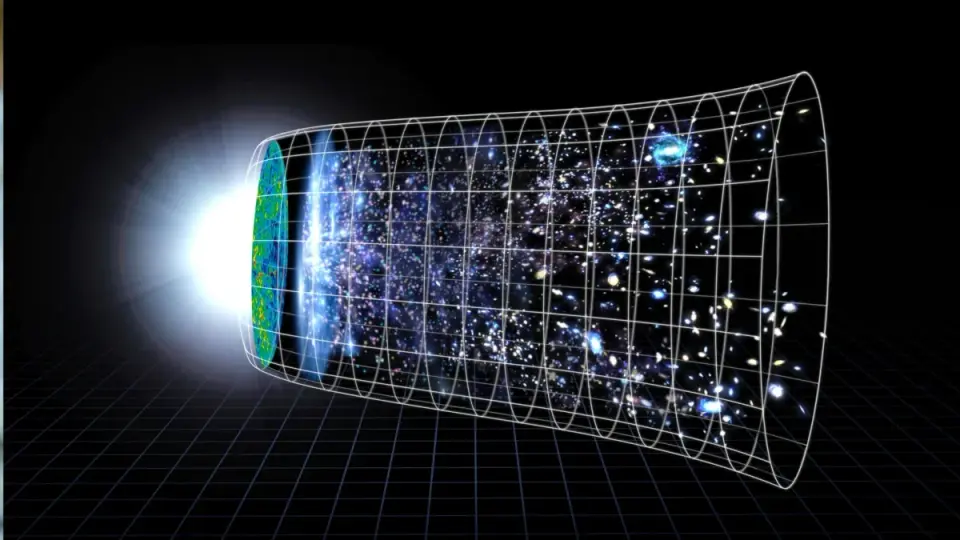
A new preprint from the University of Belgrade proposes that the universe’s specific structure of three spatial dimensions and one temporal dimension may emerge naturally from quantum geometric building blocks. By simulating over 20 billion configurations of four-dimensional simplices, researchers found that 85% of trials resulted in this familiar spacetime signature, even without incorporating physical laws or forces.
Key points
- Researchers Djordjevic and colleagues from the University of Belgrade published a preprint on arXiv exploring why the universe has three spatial and one temporal dimension.
- The study utilized a toy model of quantum gravity, constructing virtual universes from four-dimensional simplices made of triangles, edges, and vertices.
- Edge lengths were randomized between the Planck length (10^-35 meters) and a scale of 10^-20 meters, based on constraints from the Large Hadron Collider and LIGO-Virgo.
- Three topologies were tested: a four-dimensional ball with a boundary, a four-dimensional sphere without a boundary, and a disconnected set of simplices.
- The simulation yielded over 20 billion evaluations, with 85% producing a spacetime signature of three space and one time dimensions.
- Surprisingly, treating edges as space-like alone was sufficient to generate the time direction, whereas time-like edges often produced multiple time dimensions.
Background
This development follows recent theoretical explorations into the universe's fundamental structure, such as the 2026 proposal that a fifth dimension might explain anomalous neutrino detections and the hypothesis that heavy right-handed neutrinos dominated the early universe's energy density. It also aligns with ongoing debates about quantum interactions locking the universe into stable states, as suggested by studies on decoherence in the early cosmos.
Why it matters
If validated, this theory could resolve a long-standing mystery in physics: why the universe has exactly three spatial dimensions and one temporal dimension. It suggests that this structure may be an emergent property of quantum geometry rather than a fundamental constant, potentially offering a pathway to unify quantum mechanics and general relativity.
What to watch
Future research will incorporate physical laws and various shapes into the simulations to test whether the spacetime signature can be fully understood as an emergent property of quantum geometry. The authors plan to expand their models to include more complex dynamics beyond the current geometric framework.
Want the full story? Read the original reporting
Read on ScienceAlert