Tag

Quantum Gravity

All articles tagged with #quantum gravity

From Planes to Spacetime: Sabrina Pasterski’s Quantum Gravity Quest
science2 hours ago

From Planes to Spacetime: Sabrina Pasterski’s Quantum Gravity Quest

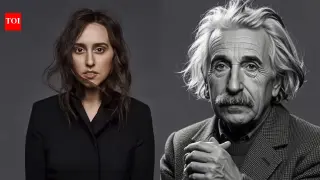
Sabrina Gonzalez Pasterski, a Chicago-born prodigy who built and solo-flied a plane as a teen, topped MIT physics, earned a Harvard PhD, and contributed to quantum gravity and the spin memory effect (cited by Hawking). She turned down lucrative offers from Blue Origin, Brown University, and NASA, and joined the Perimeter Institute in 2021 as the youngest faculty member, where she founded the Celestial Holography Initiative. In 2023, the Simons Foundation granted $8 million to support her collaborative work linking spacetime with quantum theory.

Direct-wave signal near a black hole horizon opens a new window on gravity
science4 days ago

Direct-wave signal near a black hole horizon opens a new window on gravity

Researchers analyzed a very strong gravitational-wave event (GW250114) detected by LIGO on Jan. 14, 2025 and found evidence of a “direct wave” produced from near the horizon of the newly formed black hole. The signal, matching theoretical predictions, could allow astronomers to study the region just outside the event horizon using gravitational waves, potentially testing general relativity and informing ideas about quantum gravity and the black hole information paradox. However, the claim rests on a single observation, so further detections are needed to confirm this as a universal feature of black hole mergers.

Time as an Emergent Phenomenon: Clocks Inside the Universe, Not a Fundamental Backdrop
science10 days ago

Time as an Emergent Phenomenon: Clocks Inside the Universe, Not a Fundamental Backdrop

A Space Daily piece outlines the view that time may not be a fundamental feature of reality; in quantum gravity, the Wheeler–DeWitt equation lacks an external clock, while the Page–Wootters idea shows time could arise from correlations between subsystems within the universe. Entropy and thermodynamics may explain the arrow of time, and experiments like Moreva illustrate relational time—yet the notion remains unresolved and not a claim that time is fake, just that its deepest description may be clockless.

Time Emerges from Quantum Entanglement, Not a Universal Backdrop
space13 days ago

Time Emerges from Quantum Entanglement, Not a Universal Backdrop

A theoretical study revisits the Page and Wootters idea and argues that time may not be a fundamental backdrop but arises from the entangled relationship between a clock and a system. Using a two-system model (a clock and an oscillator), the work shows that when these subsystems are properly entangled, ordinary quantum motion can emerge and, in the macroscopic/classical limit, the familiar time of classical physics and Schrödinger dynamics appears. The research also notes the clock’s limits in fully quantum regimes and emphasizes the need for the clock to behave classically for time to emerge, while stressing that experimental confirmation remains out of reach and the idea remains speculative.

physics17 days ago

Bootstrapping String Theory: From Minimal Constraints to a Unique High-Energy Description

A bootstrap analysis shows that, under ultrasoft high-energy behavior and the assumption that Regge zeros are the only zeros, the 4- and 5-point scattering amplitudes for identical scalars are uniquely fixed to the string-theory form, implying string dynamics may emerge from fundamental consistency principles rather than being assumed a priori. Built on Lorentz invariance, crossing symmetry, positivity, and analyticity, the result supports string universality but depends on whether these inputs can be independently justified or if other assumptions yield the same outcome.

Topology Could Tame the Cosmological Constant
science21 days ago

Topology Could Tame the Cosmological Constant

Brown University researchers argue that space-time topology in the CSK (Chern-Simons-Kodama) approach to quantum gravity could stabilize the cosmological constant at a small, quantized value by a mechanism analogous to the quantum Hall effect's topological protection, offering a potential path to reconciling vacuum energy with the universe’s expansion.

Time Emerges from Entropy in a Lab Mini-Universe
science21 days ago

Time Emerges from Entropy in a Lab Mini-Universe

A University of Birmingham team built a sealed quantum system of 24,000 ultracold rubidium atoms that mimics a tiny expanding/contracting universe and found that the flow of time can arise from internal entropy changes rather than an external clock. The experiment demonstrates entropic time, provides experimental support for time as a derived property in some quantum gravity theories, and shows the Schrödinger equation can be expressed with entropic time, offering a new laboratory testbed for quantum cosmology and gravity ideas.

Quantum gravity narrows the hunt for a possible fifth fundamental force
science26 days ago

Quantum gravity narrows the hunt for a possible fifth fundamental force

A new quantum gravity framework based on asymptotic safety narrows the parameter space for a hypothetical fifth fundamental force, ruling out part of the possible strength and range and suggesting that high-precision gravity experiments—like atomic interferometry and lunar laser ranging—could test these ideas and potentially reveal observable effects of quantum gravity at macroscopic scales.

Lab-made 24,000-atom cosmos hints time can emerge from entropy
science27 days ago

Lab-made 24,000-atom cosmos hints time can emerge from entropy

Researchers built a sealed, two-region quantum system of 24,000 ultracold rubidium atoms that behaves like a tiny universe, cycling between expansion and contraction without any external clock. Time appears to flow from internal changes in entropy (entropic time), allowing the sequence of events to be inferred from within the system and offering a controllable testbed for ideas in quantum gravity and early-universe physics. The study also shows Schrödinger dynamics can be reformulated under this time concept and could help probe fundamental questions about the origin of time.

Topology Reveals Global Shape of Black Hole Thermodynamics
science28 days ago

Topology Reveals Global Shape of Black Hole Thermodynamics

Black holes are not just features of their accretion disks: they possess intrinsic temperature and entropy, and topology is used to classify their thermodynamic behavior. By identifying special zero points in the thermodynamic landscape and assigning them topological charges, physicists derive a global fingerprint that distinguishes different black-hole types (such as Schwarzschild vs. Reissner–Nordström) while remaining robust to changes in mass, charge, or spin; this approach links stability and state transitions to invariant properties and could illuminate paths toward quantum gravity, with implications for light rings and spacetime bending.

Bootstrap Findings Hint at String Theory from First Principles
science1 month ago

Bootstrap Findings Hint at String Theory from First Principles

Caltech and NYU researchers show that two basic high-energy scattering assumptions—ultrasoftness that tames infinities and minimal zeros—lead to the defining features of string theory, including its infinite tower of particles, without assuming strings from the start. While not experimental proof, the work demonstrates that string-like behavior can emerge from simple principles, reviving the bootstrap approach to quantum gravity.

Bootstrapping String Theory: New Results Refresh the Debate
science3 months ago

Bootstrapping String Theory: New Results Refresh the Debate

The article surveys string theory’s status: critics call it untestable amid a vast landscape of possible configurations, but recent bootstrapping work shows the Veneziano amplitude can emerge as a unique outcome under certain high-energy assumptions, reviving the question of whether string theory is the sole correct description of quantum gravity. While mathematically intriguing, these results are debated and lack experimental confirmation, leaving the theory’s ultimate status unresolved.

Fractal Space-Time: A Scale-Symmetric Path to Predictive Quantum Gravity
science4 months ago

Fractal Space-Time: A Scale-Symmetric Path to Predictive Quantum Gravity

Physicist Astrid Eichhorn explains that gravity may be made predictive at all scales via asymptotic safety—a scale-symmetric, fractal-like space-time that reaches a fixed point around the Planck scale, linking microscopic physics to particle properties, constraining some dark-matter candidates, and potentially coexisting with other quantum-gravity approaches—while remaining testable through experiments.