Tag

Quantum Materials

All articles tagged with #quantum materials

science9 days ago

Vacuum-boosted superconductivity observed in NbSe2 inside a split-ring cavity

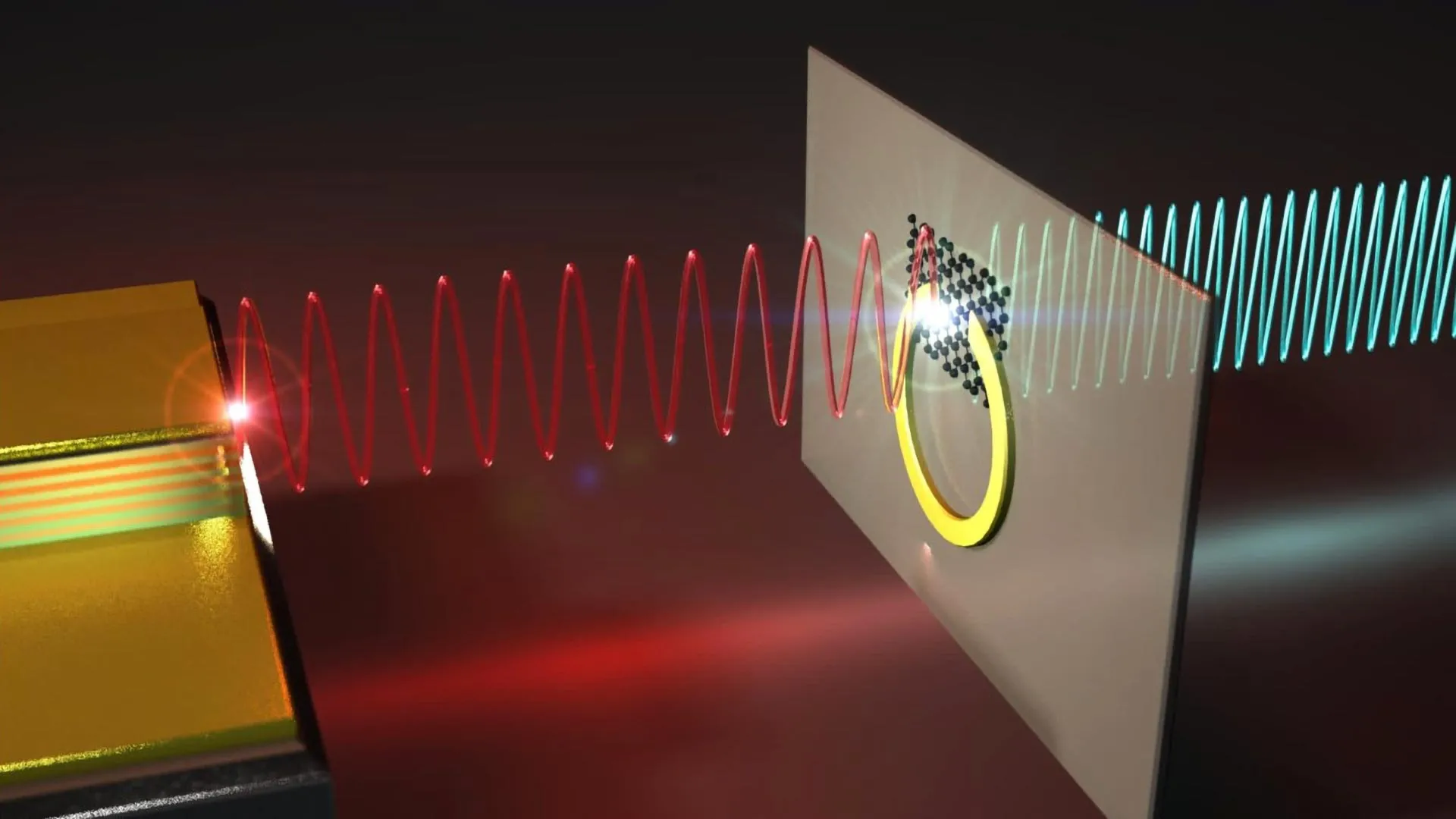
A Nature study reports that embedding NbSe2 in a split-ring cavity resonator increases its superconducting transition temperature, as well as the critical current and critical field near Tc. The results align with theory that hybridization between electronic states and fluctuating cavity modes lowers the superconducting state's energy, providing a noninvasive proof-of-principle that vacuum fluctuations can enhance superconductivity with potential implications for quantum technologies.

Gold Metacrystal Enables Room-Temperature Quantum Light Transport
science1 month ago

Gold Metacrystal Enables Room-Temperature Quantum Light Transport

LSU researchers have built a plasmonic metacrystal—a gold-on-glass nano-patterned film—capable of guiding certain quantum states of light at room temperature. By engineering the meta-atoms, the crystal acts as a statistical filter that preserves quantum states without cryogenic cooling, a proof-of-concept with potential applications in quantum computing, communications, and solar energy; future work will explore using the crystal to improve light guiding in solar cells.

Room-temperature quantum effect could enable battery-free electronics
technology2 months ago

Room-temperature quantum effect could enable battery-free electronics

Researchers demonstrate that the nonlinear Hall effect in a topological insulator can convert ambient alternating signals into direct current, remaining stable at room temperature and tunable by temperature. The mechanism shifts from defect-dominated at low temperatures to phonon-driven at higher temperatures, with the signal direction potentially reversing. This could enable battery-free electronics like self-powered sensors and wearables, though practical devices are years away.

Switchable quantum material promises real-time control for future chips
innovation5 months ago

Switchable quantum material promises real-time control for future chips

US researchers identify a nickel sulfide compound, KxNi4S2, that reversibly switches between Dirac-cone and flat-band quantum states by electrically tuning potassium content, enabling real-time control of electron speed and flow. Demonstrated at Argonne's Center for Nanoscale Materials and Advanced Photon Source, the work could simplify device design and boost future chip and sensor performance; the study was published in Matter.

Graphene Excitons Stop Flow, Hinting at a New Quantum Phase
science6 months ago

Graphene Excitons Stop Flow, Hinting at a New Quantum Phase

Scientists using graphene bilayers under a strong magnetic field observed excitons behaving as a superfluid at high density, but as density decreases the excitons halt and the material becomes insulating; heating restores the superfluid, a result that could point to a supersolid-like excitonic state or another unusual quantum phase, though measurements are not yet definitive.

Gravity-like quantum geometry steers electrons, hinting at faster electronics
science6 months ago

Gravity-like quantum geometry steers electrons, hinting at faster electronics

Researchers at the University of Geneva and collaborators observed the quantum metric—a hidden geometric feature at the SrTiO3/LaAlO3 oxide interface—that distorts electron trajectories under strong magnetic fields, bending them like gravity bends light. This experimental confirmation of a long-theorized quantum geometry could improve understanding of material properties and enable faster, more efficient electronics and advances in quantum technologies, including terahertz devices and superconductivity.

Laser flips magnetism in twisted 2D material, enabling light-defined circuits
science6 months ago

Laser flips magnetism in twisted 2D material, enabling light-defined circuits

Researchers demonstrated optical, non-thermal control of magnetism in a twisted bilayer MoTe2; a laser pulse reversibly flips the ferromagnetic polarity, with switching dynamics tied to whether electrons reside in a topological insulating or metallic state. This links topology and magnetism in a single platform and suggests future possibilities for light-written topological circuits and tiny interferometers on chips.

Breakthrough in 30-Year Superconductivity Mystery
science8 months ago

Breakthrough in 30-Year Superconductivity Mystery

New research applying shear strain to ultrathin crystals of strontium ruthenate (Sr₂RuO₄) found that its superconducting transition temperature remains almost unchanged, challenging previous theories and suggesting a simpler, one-component superconducting state. This study refines understanding of the material's hidden symmetry and opens new avenues for exploring unconventional superconductors.

Einstein's Geometry: How It Shapes Electron Movement in Chips
science8 months ago

Einstein's Geometry: How It Shapes Electron Movement in Chips

Scientists at UNIGE have discovered a hidden quantum geometry within materials that influences electron paths similarly to gravity bending light, opening new possibilities for advanced electronics and quantum technology. This finding, observed at the interface of specific oxides, challenges previous assumptions and could lead to breakthroughs in high-frequency electronics, superconductivity, and light-matter interactions.

MIT Researchers Confirm Unconventional Superconductivity in Magic-Angle Graphene
science9 months ago

MIT Researchers Confirm Unconventional Superconductivity in Magic-Angle Graphene

MIT physicists have provided the most direct evidence yet of unconventional superconductivity in magic-angle twisted trilayer graphene (MATTG), revealing a distinct superconducting gap that suggests a different pairing mechanism than traditional superconductors, potentially paving the way for room-temperature superconductivity and advanced quantum technologies.

Light-Induced Non-Reciprocal Magnetism Challenges Traditional Physics
science9 months ago

Light-Induced Non-Reciprocal Magnetism Challenges Traditional Physics

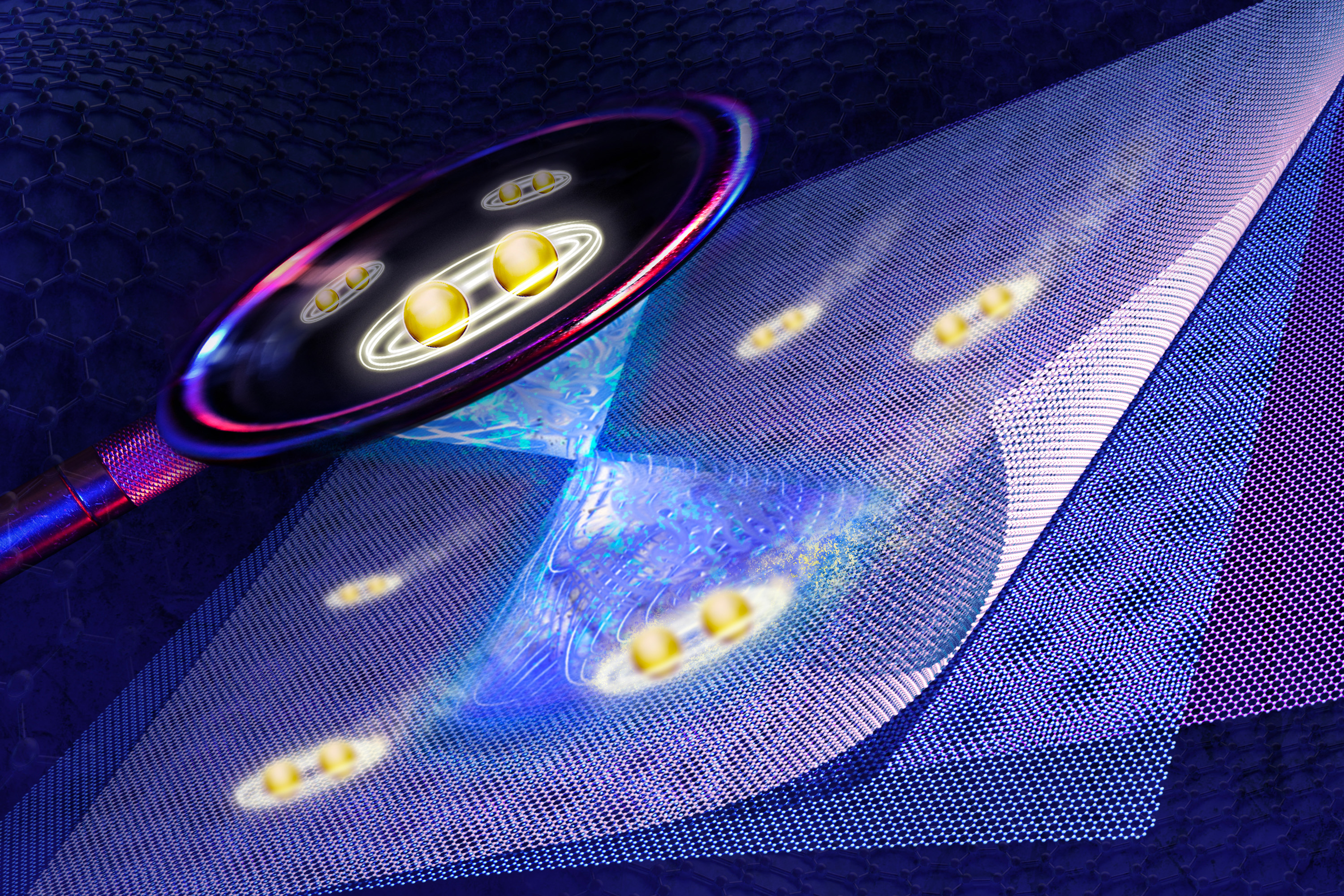
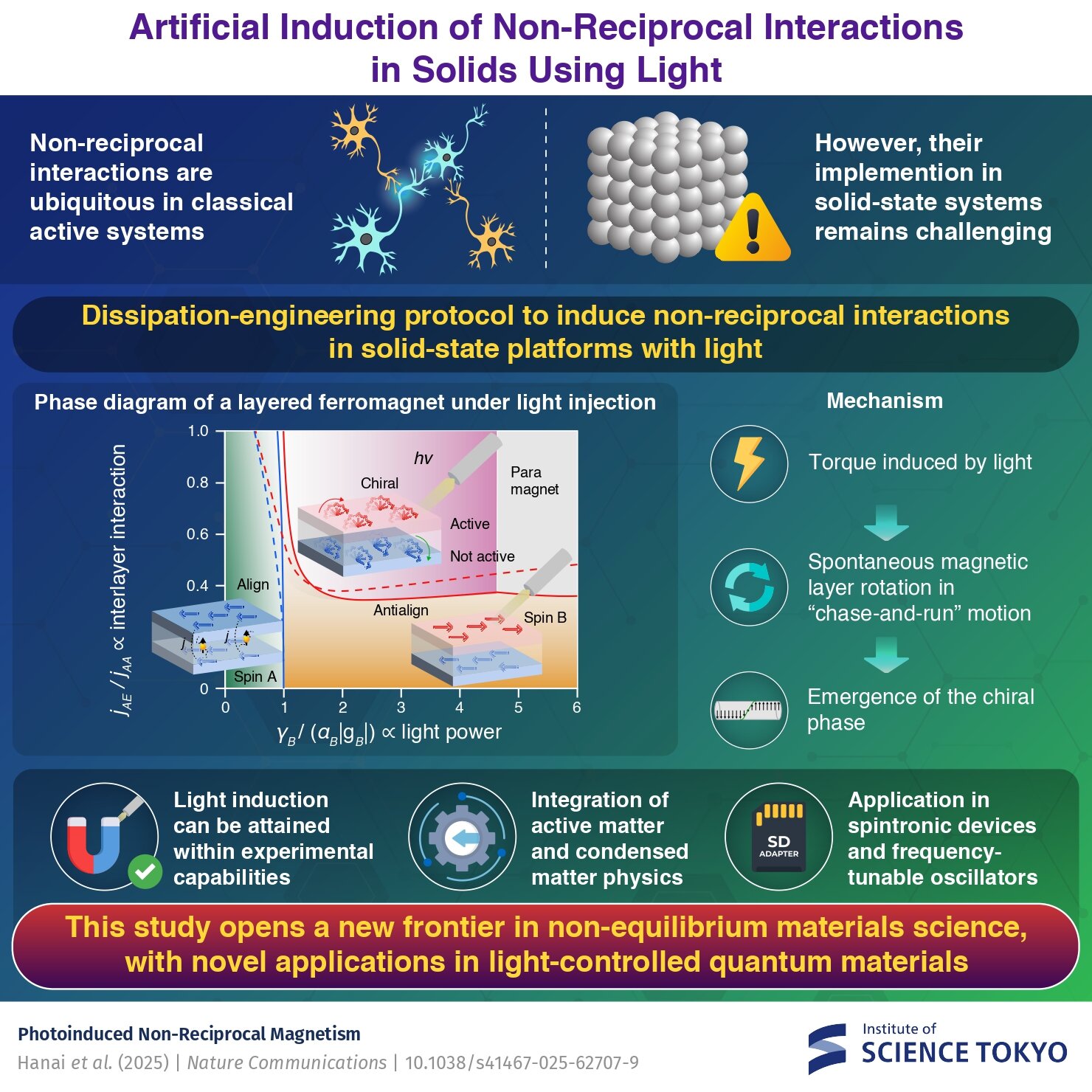
Researchers from Japan have theoretically demonstrated that shining specific light on magnetic metals can induce non-reciprocal magnetic interactions that effectively violate Newton's third law, leading to a novel chiral phase with persistent rotation, opening new avenues in non-equilibrium materials science and potential technological applications.