
Nanotyrannus 'Jodi' Heads to Auction After Scientific Rebranding
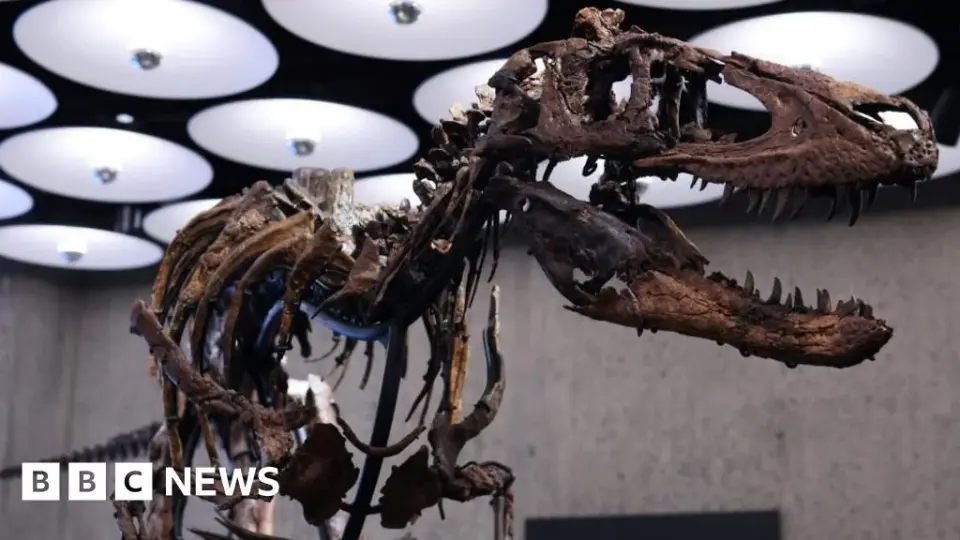
A mounted dinosaur skeleton nicknamed 'Jodi' is set for auction at Sotheby's in New York on October 27, 2026, with an estimated price of $6 million to $9 million. Once marketed as a juvenile Tyrannosaurus rex, the specimen was reclassified as a distinct Nanotyrannus following a 2025 study. The sale highlights ongoing debates over whether significant fossils should remain in private collections or be preserved in public museums for scientific research.
Key points
- The skeleton, discovered in 2019 in Montana, is one of only three known Nanotyrannus specimens.
- A 2025 study confirmed Nanotyrannus as a separate genus from T. rex, ending decades of debate.
- The auction follows the record-breaking sale of a T. rex for $50.1 million earlier this year.
- Scientists warn that private ownership may limit access to the fossil for research and education.
Background
In October 2025, researchers Lindsay Zanno and James Napoli published a study in Nature confirming Nanotyrannus as a distinct genus, separate from T. rex. This followed decades of debate over whether smaller tyrannosaur fossils were merely juvenile T. rex. The 'Jodi' skeleton, found in 2019 by rancher Jodi Pierson in Montana, was initially exhibited as a juvenile T. rex at a 2023 art fair. The current auction follows the July 2026 sale of a T. rex nicknamed 'Gus' for a record $50.1 million, intensifying discussions about fossil ownership.
How outlets are covering it
BBC and Nature World News highlight the scientific significance of the reclassification and the ethical concerns over private ownership. BBC quotes Prof. Steve Brusatte, who calls the potential private sale 'harrowing,' while Megan Jenkins acknowledges the financial realities of fossil excavation. Nature World News notes the discrepancy in completeness estimates (55% vs. 70%) and emphasizes the legal framework allowing private sales of fossils found on private land. Sotheby's describes the specimen as 'exhibition-ready' and defends commercial collectors as crucial to science, a view rejected by Stuart Sumida of the Society of Vertebrate Paleontology, who calls it a 'blatant lie.'
Why it matters
The auction tests the market value of a newly validated dinosaur species and raises critical questions about the accessibility of significant fossils. If sold to a private collector, 'Jodi' may be removed from public view and scientific study, potentially hindering future research. The outcome could set a precedent for the sale of other rare fossils, impacting the balance between private ownership and public scientific access.
What to watch
The auction will take place on October 27, 2026, at Sotheby's in New York. The final price and buyer identity remain unknown. Sotheby's has not disclosed whether any museums have registered to bid. The sale result will likely influence future debates over fossil ownership and the commercialization of paleontological specimens.
- Dinosaur skeleton goes to auction in New York with £4.5m price tag BBC
- A Nanotyrannus goes under the hammer The Economist
- Dinosaur Hunting with Sotheby’s Arts & Collections
- 1 year after recognition as a distinct dinosaur, a Nanotyrannus skeleton goes to auction Black Hills Pioneer
- Once Sold as a $20 Million Juvenile T. Rex, the Nanotyrannus Called Jodi Heads to Sotheby's with a $6 Million to $9 Million Estimate Nature World News
Want the full story? Read the original reporting
Read on BBC