Tag

Tyrannosaurus Rex

All articles tagged with #tyrannosaurus rex

Gus the T. rex goes under the hammer with a $20–30 million estimate at Sotheby’s
business2 days ago

Gus the T. rex goes under the hammer with a $20–30 million estimate at Sotheby’s

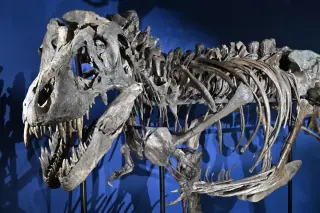
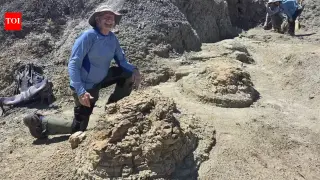
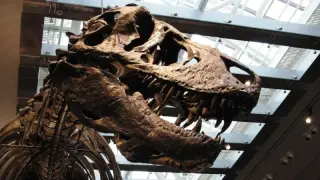
Sotheby’s will auction a 67-million-year-old Tyrannosaurus rex nicknamed Gus for a pre-auction estimate of $20–$30 million, the highest ever for a dinosaur fossil. Discovered in 2021 on a South Dakota cattle ranch by Theropoda Expeditions, the nearly complete skeleton goes on sale July 14, highlighting Sotheby’s ongoing bet on fossil sales as a luxury market. Past high-profile dinosaur auctions include Griffin’s Stegosaurus Apex (sold for $44.6 million) and other T. rexes such as Sue and Stan; bidders are typically private collectors who often loan acquisitions to museums.

Big Skull, Tiny Arms: Why Rex and Other Giants Dropped Their Forelimbs
science7 days ago

Big Skull, Tiny Arms: Why Rex and Other Giants Dropped Their Forelimbs

A new study of 82 theropods, including T. rex, finds reduced forelimbs evolved independently in five groups as heavily built skulls and strong bites became the primary hunting tool; skull robustness appears to drive forelimb shrinkage, with giant prey pushing predators toward jaw-based attacks and different lineages shortening arms via separate evolutionary paths (not merely due to overall body size).

Tiny Arms, Big Mystery: Why T. rex Arms Were Proportionally Short
science19 days ago

Tiny Arms, Big Mystery: Why T. rex Arms Were Proportionally Short

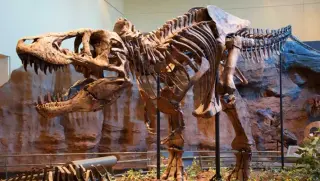
T. rex arms were about 1 meter long, roughly 30% of the leg length, prompting several hypotheses about their function—from display and prey handling to balance as skulls grew larger—with no consensus. Some scientists view the arms as vestigial or a byproduct of skull enlargement; others suggest a defensive or ecological role in crowded feeding scenarios. Ongoing fossil research may yet reveal why this tiny-arm trend occurred repeatedly in theropods.

Dino-Derived Luxury: World’s First Lab-Grown T. rex Leather Handbag Debuts
technology1 month ago

Dino-Derived Luxury: World’s First Lab-Grown T. rex Leather Handbag Debuts

At the Art Zoo Museum in Amsterdam, the world’s first handbag crafted from lab-grown Tyrannosaurus rex leather debuted, created through AI-driven reconstruction of T. rex DNA and a proprietary tissue-engineering platform. The teal bag, designed by Enfin Levé, is biodegradable, cruelty-free, and will be auctioned with a starting price above $500,000; organizers envision expanding the material to luxury brands and other sectors.

Study rewrites T. rex growth: four-decade path to full size
science2 months ago

Study rewrites T. rex growth: four-decade path to full size

A broad analysis of 17 Tyrannosaurus rex specimens indicates the species continued growing for about 40 years, reaching roughly eight tons, with growth rings detected via new imaging methods and a composite growth curve that stitches data from multiple individuals. The findings suggest a longer life history than previously thought and raise questions about whether some well-known fossils belong to related species such as Nanotyrannus.

T. rex Tiptoes Like a Giant Bird, New Study Shows
science3 months ago

T. rex Tiptoes Like a Giant Bird, New Study Shows

A Royal Society Open Science study analyzing T. rex footprints and leg anatomy finds the giant predator walked on its toes with birdlike, quick strides rather than heel-first stomping. Juveniles could reach over 37 ft/s and adults about 20 ft/s, suggesting different hunting behaviors as they aged and reinforcing the link between tyrannosaurs and living birds.

T. rex grew to adulthood over four decades, new study finds
science3 months ago

T. rex grew to adulthood over four decades, new study finds

A large study of 17 tyrannosaur fossils using expanded histology and advanced statistics finds Tyrannosaurus rex reached its adult mass of about eight tons after roughly 40 years, slower and more variable than previously thought. The work uncovers previously overlooked growth rings, suggests a longer subadult phase, and raises questions about whether some specimens (including Jane and Petey) belong to a separate Nanotyrannus-like species, reshaping debates about tyrannosaur growth and diversity.

T. rex grew into a giant over four decades, new study finds
science4 months ago

T. rex grew into a giant over four decades, new study finds

A new peer-reviewed study of 17 Tyrannosaurus rex fossils used growth rings revealed by polarized light to map year-by-year growth, showing T. rex took 35–40 years to reach full size and grew for four decades to about 8 tons, with an estimated lifespan of 45–50 years. This large dataset yields a revised growth curve and suggests a lengthy juvenile phase may have helped juveniles occupy varied ecological roles before the species became a dominant late-Cretaceous apex predator.

New study revises T. rex growth timeline, reached full size by 35–40 years
science4 months ago

New study revises T. rex growth timeline, reached full size by 35–40 years

A study of 17 Tyrannosaurus rex fossils using polarized light reveals growth rings showing they grew slowly, not reaching a maximum size of about 8 tons until about 35–40 years old. Growth rings capture only the last 10–20 years of life, but by combining data across ages researchers reconstructed year-by-year growth, finding more variability and suggesting possible taxonomic differences such as Nanotyrannus; the findings revise the dinosaur’s growth timeline and how it occupied various ecological niches.