
Nanotyrannus 'Jodi' sells for $47.3M, sparking debate over fossil accessibility
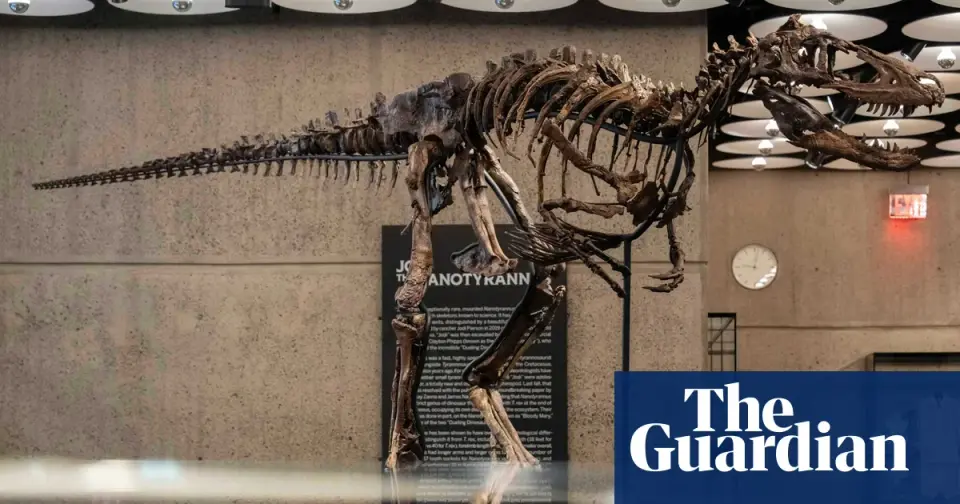
A rare Nanotyrannus skeleton nicknamed 'Jodi' sold at Sotheby's for $47.3M, far exceeding estimates and becoming the second most expensive dinosaur fossil ever sold. The sale has ignited fierce debate among scientists and collectors over the accessibility of significant fossils for public research and education.
Key points
- The 'Jodi' skeleton, discovered in 2019 in Montana, sold for $47.3M at Sotheby's, far exceeding the $6M-$9M estimate.
- It is the second most expensive dinosaur fossil sold at auction, after the $50.1M sale of 'Gus' in July.
- The sale has sparked criticism from paleontologists who argue significant fossils should be in public museums for research and education.
- The buyer remains anonymous, raising concerns about the fossil's accessibility to the public and scientific community.
- The specimen is one of only three known Nanotyrannus skeletons, a genus recently confirmed as distinct from T. rex.
Background
The sale of 'Jodi' follows the recent scientific confirmation that Nanotyrannus is a distinct genus, not a juvenile T. rex. This reclassification, based on over 150 morphological differences, has heightened the significance of the few known specimens. The sale also follows the record-breaking $50.1M sale of the T. rex 'Gus' in July, which also sparked debate over private fossil ownership.
How outlets are covering it
The sale has drawn sharp criticism from paleontologists. Thomas R. Holtz Jr. of the University of Maryland and Steve Brusatte of the University of Edinburgh argue that such high prices remove scientifically valuable specimens from public view and hinder research. They suggest the funds could better support multiple museums. Conversely, Megan Jenkins of the University of Portsmouth noted that significant effort and money go into excavation, and that many such fossils eventually end up in public collections. David Hone of Queen Mary University of London expressed surprise at the price, calling it a potential 'bubble' in the fossil market.
Why it matters
The sale highlights the growing tension between private collectors and the scientific community over the accessibility of significant fossils. It raises questions about the long-term impact of high-value private sales on paleontological research and public education, as well as the sustainability of the current fossil market.
What to watch
The identity of the buyer remains unknown. It is unclear whether the 'Jodi' skeleton will be donated to a museum or remain in private hands, potentially limiting its availability for scientific study and public viewing. The sale may also influence future pricing and availability of other significant fossils at auction.
- Rare Nanotyrannus skeleton, sells for $47.3m at New York auction The Guardian
- Nanotyrannus: Dinosaur skeleton sells for $47.3m in New York auction BBC
- A dinosaur fossil that looks like a mini T. rex just sold for a giant $47 million AP News
- Rare Nanotyrannus sells at auction for $47.3 million, becoming second most valuable fossil ever CNN
- ‘Jodi,’ a Nanotyrannus Skeleton, Gets $47.3 Million at Auction The New York Times
Want the full story? Read the original reporting
Read on The Guardian