
Hunga Caldera Collapse: New Data Links Rapid Submersion to Record Tsunami
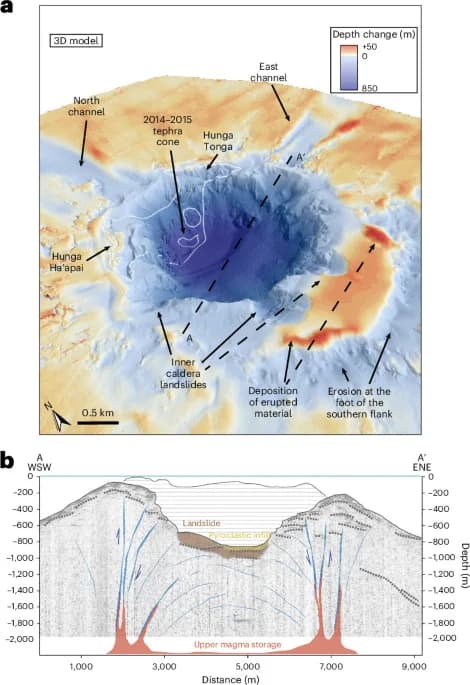
A new study in Nature Geoscience details how the 2022 Hunga Tonga eruption caused a rapid, piston-style collapse of its submarine caldera, displacing 8.9 cubic kilometers of material. This sudden subsidence, which occurred during the eruption, is linked to the generation of an extreme tsunami and the severing of underwater cables, highlighting the hidden hazards of small underwater volcanoes.
Key points
- The 2022 Hunga eruption caused the volcano's center to collapse by over 1 kilometer, displacing 8.9 ± 0.1 km³ of material.
- Geophysical surveys confirm the caldera collapsed during the climactic eruption, not after, as evidenced by interlayered landslide and pyroclastic deposits.
- The collapse was a 'piston-style' event, where the caldera floor dropped as a single unit, displacing a massive volume of water and triggering a record tsunami.
- The magma reservoir's thin roof required only a 30% loss of magma to fail, suggesting small calderas can produce disproportionately large hazards.
- Researchers emphasize the need for high-resolution repeat seafloor mapping to better assess tsunami risks and protect critical underwater infrastructure.
Background
Our earlier coverage on September 14, 2026, noted that time-series bathymetry already suggested a rapid, piston-like collapse at Hunga Tonga, displacing approximately 8.9 km³ of material. That report highlighted the potential for small submarine calderas to generate extreme tsunami hazards, underscoring the need for improved hazard assessments and seafloor infrastructure protection. The current study provides the detailed geophysical evidence confirming the timing and mechanics of that collapse.
How outlets are covering it
Nature Geoscience and Tech Explorist focus on the physical mechanics of the collapse, emphasizing the 'piston-style' subsidence and the volume of material displaced (8.9 km³). Ars Technica highlights the broader implications for global hazard assessment, noting that even small calderas like Hunga can generate dangerous tsunamis if they collapse rapidly. AMS Headlines shifts the focus to the far-field consequences, detailing how the eruption's atmospheric pressure waves contributed to a 'triple jeopardy' flood event on the U.S. East Coast, combining a storm surge, a meteotsunami, and the volcanic tsunami. While all sources agree on the event's severity, they differ in emphasis: some focus on the local geophysics, while others highlight the global atmospheric and oceanic impacts.
Why it matters
This research reveals that the size of a volcano's caldera is not the only factor in determining tsunami risk; the speed and style of its collapse are critical. This finding challenges existing hazard models that may underestimate the threat from smaller submarine volcanoes. It also underscores the urgent need for better seafloor mapping to protect underwater cables and improve tsunami early-warning systems, particularly in poorly surveyed regions like the southwest Pacific.
What to watch
Researchers plan to analyze near-field waves from the 2022 eruption in Australia, New Zealand, and Antarctica to better understand the local impacts. They also intend to investigate slower atmospheric waves associated with the eruption. Additionally, there is a call for more high-resolution repeat seafloor mapping to monitor underwater calderas and protect marine infrastructure.
- Sudden collapse of submarine volcano drives extreme hazards Nature
- Scientists reconstruct one of this century's most explosive volcanic eruptions to explore its role in a tsunami Phys.org
- Small undersea volcanoes may unleash outsized tsunamis Ars Technica
- A Triple Jeopardy Flood Event AMS Headlines
- Hunga volcano’s seafloor collapsed 700 meters during eruption Tech Explorist
Want the full story? Read the original reporting
Read on Nature