
Satellites Detect Massive Methane Release from Ethiopia's Fentale Volcano
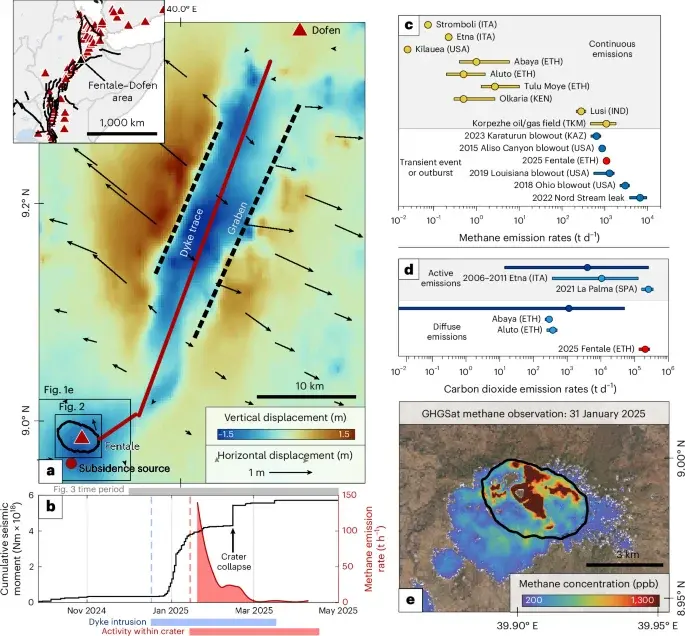
Satellite data reveals a massive, short-lived methane outburst from Fentale Volcano in Ethiopia, driven by magma interacting with sedimentary rocks. The event released over 38,000 tonnes of methane and 2.9 million tonnes of CO2 in three months, highlighting a previously unrecognized natural source of greenhouse gases.
Key points
- Fentale Volcano in Ethiopia released at least 38.2 kilotonnes of methane and 2.9 megatonnes of CO2 between January and April 2025.
- The peak methane emission rate reached 157 tonnes per hour, a figure comparable to major industrial leaks and vastly higher than typical volcanic emissions.
- The release was triggered by a mega-dyke intrusion that disrupted an impermeable cap, releasing methane trapped in hydrocarbon-rich sediments.
- Satellite instruments, including TROPOMI and GHGSat, detected the plumes, which coincided with ground subsidence and thermal anomalies in the caldera.
- While the total volume is small compared to global annual emissions, the event demonstrates a new episodic source of methane from magmatic-sedimentary interactions.
Background
This event follows earlier geological studies suggesting that large igneous provinces can trigger thermogenic greenhouse gas fluxes, potentially influencing past climate changes. The discovery adds to the understanding of how magma-sediment interactions can release trapped gases, a process previously linked to rapid climate perturbations in Earth's history.
Why it matters
Identifying episodic volcanic methane sources improves the accuracy of global methane budgets and climate models. Understanding these natural outbursts helps distinguish between anthropogenic and natural emissions, which is critical for effective climate policy and forecasting.
What to watch
Researchers will continue monitoring Fentale Volcano for further activity and analyze the long-term environmental impact of such episodic releases. The findings may lead to updated models for natural greenhouse gas emissions in geologically active regions.
Want the full story? Read the original reporting
Read on Nature